
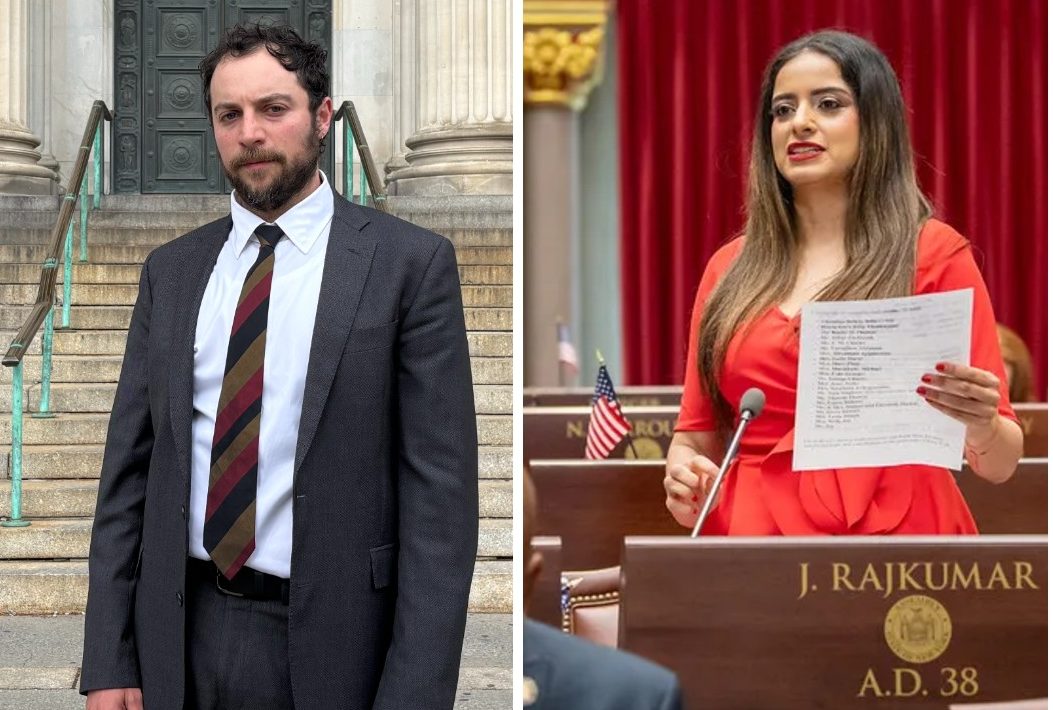
Her challenger, David Orkin, a Democratic Socialists of America-endorsed candidate, alleged that the vast majority of her petition signatures were falsely validated by a group of young campaign workers and riddled with forgeries.
After a day of sparring over subpoenas, Supreme Court Justice Denise Johnson tossed the case, arguing that Orkin’s attorneys had not filed its witness list and subpoenas according to the state’s precise rules for petition fraud cases.
“Before the court can address the substantive issues… the rules of court must be followed,” Johnson said in her ruling.
In court filings, Orkin’s election lawyer, Renee Paradis, accused Rajkumar’s campaign staff and consultants of pressuring a group of young campaign workers from ages 19 to 23 to falsely sign witness statements that would have allegedly affected over 80% of the total signatures for Rajkumar’s campaign.
Paradis claimed that the volume of signatures was so large that it was not possible to check all of them for forgeries, but said they had found the documents “permeated” with fraud and produced around 20 declarations from constituents who said someone had falsely signed their name on the document.
Rajkumar’s attorneys, Gerard Sweeney and Frank Bolz, of the influential law firm that leads the Queens County Democratic Party’s legal operations, called the suit a “fishing expedition” that was not properly pleaded.
Sweeney and Bolz first successfully blocked Paradis’ attempt to subpoena witnesses, including the group of Rajkumar volunteers who were accused of falsely witnessing the petition documents, by arguing that the subpoenas were not properly served and vetted. Then they blocked the other witnesses that Orkin’s campaign had gathered to testify because they had not filed a consolidated list of the witnesses, in accordance with election law.
“They are wasting our time on things that they didn’t do,” Sweeney said in the hearing. “They have a social media lawsuit going on.”
Johnson dismissed the lawsuit without any of the witnesses testifying. Paradis said the campaign was weighing its options as to whether to move forward with an appeal.
“What you saw in there was the Democratic machine trying to crush a grassroots campaign,” Orkin told amNewYork after the dismissal. “What’s concerning is how afraid my opponent is of hearing from people who worked for her and her own constituents.”
Rajkumar claimed that the lawsuit was an attempt to block her supporters’ voice.
“This was an ugly attempt by the Democratic Socialists of America to disenfranchise Queens voters, especially minority voters, and to bully a team of young South Asian and minority canvassers who represent the future of our state,” she wrote in a statement. “Love will always win over hate.”
Among the group of constituents who came to testify about finding their signatures forged on Rajkumar’s petitions, some were supporters of Orkin’s who were outraged to see their names used by his opponent but others said they weren’t tuned into the race before they had been reached by his campaign and felt violated by the experience.
One of those witnesses, Paul Mastroianni, said that he had originally signed a petition to get Rajkumar on the ballot, but then found his name a second time on a petition with a signature he recognized to be a forgery. He was disappointed that he did not have a chance to get a chance to testify, and see the case run its course.
“It feels like a real miscarriage of justice,” Mastroianni said. “It feels like people in power are insulated in a way that normal people cannot penetrate.”
In another instance, the Queens Chronicle reported that one of their editors had found their name forged onto Rajkumar’s petitions.