
ROCHESTER, N.Y. — Changes are coming to about 450,000 New Yorkers’ health insurance. Three months from Friday, qualifications for the state’s Essential Plan will be in effect. However, some have already started to feel the pressure.
“My husband is also self-employed. He is a retired teacher and now he’s a full-time house painter. And because I own my company, we both needed to get our insurance through the marketplace, and that’s what we have done for the last eight years,” said Lauren Goetz, owner of Everyday Hands.
Goetz and her eight employees help the elderly population, and it’s no secret that owning a business is hard work.
“People count on us to care for the older population. There’s many people who live out of town, and they count on us to keep an eye on their parents, and be their eyes and ears to advocate for our clients, to provide companion care,” she said. “The cost of running the business has increased tremendously, therefore, leaving less money to pay myself. And then take that with the increased cost of health insurance. I’m in the worst financial position I have been in in my life, and that’s not how it’s supposed to go. It’s not the American dream.”
Goetz and her husband are in their 50s. Therefore, they rely on their health insurance for preventative care. Goetz is also a breast cancer survivor. Having access to affordable healthcare is important, but becoming more challenging.
What You Need To Know
On July 1, about 450,000 New Yorkers will lose access to their health insurance
Federal cuts have decreased qualifications for the state’s Essential Plan from 250% to 200% above the federal poverty line
Small business owner, Lauren Goetz, says overnight her insurance went from $314 to $1,400 a month
State Sen. Jeremy Cooney has sponsored a bill that looks to provide an option to buy into the Essential Plan
“We eat healthy, we exercise, we do all the things that we’re supposed to do, but that still doesn’t mean things don’t happen,” Goetz said.
They were prepared for the cost of their health insurance to increase at the beginning of the year, but it still came as a shock.
“I couldn’t believe it,” she said. “It’s a 345% increase.”
On Jan. 1, 2026, federal cuts took effect and decreased access to the state’s Essential Plan. According to the state Department of Health, the required household income moved from 250% to 200% above the federal poverty line. For Goetz and other families of two, it means if they make more than about $42,300 a year, they’d lose their coverage. Goetz says that overnight her monthly cost for health insurance increased from $314 to $1,400.
“Combined between our deductible and our premium, we’re going to pay $28,000 this year,” she said. “This is more than our mortgage, our groceries and our RG&E combined.”
In a statement, the state Health Department said:
“The New York State Department of Health has warned for months about the harmful impact of federal H.R.1 legislation on New York’s 1332 State Innovation Waiver. This legislation makes it significantly harder for hundreds of thousands of New Yorkers to access affordable health insurance. The responsibility for those losing coverage rests squarely with House Republicans, and now New Yorkers are beginning to feel the impact.”
“You have to have health insurance. People still get sick. So whether, regardless of how much your premium cost is or what type of insurance plan you use, you want to take care of yourself and your family. And we want to make that more affordable in New York,” Democratic state Sen. Jeremy Cooney said.
He sponsored a bill that looks to provide the options for people to buy into the Essential Plan.
“We’ve tried to be creative and come up with a common ground solution that’s not perfect in the sense that it solves everyone’s problems, but it helps move the needle in the right direction,” Cooney said.
It’s called the Health Equity Affordability Reform Act, also known as HEARA.
“People who are on the Essential Plan get access to comprehensive care with no co-pays, no premiums. They get all of their regular routine checkups taken care of. They actually get to use healthcare as healthcare was designed to be used,” he said. “Our legislation says, ‘what if we take that Essential Plan model and open it up to the public so that anybody, regardless of their income, has the opportunity to buy into the Essential Plan?’ So those low-income New Yorkers who don’t pay anything, they’ll still pay nothing, but other people who want to join into that plan and take advantage of those benefits can pay proportionate to their household income.
“In fact, higher earning New Yorkers will be able to pay in premiums that will help offset the losses from the lower income New Yorkers.”
He says the legislation has no prescriptive formula to determine the cost per household if New Yorkers would like to buy-in, if the bill is passed.
In the writing of this bill, Cooney says he worked with New York State of Health, who administers the insurance, in addition to healthcare insurance providers, like Excellus BlueCross BlueShield (BCBS), who he says would be absorbing some of the costs.
In a statement, Lev Ginsburg, the executive director of the New York Conference of Blue Cross and Blue Shield Plans (NYSCOP), said:
“We appreciate Senator Cooney’s interest in improving the affordability of healthcare for New Yorkers. NYSCOP is deeply focused on collaborating with state policymakers and stakeholders to find sustainable solutions that lower costs across the entire individual market. Our priority is to address the primary drivers of rising healthcare costs and to advocate for policies that reduce or eliminate the various underlying causes, such as hospital cost inflation, mandates, drug prices and taxes currently placed on health insurance premiums. The Essential Plan is a government-sponsored program, largely funded by the federal government, to serve New Yorkers based on specific income eligibility. Any proposal to significantly expand this eligibility or introduce a buy-in option requires rigorous analysis. Expanding the program beyond its current criteria could fundamentally shift the risk pool, potentially increasing overall costs and leading to higher premiums for participants.”
The NYSDOH in a statement said:
“While New York State cannot fully offset the consequences of federal action, we remain committed to ensuring that every New Yorker affected by these changes knows what affordable coverage options are available to them and providing personalized guidance to make the path to new coverage as clear and as smoothly as possible.”
“Change is hard, right?” Cooney said. “So when you go into a highly regulated system like health insurance, you’ve got hospital systems who are worried that the plan won’t cover all of their procedures. You’ve got insurance companies who are worried about, will they make enough profit off it? You’ve got health consumers and health seekers who are saying, ‘Will this give me the coverage that I need?'”
That’s what Goetz is waiting to find out. Currently, she says she’s paying for her health insurance on a credit card for the first time in her life. Goetz plans on taking advantage of the Essential Plan buy-in option if the bill is passed later this year.
“It’d be a lot less stressful. I would be able to concentrate on what’s really important, which is growing my company, treating my employees well, doing all the right things to keep helping as many people as we can,” she said. “Instead of being distracted and having to make decisions within the business, based on the health, the cost of the healthcare and what I can bring home out-of-pocket.”
The legislative session goes until June. As soon as the budget is finalized, Cooney says he’s hoping the bill will make it to the health or insurance committee for review, and then onto the floor for a vote. According to the state DOH, July 1 is when changes to the Essential Plan will take place. Cooney says the earliest the bill could take effect would be next year, after insurance providers next open enrollment.
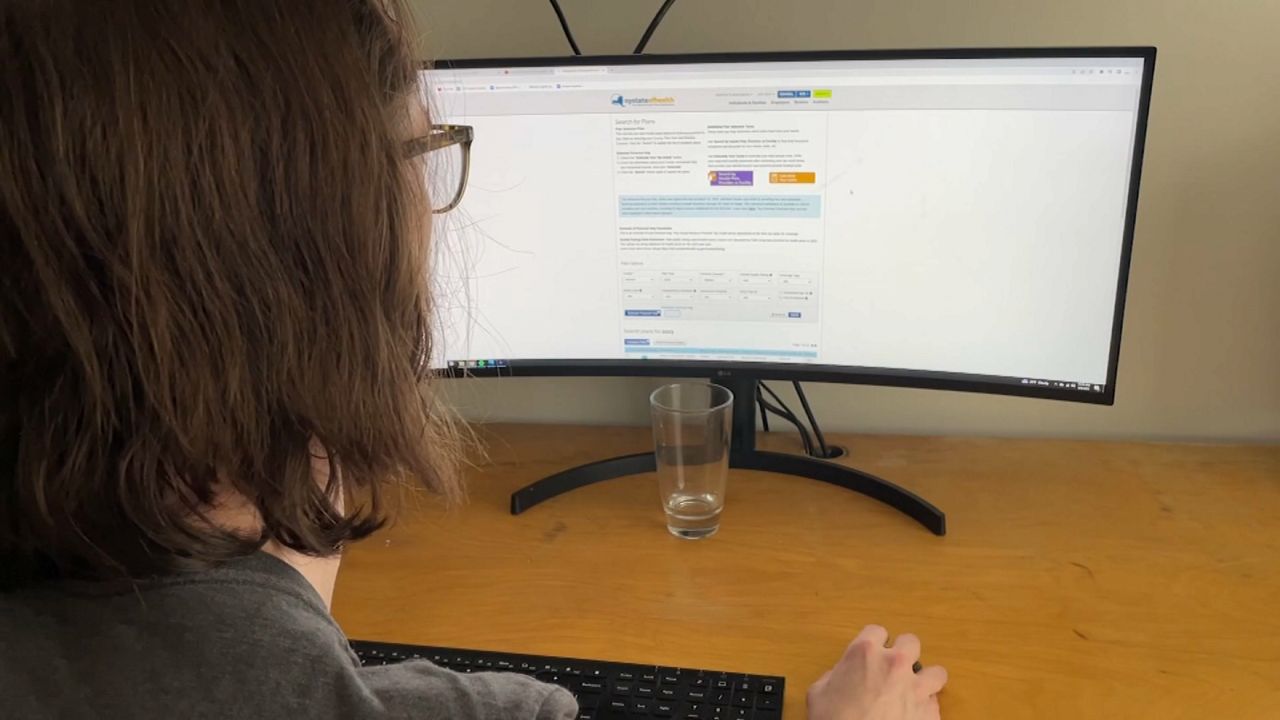
Until then, it will be important for New Yorkers impacted by the cuts to go to the state’s website and update their household income to make sure they qualify for any new subsidies that are in the works. Information for enrollees is available here.