
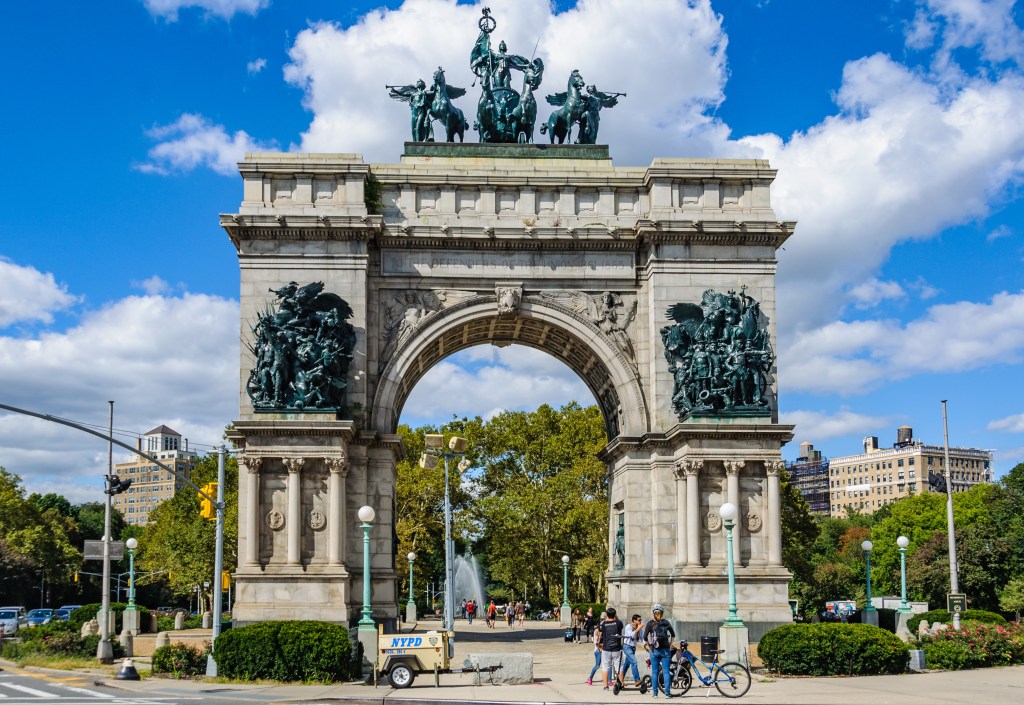
The mayor has advanced the city Department of Transportation’s proposal to change the traffic pattern around Soldiers’ and Sailors’ Arch in Grand Army Plaza near Prospect Park in Brooklyn. I salute the idea, and encourage the city to do more. To explain my position, indulge me for a moment while I provide a little history of a similar effort.
In the 1990s, while the area around Columbus Circle was being rebuilt by private developers, the city was considering an upgrade to the traffic circle itself. At that time, I was a partner in Urbitran, a full-service engineering consulting firm. The head of the firm was Michael Horodniceanu, better known as Mike H. for obvious reasons. Mike later became an historic figure by leading a Robert Moses-like building of the Second Ave. subway, Grand Central Madison, and the No. 7 extension while president of the MTA’s Capital Construction division.
While at Urbitran, Mike was asked to reimagine Columbus Circle by one of the potential private developers to complement their building plans. He proposed moving traffic around one side or the other of the world-class monument in the center of the Circle. His plan improved traffic, but, more significantly, opened up almost half of the space for pedestrians, either from Central Park or from the new building on the other side, the Time Warner Building.
His plans made the space far more pleasant for pedestrians and made access to the monument immeasurably better. The parks commissioner, the infamous Henry Stern, loved the version of the plan which, in essence, extended the Park’s south end entrance. Rather than being surrounded by six lanes of asphalt and rushing traffic, people would easy have access to rest comfortably around the monument.
The developer that had approached Mike decided not to build, so Mike’s plans were not going to be advanced. But when I saw the plans, I believed they were too good to be ignored.
At that time, the Municipal Art Society, an important civic organization of influential people, had expressed an interest in the Circle. I suggested to the Society’s leader, my friend, the late venerable Brendan Sexton, that I show him Mike’s alternate ways of considering the Circle.
At that meeting, I opened by asking two questions. The first was “what do Times Square, Herald Square, and Greeley Square all have in common? The answer is none of them are squares, they are triangles.” I went on to say therefore Columbus Circle doesn’t actually have to be a circle to be called Columbus Circle.
The second question was “has anyone ever been to the magnificent monument in Grand Army Plaza?” No one had. Why? Because crossing four lanes of onrushing traffic was too risky. The spectacular monument is a grossly underutilized asset for the city, especially when it comes to attracting tourism to Brooklyn.
Today the monument is still virtually inaccessible due to being surrounded by cars. The DOT plan changes that and improves access to the Brooklyn Museum, Prospect Park and other terrific institutions in the area. Opening the area for pedestrians would be a boon to the institutions and the local businesses in the area.
Traffic circles are good in many places. They are smart for traffic but not good when there are spectacular public spaces in the center or nearby. I applaud the mayor and suggest he helps DOT do more, including reopening the question of Columbus Circle, which the city, unfortunately, chose to leave as a traffic circle.
Riccio is a former NYC DOT commissioner and currently teaches at NYU’s Stern School of Business.