
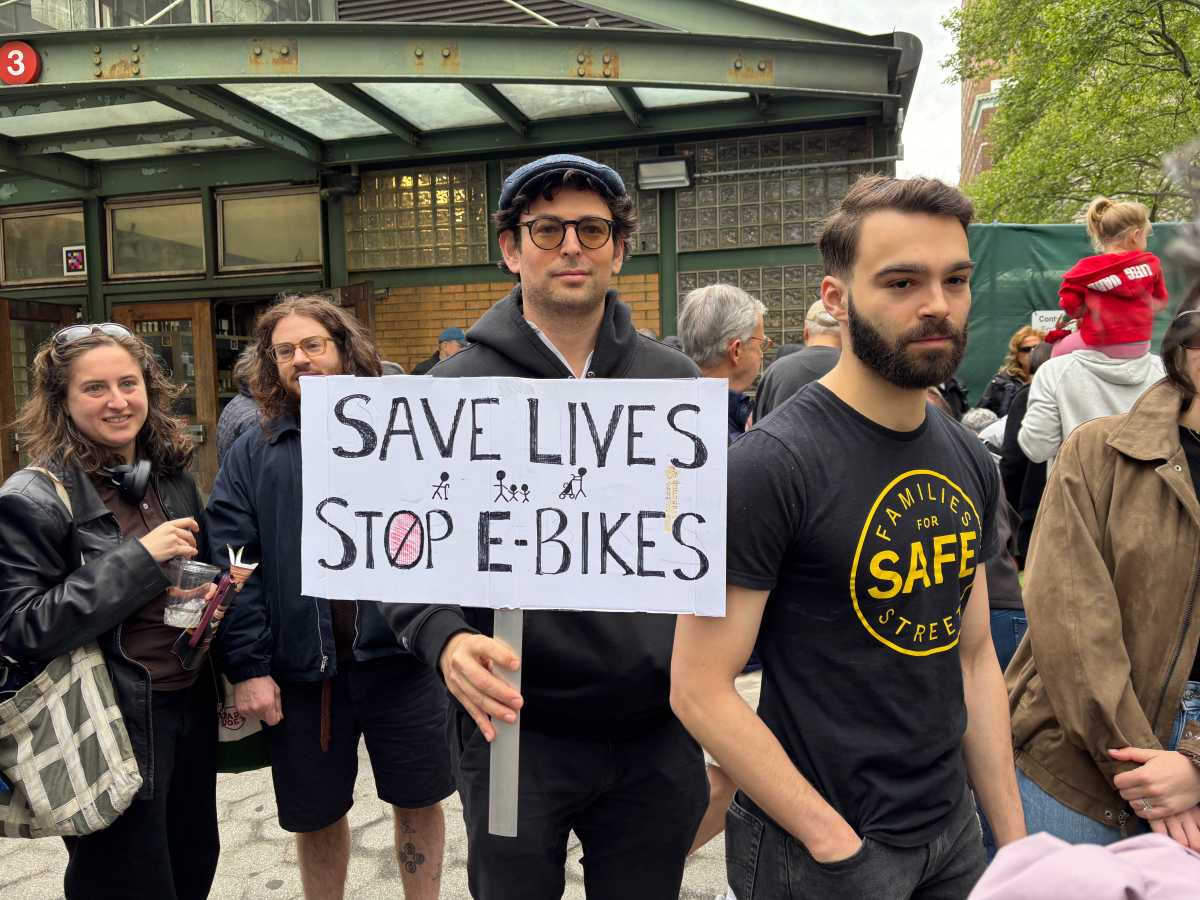
Nearly 150 residents rallied in Verdi Square on Saturday morning, asking the city to put the brakes on bike lanes being considered for West 72nd Street, citing process and potential problems for pedestrians, the elderly and residents in general.
The New York City Department of Transportation (DOT) has proposed two bike lanes on West 72nd Street between Central Park West and Riverside Boulevard, reducing the street from four to two lanes for motorized vehicles.
The bike lanes would connect the Central Park Loop with the Hudson River Greenway and provide what the DOT says would be the only protected crosstown bike lanes in Community Board 7 with such lanes on East 61st and 62nd St in Community Board 8.
The sidewalk in front of the 72nd St. subway station, near Broadway and Amsterdam, however, became the site for residents who want the bike lane plan put on hold.
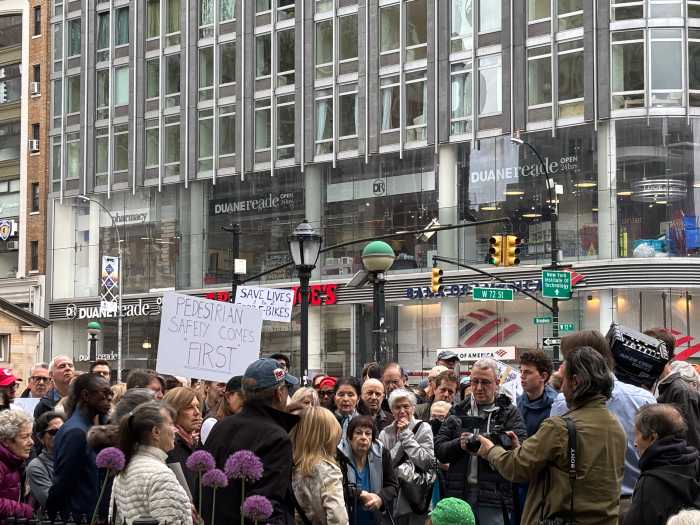 Upper West Side residents gather urging the city to reconsider a bike lane plan in their neighborhood.Photo by Claude Solnik
With chants beginning “What do we want, no bike lanes,” protestors brandished signs saying “Pause the Plan,” “Pedestrian Safety Comes First,” “A Safe Design Needs a Better Plan,” “Save Lives, Stop E-Bikes.”
The rally, organized by the 72nd St. Coalition of Residents and Businesses, opposes the plan, supported by Community Board 7’s Transportation Committee and slated to go before the full board for an advisory vote.
DOT Commissioner Mike Flynn, as reported in amNewYork, has said “creating a protected, two-way bike lane on 72nd Street will finally deliver a safe, seamless crosstown connection between the Hudson River Greenway, Central Park, and the East Side Greenway.”
Critics worry this could turn an already busy street into a bikeway, attracting cyclists and increasing pedestrians’ risk.
They also worry the plan would remove some direct curb access and wanted more time and options for neighbors and businesses to “shape solutions.”
“I think this plan is not well thought out and I think that New York City can do better,” said Michelle Kaufman, 72. “The plan doesn’t provide for safe ways for people to get on and off a bus, to cross the street, for us to shop in the area, for trucks to deliver to the area.”
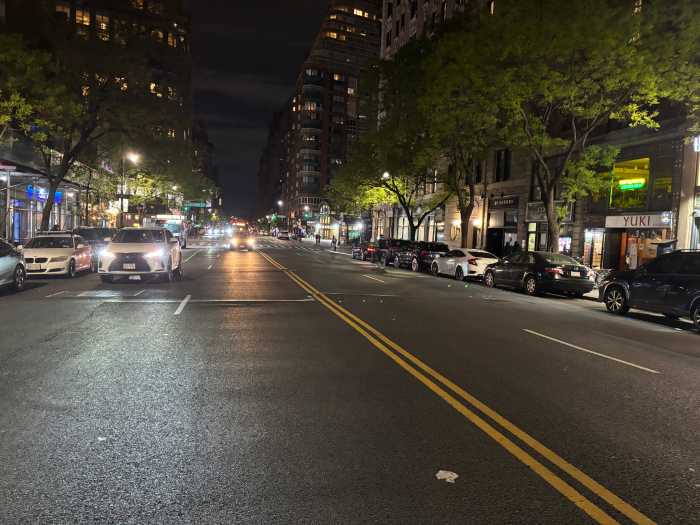 72nd Street in the evening.
The DOT argues the plan would make the street and sidewalk safer for all, including seniors, which make up less than 15% of New York City’s population, but over 45% of pedestrian fatalities.
The DOT said on streets with protected bike lanes, seniors saw a 22% drop in overall injuries and non-senior adults saw a 9% drop in overall injuries.
The agency said the plan can allow access, changing curb regulations, adjusting parking regulations to increasing turnover and installing loading zones.
The DOT said peak-hour vehicle volumes can be accommodated with one lane in each direction, where double parking effectively shrinks access.
Michael Bretholz — who said this is the first time he attended a protest and has three children in elementary school, kindergarten and nursery school — cited e-bikes as a big concern.
“The situation with e-bikes in the city has gotten out of control,” Bretholz said. “Our son has been hit by an e-bike going the wrong way. We’ve had to dodge e-bikes on Riverside Park on the bike path.”
He believes more e-bikes combined with lax or lack of enforcement could put pedestrians at risk.
“We can’t have a situation with one lane in each direction,” Bretholz said. “I think it’s going to be a hazard for the disabled, families with babies.”
He said he supports bike lanes, but pedestrian thoroughfares may not be the ideal place to attract bicycles and, in particular, e-bikes.
“I think bike lanes are wonderful,” Bertholz said. “I’m a biker but bike lanes don’t belong on W. 72nd St.”
Nora Singer portrayed the lanes as attracting cyclists to a busy street, disrupting the neighborhood, citing major developments from the past.
“It reminds me of when Robert Moses came in and was destroying functional neighborhoods to build a Cross Bronx Expressway,” Singer said. “They’re planning to make it into a bicycle highway that I suspect will bring in more bikers.”
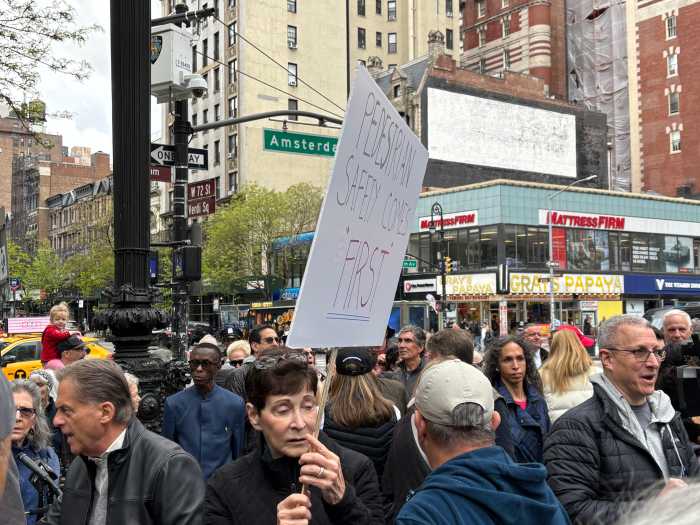 DOT officials have said “creating a protected, two-way bike lane on 72nd Street will finally deliver a safe, seamless crosstown connection between the Hudson River Greenway, Central Park, and the East Side Greenway.”Photo by Claude Solnik
Kathryn Amira said two-way bike lanes could cause problems for people with visual problems.
“It is very hard to look both ways and to assess the bicycle traffic that’s coming up further,” she said. “To get a handicapped person across the street, one must look both ways to properly assess the bicycle traffic and then move across the bike lane.”
New York CEO Ken Podziba, however, earlier told amNewYork that “creating a dedicated, predictable space for cyclists that reduces conflicts with cars and makes the corridor safer for everyone: cyclists, pedestrians, and drivers alike.”
Critics argue there is no reason to fix something that’s broken, but the DOT contends current concerns over collisions result, at least in part, from current design.
Crashes on W 72nd St. and Riverside Drive, the DOT said, are in the top 10% of Manhattan streets where seniors account for 20.5% of all injuries compared to 8% for the entire borough
Amira, however, believes more bikes will create more potential collisions and greater risk to pedestrians.
“I’m concerned with the safety of the sidewalk as well because these bicyclists are going to them want to stop and where are they going to park the bicycles?” Amira said. “It’s going to create an additional obstruction to the sidewalks.”