
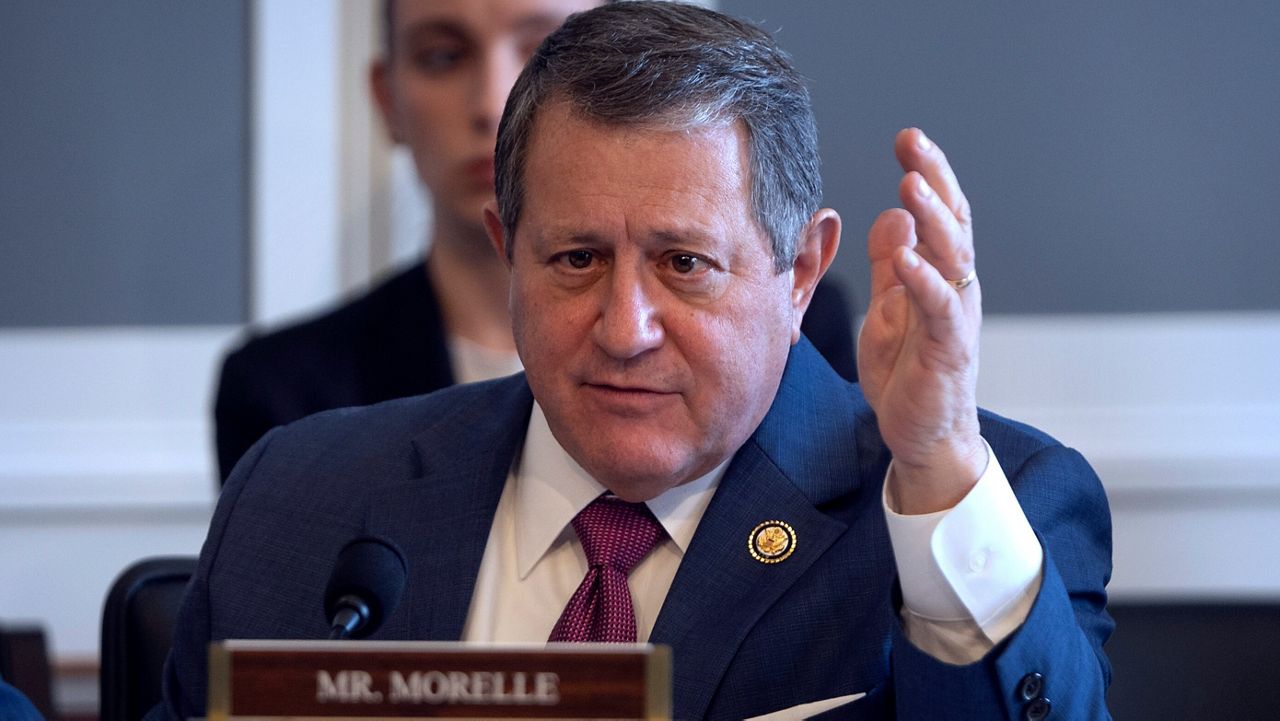
U.S. House Minority Leader Hakeem Jeffries has tasked Democratic U.S. Rep. Joe Morelle with steering New York Democrats’ efforts to change the state’s redistricting process in the wake of the Supreme Court’s decision last week that weakened a landmark Civil Rights-era law that has been credited for increasing minority representation in Congress and amid a larger national mid-decade redistricting arms race that has intensified over the last year.
“While far-right extremists on the Supreme Court have twice recklessly cleared the path for partisan gerrymandering, Democrats refuse to unilaterally disarm. Today, I have asked Ranking Member Morelle, the former Majority Leader in the New York State Assembly, to travel to Albany to meet with State leaders tomorrow on redrawing New York’s congressional districts for the balance of the decade in response to the Callais decision and the recent action in Florida,” Jeffries, who also represents New York in the House, said in a statement Monday.
The nation’s high court ruled 6-3 in striking down a majority Black congressional district in Louisiana that it said relied too heavily on race. Section 2 of the Voting Rights Act of 1965 bans voting practices that diminish or dilute the power of minority voters, which essentially has shown to have an impact on electing minority candidates.
The decision is wrapped up in an unusual national battle over redrawing congressional lines in the middle of the decade that started in Texas last summer at the request of President Donald Trump to help boost Republicans in the 2026 election cycle. California Democrats responded in kind. Missouri, North Carolina, Ohio, Virginia, and most recently, Florida have joined the effort, bringing red states and blue states into the gerrymandering fight to try to outflank the other for so-called safe seats and eliminate more competitive seats.
“This is just the beginning. Across the nation, we will sue, we will redraw and we will win,” Jeffries said. “House Democrats will not allow a MAGA majority to be built on rigged maps and the dilution of Black voting strength. Ultimately, this will end poorly for Republican extremists. It’s the American people who get to decide who wins the majority in Congress, not Donald Trump.”
Hochul and New York lawmakers have promised a response since the initial move in Texas — even hosting Texas Democrats in Albany — though the topic had not received much attention until lately while lawmakers are in the middle of a lengthy state budget process.
“The Supreme Court’s Voting Rights Act ruling is the latest civil rights and democratic disaster,” Morelle said in a statement. “As Donald Trump and his Republican allies intensify extreme partisan redistricting efforts, I am proud to be entrusted by Leader Jeffries to work with partners in New York to explore every option to protect voters in 2026, 2028, and beyond. We will not allow these efforts to silence communities or undermine fair representation. We will fight, we will win, and we will protect the voters’ voice.”
Morelle represents New York’s 25th Congressional District, which encompasses all of Monroe County and parts of northwestern Ontario County, including Victor. A veteran of Albany politics, Morelle served for nearly three decades in the state Assembly before Congress.
To do any kind of redistricting changes, New York faces constitutional limitations. The state in 2014 approved a state constitutional amendment that created the Independent Redistricting Commission with the aim of taking redistricting out of the sole hands of the state Legislature and assigning the task to the panel.
Changing the process would require once again a state constitutional amendment. In New York, constitutional amendments must be passed by two separately elected versions of the state Legislature and then approved by a majority of voters. At the fastest rate, Democrats would have to pass an amendment to give back power to the Legislature this year and again after the 2026 elections, meaning it wouldn’t be put to voters until November 2027 at the earliest, with any kind of potential new maps not taking effect until the 2028 election.
Last week, when asked by reporters if redistricting has been discussed, state Senate Majority Leader Andrea Stewart-Cousins told reporters that “we’ve had that conversation.”
New York Republicans have railed against the effort despite its roots in the Texas redraw.
The Associated Press contributed to this report.