
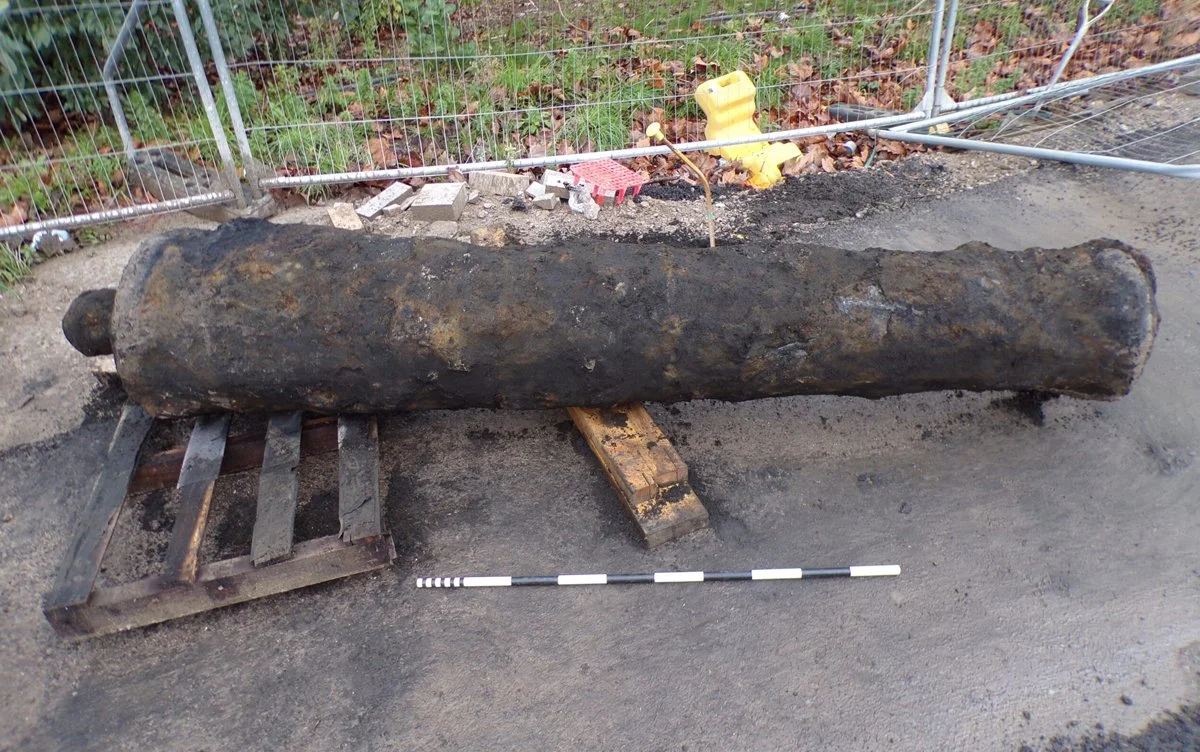
Work at Queen’s Gardens in Hull, England, has brought an unexpected find to light: a buried cast-iron cannon.
The find was made during excavations for an attenuation tank, when local contractors, C R Reynolds, discovered the large object embedded beneath ground level.
– Advertisement –
For a short time, there was concern it might be unexploded ordnance. As soil was cleared away, its shape became clearer. It was a cannon.
The piece is roughly 2.6 metres (8.5 feet) long and weighs more than a tonne. Dating remains broad for now, with archaeologists placing it somewhere in the late 17th to 18th century.
Staff from Humber Field Archaeology took over the recovery. Close inspection shows the muzzle has been sealed, a sign the weapon had been put out of use before burial.
Initial observations indicate the cannon had been decommissioned, with the nozzle deliberately capped. Archaeologists believe it was likely repurposed as a mooring post, a common practice in the late 19th and early 20th centuries, before being pushed into the dock area prior to it being infilled in the 1930s.
– Advertisement –
Peter Connelly, of Humber Field Archaeology, said: “This is a fascinating discovery that offers a glimpse into Hull’s maritime and military past. Our archaeology team is now carrying out detailed assessments and we’ll be able to share more once their work is complete.
“Finds like this highlight the rich history beneath our city and the importance of careful excavation as we deliver the Queen’s Gardens transformation.”
After identification, the pace of excavation changed. The area was recorded, and the cannon was lifted out with care. It has since been moved for further study, where specialists will look for markings and construction details.
Sources : City of Hull
– Advertisement –