
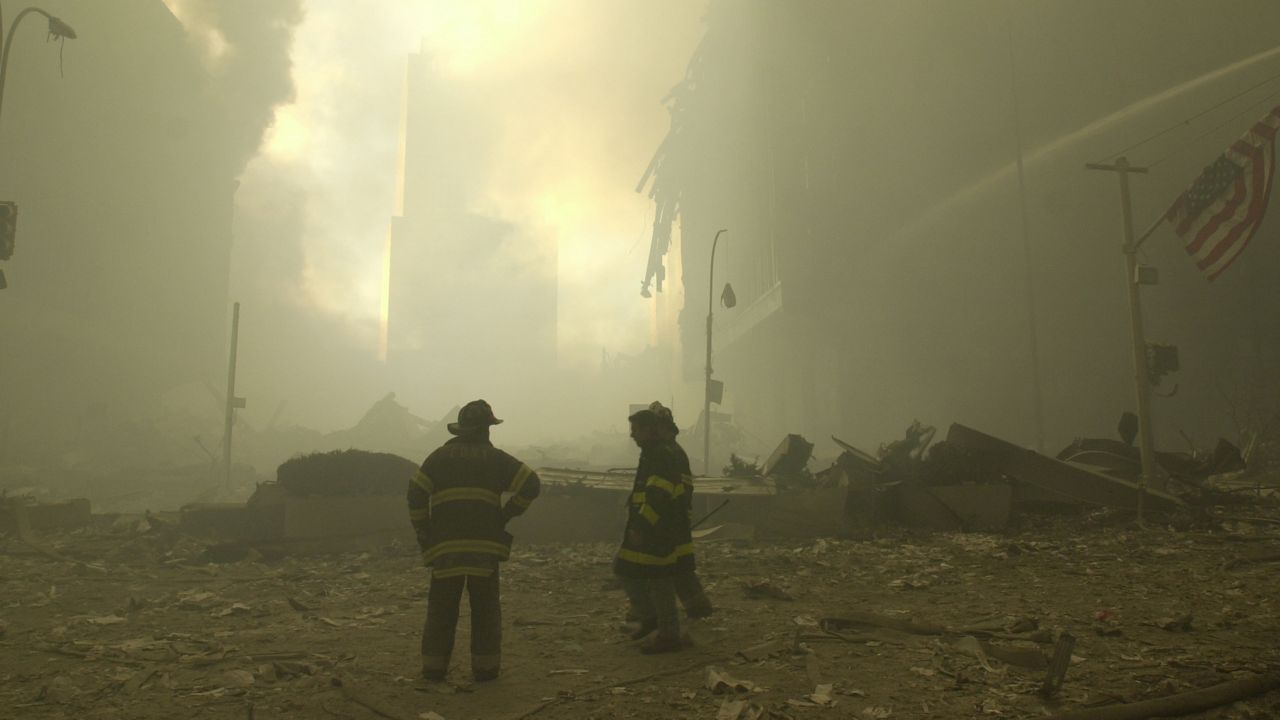
For more than a year, New York City’s Department of Environmental Protection claimed it had no documents related to an extensive request for files about its investigation into the air quality in Lower Manhattan after the Sept. 11 terrorist attacks.
Last month, the agency did an about-face after calling the request a “fishing expedition” — admitting that it did find potentially relevant documents.
What You Need To Know
The Department of Environmental Protection leaders have publicly talked about its role in investigating the air quality in Lower Manhattan after 9/11
The agency, however, in an extensive request for documents on the subject, claimed it had none
In the last two months, it has reversed course despite repeatedly claiming otherwise
Forty boxes are set to be turned over to the people who had requested the documents
Fast forward to this week, the agency has at least 40 boxes of materials, according to an email from a city lawyer that NY1 has obtained.
“Outrageous,” said Cory Morris, a lawyer who specializes in public records access in New York, when he learned the latest development.
It was more than two years ago that Andy Carboy filed a Freedom of Information Law, or FOIL, request to several city agencies. It included more than two dozen specific requests for documents from the aftermath of both the 1993 and 2001 terrorist attacks at the World Trade Center.
The inquiries centered on testing and discussion of any public health risks.
Carboy filed the FOIL request on behalf of the nonprofit, 9/11 Health Watch and a slew of first responders and family members of people who passed away from 9/11-related illnesses.
In January 2024, Carboy received an email from the Department of Environmental Protection, or DEP, that his request for documents was denied.
“This agency does not have the records requested. You should direct your request to a different agency,” part of the denial email reads.
This denial that records existed came despite the agency’s leader testifying before the U.S. Senate in 2002 about its role in the aftermath of the terrorist attacks.
“Since September 11th, DEP or its contractors analyzed 3,060 samples from 37 outdoor monitoring sites in Lower Manhattan; 500 samples collected adjacent to the four schools in the vicinity of the Trade Center; and 328 samples taken in the four boroughs of the city outside of Manhattan,” said Joe Miele in a transcript of his testimony NY1 obtained.
NY1 has also obtained an internal memo from October 2001 that states DEP was concerned some blocks near the World Trade Center were “not yet suitable for re-occupancy,” due to the air quality.
Back to the FOIL denial, the email noted Carboy had the opportunity to appeal the ruling, which he did.
Less than a month later, Carboy received a letter from the DEP FOIL appeals officer, Russell Pecunies.
“I hearby certify that a diligent search was performed in DEP’s records in response to your FOIL requested, and no responsive records were found,” Pecunies wrote.
This denied appeal stated that Carboy could again take action, this time by filing a lawsuit against the city. Which Carboy did, yet again.
The city tried to get the lawsuit thrown out.
“Compelling an additional search in this case, where DEP has repeatedly certified that it has no responsive records, will have no practical effect on the parties,” Saarah Dhinsa, the assistant corporation counsel for the City of New York in November of last year in her filing to have the lawsuit dismissed, said.
She called the request “a fishing expedition” that should be “dismissed as moot.”
Yet less than a year later, Dhinsa sent another letter, revealing that there were, in fact, potentially relevant documents discovered.
“Respondent has located multiple boxes that are believed to contain at least some responsive records,” she wrote on Sept. 16.
And on Oct. 27, Dhinsa emailed Carboy saying there are “about 40 boxes ready for review.”
It marks a complete reversal in less than two years’ time of when Carboy’s initial FOIL and appeal were denied.
NY1 reached out Wednesday morning to the DEP and City Hall, asking how all these documents could be missed when the agency claimed it conducted a “diligent search” and where these 40 boxes were located.
“While we cannot comment on the specifics of pending litigation, the city has begun turning over documents to plaintiff’s counsel, and both parties are working out a schedule to continue this process,” said the emailed statement from a City Hall spokesperson, in part.
There were no explanations given for NY1’s questions.
Over the summer, the City Council passed a resolution compelling the city’s Department of Investigation, which serves as the inspector general, to look into the city’s response to the air quality concerns in lower Manhattan after the 9/11 terrorist attacks.
“The Department of Investigation shall review all of the materials it deems appropriate in the scope of the investigation,” the resolution states.
A DOI spokeswoman told NY1 the process has already begun.
“All agencies have responded to our request that they identify what documents they have concerning 9/11 toxins,” a DOI spokesperson told NY1 in a statement.
However, she declined to specify which agencies have been contacted “because we are in the preliminary stages of this investigation.”
It is unclear as a result if the DEP is one of the agencies DOI has been in touch with.
However, Councilmember Gale Brewer told NY1 she believes it’s no coincidence the documents are being turned over now.
“I think that’s why the 40 boxes turned up,” said Brewer, who was the lead sponsor on the resolution.
She called the DEP’s admission that there are documents only now “alarming.”
“I don’t know what happened. I don’t know,” she said in an interview Wednesday afternoon. “I find it abhorrent that information like this would not be shared. Why not share it? I assume they are worried about lawsuits.”
Fear of litigation is not a legal reason to withhold documents, according to Cory Morris, the lawyer who specializes in New York’s public records laws.
NY1 specifically asked Brewer if she thinks the city may have been improperly withholding documents.
“I would think so,” she said, specifically referring to FOIL.
There had been concern growing about a violation of FOIL due to the city’s changing course, even before Monday’s email that there are 40 boxes of documents from the DEP.
Earlier this month, Rep. Dan Goldman told NY1 he believed DOI, the city’s inspector general, should open an inquiry into why the DEP had insisted no files existed for more than a year.
“We would want to know who was involved. How far up to the top did it go, and there needs to be accountability and consequences for those people who are violating [the Freedom of Information Law],” Goldman said. “It’s a critical, critical law in our democracy.”
The Freedom of Information Law is a state law that “provides the public right to access to records maintained by government agencies with certain exceptions,” according to the state definition.
In 2024, NY1 interviewed Goldman when the DEP still claimed it had no documents.
“If in fact their responses that there are no documents and yet there — the documents do exist and there are some documents related to this, and I’d be very surprised if there are not, that is a violation of FOIL,” he said at the time.
Fast forward to this month — and before the city admitted it had 40 boxes to turn over — NY1 asked him if the state law had been violated.
“Well, it certainly seems that way. And you know these things have legal details and complications,” he said. “That’s why we need an investigation.”
NY1 reached out to DOI about Goldman’s request for an inquiry to be launched.
“DOI declines to comment,” a spokeswoman responded.
Brewer said she would be open to DOI including the city’s changing response on its turning over of documents to its ongoing investigation. That centers on New York City’s response to the health concerns in Lower Manhattan after 9/11.
The DOI’s investigation must be complete within two years, according to the city resolution.
But some of the documents from the DEP, at least, will be released to Andy Carboy and his clients well before then.