
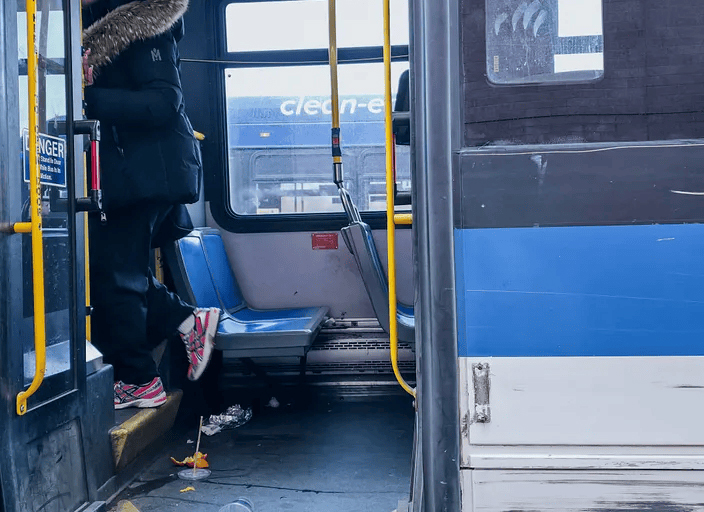
A man boarded the M116 bus and raised his hand toward the OMNY reader — then bumped his fist against the machine, a mocking gesture, and kept walking. The driver said nothing; he didn’t even glance back. “Mayor’s saying free bus, right? Please, it’s already free now because nobody pays for it,” said Richie Ramos, an MTA bus driver and line steward who has watched fare evasion go unchecked for 25 years. “And God forbid I say something, they’re going to assault me.”
Ramos has been assaulted seven times: He’s had a bottle broken on his scalp, urine thrown at his face, and been slashed with a pocket knife.
Free bus fare was a staple of Mayor Mamdani’s campaign, a promise yet to materialize. Mamdani frames the transit dilemma as a cost problem: fares burden the working class, so eliminate them. But nearly half of local bus riders don’t pay the fare. On Select Bus Service routes, the number is even higher.
The free bus future Mamdani promises has already arrived. And the buses are filthy, unsafe, and late. The problems are cultural: trash, threats, disrespect toward drivers, and apathy toward the system.
Cynthia Adams has lived in Harlem for years. She voted for Mamdani. Yet riding the M116, she says his transit promise “is a Band-Aid.” The difference, for her, isn’t the price but the care. “If you only give dirt, you get dirt,” she said. “They don’t respect anymore. They don’t cherish it.”
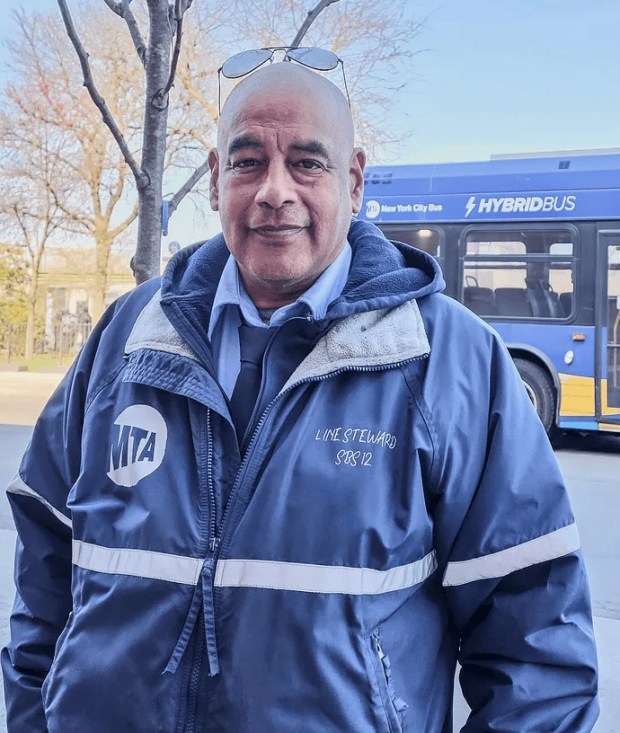 Richie Ramos on his 25th anniversary as an MTA driver. (Kali Bomeli and Zoe Millán)
Milton Duran, a graphic designer who has lived in NYC for six years, supports Mamdani but not his free fare promise. “There’s a lack of respect,” he said. “I don’t see that working. In society, people need to have some level of responsibility.”
For a city that prides itself on its culture, the bus is often left out of that identity, and the mayor’s proposed solutions don’t include civic culture. Besides free buses, Mamdani’s efforts include reviving the Fordham Road project on the Bx12. Ramos, who has driven the Bx12 for 12 years, is skeptical: he often sees cars parked in bus lanes, and the MTA doesn’t enforce penalties quickly enough to make people respect the policies.
Antanas Mockus, the former mayor of Bogotá, Colombia, replaced 1,800 corrupt traffic officers with 400 mimes. Their job was to mock people violating traffic laws. It worked: people found that being mocked wasn’t worth it. The lesson isn’t that New York needs mimes, it’s that the levers available to city leadership go well beyond the fare box.
Still, for some riders, the fare does matter. Joseph Di Lorenzo, a formerly unhoused man, relies on the bus and is among the 72% of New Yorkers who back fully subsidized public transportation. But fares aren’t his only concern: “Even if they don’t want to pay, the service is disgusting.”
For Mamdani, acknowledging that part of the problem might be his own citizens may be impossible. His political identity depends on defending working people against the system, not on asking them to change.
A bus stopped in front of Ramos, swinging its doors open. On the floor was a tipped-over cup, foil food wrapping, and a mandarin peel. “Look at that! That’s a disgrace. This bus has only been out for three hours. And that’s what we got — that’s our own people.”
Bomeli and Millán are students in the opinion writing seminar at Columbia University Graduate School of Journalism. This op-ed and four others that the Daily News is publishing were written as part of an assignment about what Zohran Mamdani’s political vision actually looks like on the ground.