
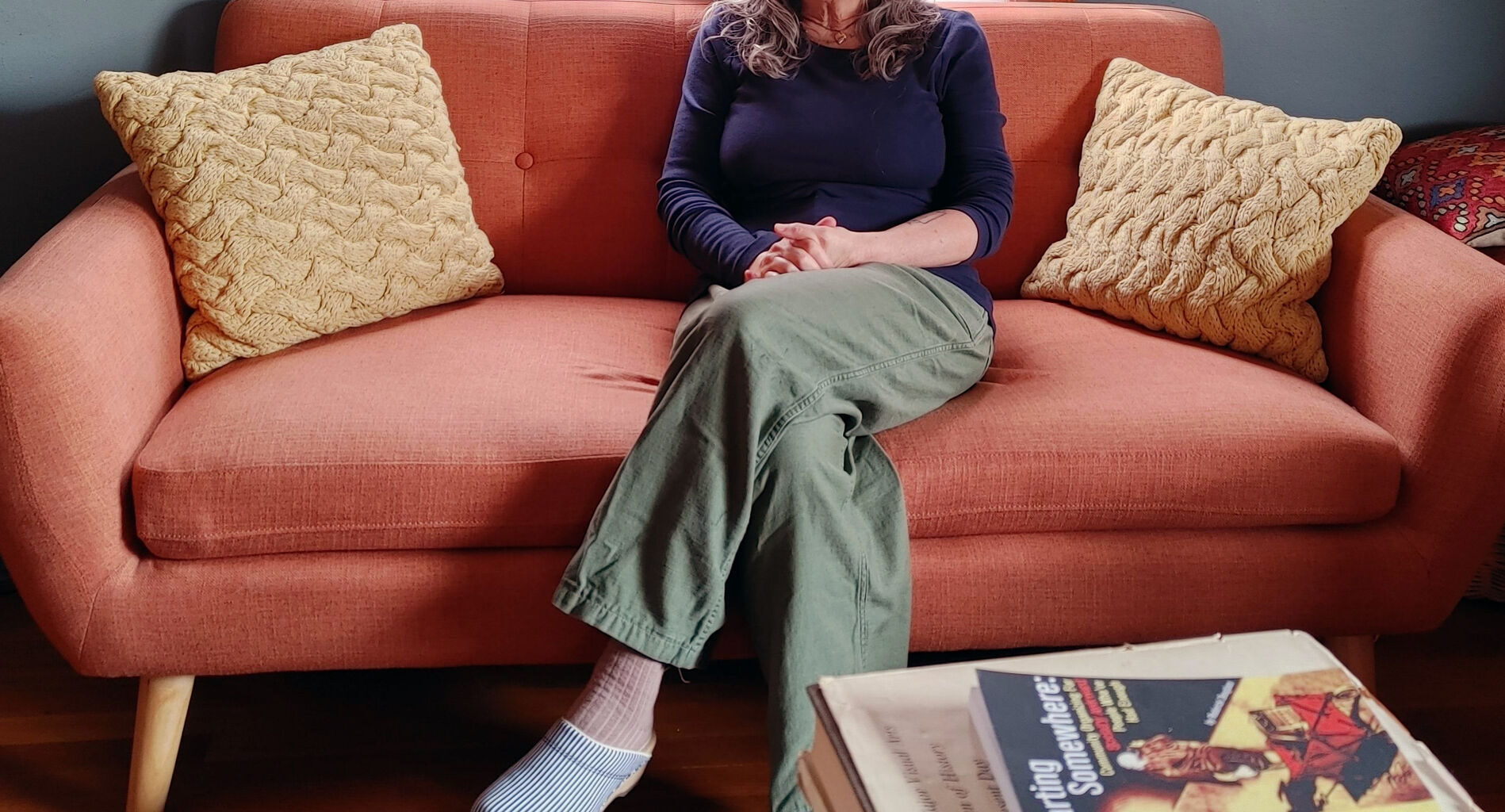
Sari Botton at home in Kingston on April 10, 2026. Botton, who runs two popular Substack publications, is hitting new heights in a long and distinguished career in publishing.
Barbara Reina/For the Times Union
At a time in life when most might be considering retirement, author, editor and teacher Sari Botton is having an unexpected career renaissance.

Working from her home in midtown Kingston, Botton, 60, is the editor of the very successful Substack magazine, Oldster, which has 85,000 subscribers and counting. She was recently profiled in the New York Times. And an Oldster anthology is slated for release in 2027.
Article continues below this ad
“There are a lot of possibilities when you get older,” she said. “Even in a competitive, slightly daunting field, you can thrive later in life.”
Not that Botton had no success before recently. She has published an essayistic memoir, “And You May Find Yourself…” and edited two anthologies of writers writing about New York: “Goodbye to All That,” about loving and leaving the city, and “Never Can Say Goodbye,” where writers extol their unshakeable love for the city. And she has long taught writing at various levels, including leading an essay workshop last month at the Southern Vermont Writers’ Conference.
A self-proclaimed “Gen X weirdo” and “pioneer gentrifier,” Botton and her husband, Brian, moved to the Hudson Valley 21 years ago after high rents squeezed them out of their Manhattan loft apartment. Since then, Botton has boosted the local creative community as a writer-in-residence and mentor. She believes everyone has the ability to write and stories to tell. Often, they just need the assurance of a skilled guide.
Make the Times Union a Preferred Source on Google to see more of our journalism when you search.
Add Preferred Source
In this conversation, Botton talks about her surprising career surge, the Hudson Valley creative community, and the discovery of her own ancestral roots in Kingston. This interview has been lightly edited and condensed.
Article continues below this ad
Is this time in your life somehow different, or is it what you expected?
It’s not at all what I expected. It’s way better. I was very afraid of turning 60; I thought my life was not going to line up with what’s expected of people in their 60s. I think, as someone who didn’t have kids, I’m not on the same track as everyone else; my peers are having grandchildren now. But it’s just not for me.
I also didn’t know that this was going to be the best time in my career because, in 2020, when I left Longreads, where I was an editor, I found I couldn’t get a job. I thought it was all over, and now I’m having this renaissance.
People who contribute to Oldster or comment at Oldster keep telling me that their lives improved later, after 60, after 70, even after 80, and now I believe that.
Article continues below this ad
You call yourself “a late-blooming, Gen-X Weirdo” in one of your books. As women of Gen X, do you think we’ve been through a lot of growing pains when it comes to careers, relationships, and our view of ourselves as women?
I think that Gen X is a very confused demographic because we had parents who started out one way, then switched gears during the sexual revolution and the divorce boom, so it was very confusing to us — the messages of how to be an adult, what does an adult look like. We watched our parents have a belated second adolescence. So, after being raised for a certain number of years by these sort-of formal parents, we were suddenly being raised by people who were breaking all the rules. I think it has led to a lot of confusion among Gen X about how to be grownups.
Sari Botton with a copy of “Goodbye to All That” at the Union Square Barnes and Noble in 2013.
Courtesy of Sari Botton
Do you think memoir writing gets better with age?
Article continues below this ad
Definitely. I think there are a lot of older people writing short memoirs, personal essays and longer memoirs now, and I’m really here for it. I recently started a feature called Oldster Bookshelf, where I feature books by older people, and there are a lot of great memoirs. The older you are, the more experience you have, the more you have to say, and — if you have been writing for a long time — the more confident you are in your voice and your style.
As an editor, teacher, and bestselling former ghostwriter, you stated that you’ve learned how to gently coax important, compelling stories out of people. Can you elaborate?
Memoir writing is anxiety-provoking. You’re revealing yourself, and you can’t do it without revealing some things about other people, even if you blur your identities. So, it makes people nervous. It helps to have a nurturing guide who can help you find your voice, be confident in your voice, talk to you about the challenges and how to overcome them. I try to be that person.
What is an average day like for you?
Article continues below this ad
I work 12 hours most days. I get up at 7 a.m. and get right to work until 7 p.m. I also work on the weekends, editing Oldster and Memoir Land (another Substack Botton oversees). They’re both doing really well, so I can’t just abandon them, and they both scratch certain itches for me. Memoir Land is not focused on age; it’s about any subject and it lets me continue the work I was doing at Longreads and Catapult, editing personal essays on any subject by anybody.
So, I’m working a lot. I love it. It’s also my strategy for surviving these times: being busy, too busy to focus on (the global political climate).
How has living in Kingston affected your writing?
I’ve been in the area for 21 years now. First, we were in Rosendale, then we moved to Kingston. There’s a lot of creative community around here. Almost all my friends are writers, artists, musicians, filmmakers, so it’s a very fertile place to be inspired and supported by other people.
Article continues below this ad
I love living in Midtown Kingston. I can walk two blocks to restaurants, the Upstate Films movie theater, UPAC. There’s so much for me to walk to, uptown, downtown, ride my bike. It’s a nice, small city.
For three years, I also operated a coworking space called Kingston Writers Studio, which closed in 2020 due to the pandemic. It was very social and nice to work in the presence of other writers. I grieve it (but) I can’t afford to do it again. Rents were so low back then.
After you chose Kingston as your home, what surprising fact did you discover about your family roots in Ulster County?
What I found out later was that my ancestors were here from the 1860s to the 1920s. My great-great-grandparents are buried a mile (from my house) at Wiltwyck Cemetery, so I have deep roots here.
Article continues below this ad
Two of the anthologies you’ve edited are about New York City. How do you feel about upstate New York, particularly Kingston, right now?
I do miss New York City. I’ll never get over it. Some part of me, for the last 21 years, has thought this was a temporary move. But I love it here. It’s close enough that I can go to NYC when I need to; it’s also close to the Berkshires and not too far from my family on Long Island.
What I don’t love is the housing crisis. I don’t love that, every time we get a spate of good restaurants, it means the prices go up and more people get priced out. I don’t know what the answer is.
Sari Botton, at 29, covers a benefit for “Fresh Air” at Tavern on the Green in New York City on June 9, 1995.
Steve Eichner/WWD/Penske Media via Getty Images
You and your husband call yourselves “pioneer gentrifiers.” Can you elaborate?
Article continues below this ad
I don’t love that about myself, but I’m owning it; it is accurate.
Pioneer gentrifiers are the creatives who don’t make a lot of money, who are the first to move to a somewhat depressed area, because they get priced out of the last depressed area they were in, which is what happened to us in the East Village. We had a very affordable rent on a huge loft, and it got gentrified. The tenant after us in our apartment was the filmmaker Michel Gondry and the tenant after that was Matt Dillon, so that tells you what happened. We are the kind of people who keep going to the next place and the “speculators” follow.
We bought a foreclosure house (in Kingston) because we got kicked out of a loft here, too, in Uptown. One of the big-money developers bought the building we were living in and kicked us out. This was in 2018, and we couldn’t afford a single house on the regular market, so someone advised that we look at the foreclosure market.
You were a writer-in-residence at SUNY New Paltz in 2023. Do you have a particular memory of your residency having an impact on someone?
Article continues below this ad
I led a workshop. It was exciting to have my students get excited about writing personal essays. It was fun watching students who had never written personal essays get the bug.
What effect do you feel that your writing — whether it’s Oldster or your latest books — has on readers?
I hope that it’s resonant and identifiable. I know that if something is nagging at my curiosity and telling me to write about it, there are going to be other people who are curious about the same thing, thinking the same thoughts, feeling the same things. So, I strive to write in a way that people can see themselves in my experience, but also, I want to make them laugh and cry at the same time. I want them to come away from it feeling moved.
I also like to highlight the absurdity of people and experiences, how just wild they can be, and make people laugh in even the darkest topics.
Article continues below this ad
If someone said to you, “Sari, you made a real difference here in the Hudson Valley,” what would you hope that legacy might be?
Fostering a writing community and encouraging other people to develop as writers.