
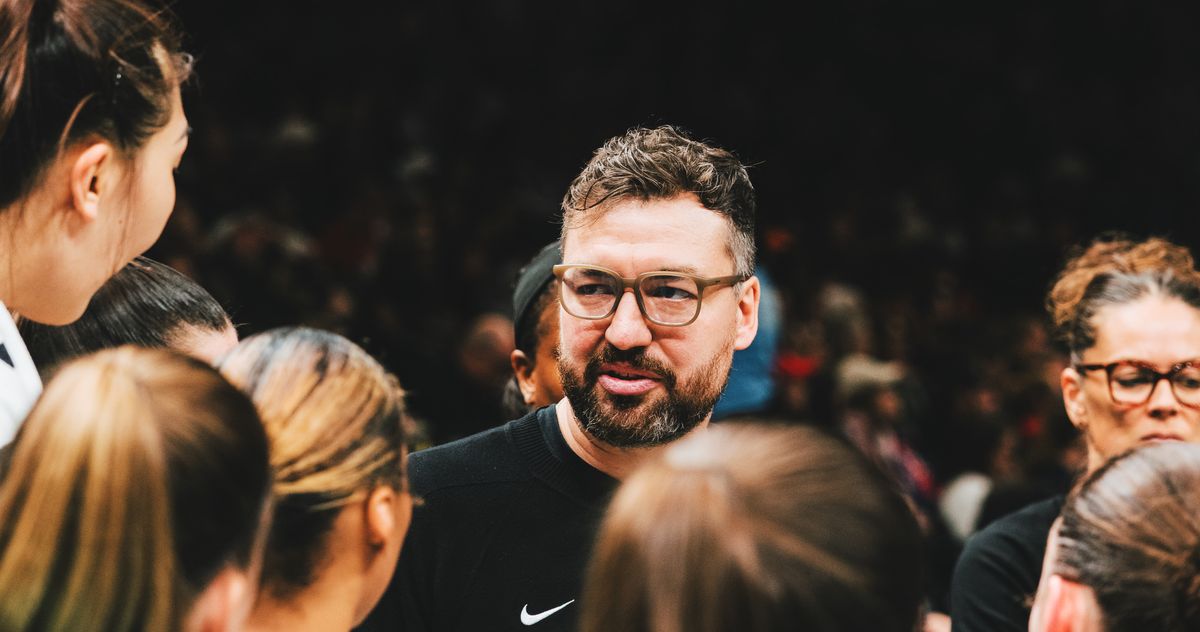
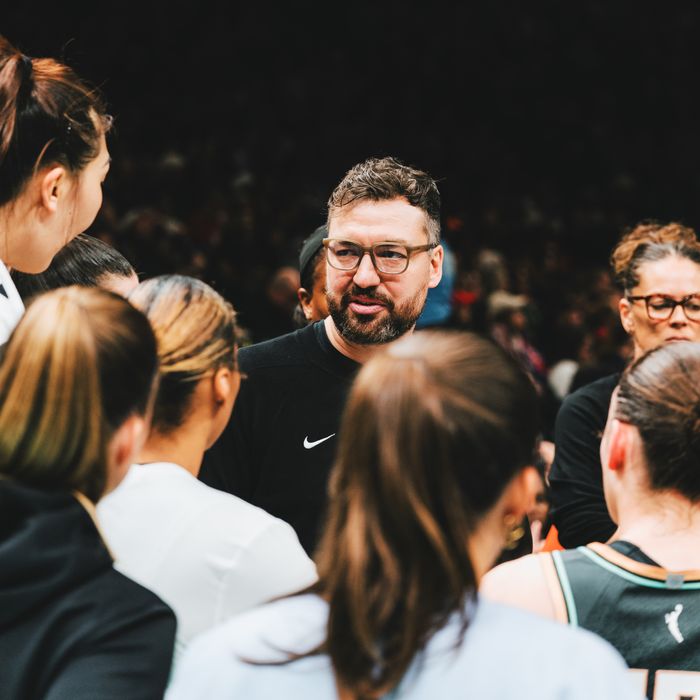
Photo: Jack Califano for New York Magazine
One of the loudest places in New York before 10 a.m. is perhaps the Brooklyn Basketball Training Center, especially on days high-schoolers come to visit. One recent Tuesday morning, 50-odd teens from Cristo Rey Brooklyn High School in East Flatbush are warming up, yapping with one another while stretching their quads or screaming “I’m LeBron James, literally, y’all!” after sinking a free throw. Nearby, Chris DeMarco, who was named head coach of the New York Liberty at the end of last year, towers above them in a pair of seafoam Stewie 2’s. DeMarco, 40, likes to pop in on his way to his office in the Barclays Center and either pitch in as a coach or, like today, join up with the students. In a way, he’s envious of them: Professional-grade facilities and training would never have been accessible to a young DeMarco, who grew up playing in Wisconsin. “It’s a very European-soccer mind-set of building the youth up to the professional level,” he says. “The kid in me wants to be in here hooping.”
As you may have seen on somebody’s T-shirt lately, EVERYONE WATCHES WOMEN’S SPORTS. Five years ago, the average WNBA game would have around 300,000 viewers; now, viewership routinely passes 1 million. Joe Tsai and Clara Wu Tsai, the billionaires who acquired the Liberty in 2019, helped foment this interest in the team locally. They set off on a soup-to-nuts remodel: new star players in Sabrina Ionescu, Jonquel Jones, and Breanna Stewart; a brand makeover, complete with Ellie the Elephant, likely the first-ever league mascot with lash extensions; and, most crucially, a rescue mission to move the team from the Westchester County Center to Brooklyn. It worked. In 2024, after 28 years, one of the league’s original franchises won its first championship, at home, in a nail-biter of a game five. But the 2025 season couldn’t replicate that magic, and the reigning champs failed to make it out of the playoffs’ first round. Coach Sandy Brondello’s contract was not renewed, and DeMarco came over from the NBA, where he had spent 14 years with the Golden State Warriors — meaning that this year, as has been the case for 13 of the WNBA’s 30 seasons, there are more male coaches in the league (eight) than female (seven).
DeMarco joined the league during a long-simmering effort to get the players a more fair contract — one that, among other things, increased the minimum salary from around $70,000 to around $300,000, a sign of how much more lucrative the league has become. Its ratification in March also meant the Liberty’s makeup changed drastically: Fan favorites (Isabelle Harrison, Natasha Cloud, Nyara Sabally) have rotated out, and a familiar face has returned from medical leave (Betnijah Laney-Hamilton). After the Liberty lost its first preseason game to the Indiana Fever, DeMarco didn’t seem fazed in a press conference. “We’re always going to be playing hard,” he said. “The outcome today, the result wasn’t there, but I loved our team’s fight.”
The high-schoolers split the court at practice today, boys on one side, girls on the other. DeMarco hangs with the girls, dapping up players and goofing off. He is lightly sarcastic and unflappable with the vibe of that one teacher who didn’t mind if you swore around them. A coach blows his whistle and everyone circles up. DeMarco gestures to a student hanging back to come stand next to him. They practice their crossovers, trying to find the right angle to bend their knees, then dribble up and down the court. The rule is if you lose control of the ball, you have to stop and do ten jumping jacks — DeMarco does plenty. The students are totally enchanted by his presence, fist-bumping him with enthusiasm and nodding intently at his advice to focus on the backboard for layups, not jump shots. During a water break, two girls ask him for a selfie and then everyone does.
After practice, we walk the seven minutes to his office deep in the bowels of the arena. It’s covered in wall-to-wall whiteboards, full of notes about player status and upcoming events in shaky boy handwriting. (Listed underneath the staff-retreat section is an item titled “Corny Events.” “Is there a better name for that, like when nobody wants to do it and then they like it?” DeMarco asks.) Hanging next to his door is a copy of the “Ten Indian Commandments”: “Remain close to the Great Spirit. Show great respect for your fellow beings.”
DeMarco grew up wanting to play professional basketball. Undoubtedly, he was inspired by his father, who coached all four of his kids in every sport they played: basketball, football, softball. “He would coach the game like it was a practice. Back then, people weren’t shooting as many threes, so the second a shot went up when we were on offense, he’s out there screaming to get inside the three-point line,” DeMarco says. “He was very serious about sharing the ball, and he was very serious about effort and playing hard.”
The younger DeMarco is too, though in a squishy way reminiscent of freshman orientation: He speaks abstractly about wanting to define the team identity and values, refining practice so it can be most fruitful for players, creating space for them to share their varied experiences. “The international-basketball piece is very important to me,” he says. (DeMarco is also head coach of the Bahamas men’s national team.) He wants team dinners that feature cuisine from players’ countries of origin. “There’s a camaraderie there that I think is important. There are more and more international players in the WNBA, and it’s important that everyone understand the experience they’ve had that’s different from America.”
As for the gender disparity among the WNBA coaches, DeMarco thinks it’s not a matter of talent but of getting enough people through the notoriously opaque process of joining a league. The Liberty created two new junior positions of coaching associate, intended to be an early step on a path toward head coaching or becoming a general manager or managing operations. DeMarco’s bench of assistant coaches is mostly women, three to two, including Courtney Paris, a WNBA vet. “I’m gonna coach the individuality of a player, whether it’s the men’s or women’s side. It’s always going to be about understanding somebody, building trust, then bettering their weaknesses and solidifying their strengths,” DeMarco says. “The same way people poured into me, that has now given me this opportunity to be a head coach. I’m gonna do the same with my staff and build not just on the court but off it, like all my coaches.”
Since getting to New York, he has been trying to spend one-on-one time with each player, discovering who’s the biggest foodie (Laney-Hamilton, who made breakfast sandwiches for everyone this morning) and the best texter (“God, I hate to give her this, but it’s Sabrina — she’s funny, she’s quick”). In the lead-up to the season, he has been taking time to enjoy — and adjust to — the city: eating at Enoteca Maria, a restaurant run by nonnas in Staten Island; figuring out the subway; going to see the actor Chazz Palminteri’s one-man show (“I’m a huge fan of him and what he’s done”). Through it all, New Yorkers have made their expectations for him no secret. DeMarco is now frequently recognized on the street and told how to do his job. “A lot of fans will stop me and say, ‘Better win a championship,’” he acknowledges. “I just love the passion.”
Thank you for subscribing and supporting our journalism.
If you prefer to read in print, you can also find this article in the May 4, 2026, issue of
New York Magazine.
Want more stories like this one? Subscribe now
to support our journalism and get unlimited access to our coverage.
If you prefer to read in print, you can also find this article in the May 4, 2026, issue of
New York Magazine.