
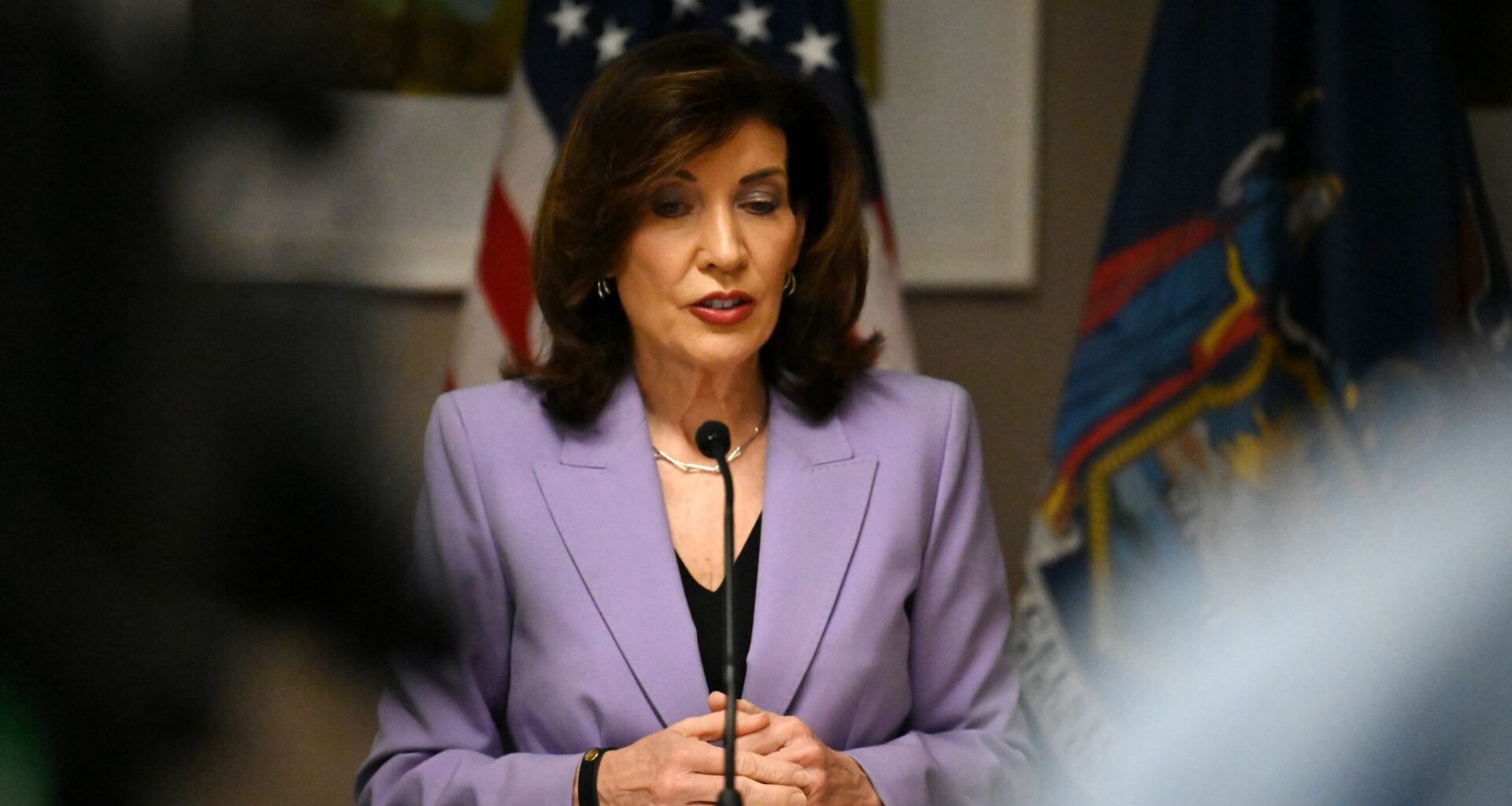
Gov. Kathy Hochul says the state is on track to complete its five-year effort to create or preserve 100,000 residential units.
Will Waldron/Times Union
ALBANY – Gov. Kathy Hochul on Tuesday celebrated what she said has been the fastest year of residential unit production in her administration, with the state is on pace to complete and exceed a 100,000-unit housing plan ahead of schedule.

But even as Albany pours billions of dollars into subsidizing construction of New York’s housing infrastructure, experts say the state remains in a deep shortage of residences that was decades in the making and driven by high costs and a failure to build enough units.
Article continues below this ad
Gov. Kathy Hochul says the state is on track to complete its five-year effort to create or preserve 100,000 residential units. (Will Waldron/Times Union)
Will Waldron/Times Union
Gov. Kathy Hochul visited this apartment project in Menands on Tuesday to tout her efforts to increase New York’s housing supply. (Will Waldron/Times Union)
Will Waldron/Times Union
Gov. Kathy Hochul at a news conference on her affordable housing initiative on Tuesday at Broadway Apartment in Menands. (Will Waldron/Times Union)
Will Waldron/Times Union
Gov. Kathy Hochul takes questions during a news conference on her affordable housing initiative on Tuesday, May 5, 2026, at Broadway Apartment in Menands, N.Y. (Will Waldron/Times Union)
Will Waldron/Times Union
State sign for the 35 Broadway Apartments veterans supportive housing on Tuesday, May 5, 2026, on Broadway in Menands, N.Y. (Will Waldron/Times Union)
Will Waldron/Times Union
Apartment projects like this one in Menands, which will set aside some units for military veterans, are part of New York’s answer to an ongoing housing crisis. (Will Waldron/Times Union)
Will Waldron/Times Union
Hochul made the announcement at a residential project in Menands that she said will provide 67 apartments with 35 units set aside for veterans who are homeless or at risk of becoming homeless. Projects like these were financed by the state’s affordable housing arm, which either helped pay for the creation or preservation of more than 22,000 residences during the current fiscal year.
All of the residences subsidized by the state in the Capital Region are multifamily units, according to data posted on New York Community Homes and Renewal’s website.
The 22,000-unit figure is highest single-year total under the state’s five-year housing plan. State officials say more than 81,000 residences have been financed or preserved since the latest initiative began, putting the state on track to exceed its 100,000-home target before the effort concludes next year.
Article continues below this ad
Make the Times Union a Preferred Source on Google to see more of our journalism when you search.
Add Preferred Source
The milestone comes as Hochul attempts to make housing construction easier by streamlining the state environmental review process and accelerating development approvals. That plan is proposed in the state’s ongoing budget negotiations.
“Rents are too damn high because housing is scarce, and you cannot solve a housing crisis without having the guts, the resources, and the vision to build more homes,” Hochul said.
The state’s housing push has become one of the largest public investments in housing in recent decades, officials say. It involves $25 billion in housing spending, billions of dollars more in tax credits and financing tools, and additional funding proposed in the state budget, which is 35 days past its April 1 deadline. It’s the latest budget in Hochul’s tenure as governor.
Article continues below this ad
‘New York is woefully behind’
Yet the state’s own estimates underscore the scale of the challenge ahead. In 2023, Hochul said New York needed about 800,000 new residences to make up for decades of underproduction and meet growing demand.
The amount of new housing hasn’t changed much in the last decade, despite efforts by New York’s last two governors.
Permits for new residences went from 40,874 since Hochul took office in 2021, to 45,473 in 2024, according to data from the U.S. Census. The Capital Region saw an annual 21% increase in building permits issued in 2024, according to the latest report from the Capital District Regional Planning Commission.
Article continues below this ad
For housing researchers, the gap highlights a broader problem that extends beyond subsidized housing alone.
“New York’s housing shortage is no longer simply an affordability problem,” said Marc Norman, a clinical professor at New York University’s Schack Institute of Real Estate. “It is increasingly a supply problem.”
Norman said the state has fallen behind peer states, including neighboring New Jersey, in overall housing production over the last two decades.
“New York is woefully behind in housing production,” he said.
Article continues below this ad
State officials say more than 81,000 housing units have been financed or preserved since the latest initiative began, putting the state on track to exceed its 100,000-home target before the plan concludes next year.
Will Waldron/Times Union
Norman said that certain local zoning restrictions limit multifamily housing construction, particularly in suburban communities resistant to density.
New York’s housing shortage has helped drive rising rents and home prices while hollowing out the supply of middle-income and starter homes.
Norman pointed to Austin, Texas, where aggressive housing construction during and after the pandemic helped push rents downward after years of rapid increases. By contrast, New York has not seen similar price stabilization because housing production has failed to keep pace with demand, he said.
Article continues below this ad
Hochul is apparently aware of that, saying Tuesday that people are leaving New York for neighboring states because they cannot afford to live here.
“They went because they built more housing, therefore, the housing cost less in those states. And I cannot tolerate that any longer in New York,” Hochul said.
Finishing what Cuomo started
The governor’s housing push follows an earlier statewide effort under former Gov. Andrew M. Cuomo. He announced his plan during a State of the State address in 2016, when he called for a financial and spiritual commitment to bolster the state’s housing infrastructure to address homelessness and a lack of affordable housing.
Article continues below this ad
In 2021, Cuomo announced the state was nearing completion of that $20 billion plan to create or preserve 100,000 affordable housing units. He proposed an additional $250 million capital to continue accelerating development. The initiative was completed under Hochul’s administration after Cuomo resigned amid sexual harassment allegations.
Almost immediately afterward, the state launched its current five-year housing plan. Like Cuomo, Hochul is also proposing $250 million in this year’s budget to help speed up development.
RuthAnne Visnauskas, the commissioner and chief executive officer of Homes and Community Renewal, has overseen both efforts. She said the state’s housing programs are designed to provide long-term financing certainty for developers navigating projects that can take years to complete.
She described the state’s housing apparatus as functioning “like a bank,” combining federal tax credits, state subsidies and financing tools to make projects financially viable in markets where construction costs often exceed what developers can recover through rents or sales.
Article continues below this ad
In upstate cities, including Buffalo, Rochester and Syracuse, the governor said developers often cannot build housing profitably because construction costs far exceed market values.
Downstate, the challenge is the cost of rents and residential prices, which have climbed beyond the reach of many middle-income residents.
Visnauskas emphasized that the administration’s housing targets reflect projects already financed or under construction, not aspirational goals.
The administration has also paired those investments with efforts to pressure or incentivize local governments to allow more housing developments.
Article continues below this ad
The bigger issue
Earlier in her term, Hochul proposed requiring municipalities to meet state housing growth targets, particularly in suburban areas surrounding New York City. The proposal sparked fierce backlash from local officials and suburban residents and was ultimately abandoned.
Since then, the governor has pivoted toward what she describes as a “carrot, not the stick” strategy through a program that gives municipalities preferential access to discretionary state funding if they adopt pro-development policies. Hundreds of localities have received the designation.
At the same time, Hochul continues pushing for changes to the state Environmental Quality Review Act, saying that lengthy environmental reviews often delay projects and increase construction costs. Hochul said Tuesday that she wants to speed up development and lower building costs statewide, noting that tariffs have driven up prices for some materials, including lumber and aluminum. She added that upcoming budget and regulatory changes could boost housing construction and help address New York’s population loss.
Article continues below this ad
“Anytime you can reduce time, you can reduce cost,” said Norman, the NYU real estate expert.
Still, Norman cautioned that financing and regulatory reform alone may not fully resolve the state’s housing shortage. Rising material prices, labor shortages and local political resistance continue to complicate efforts to rapidly expand supply.
For Norman, the question facing New York extends beyond whether the state successfully reaches another 100,000-unit milestone. The larger issue, he said, is whether New York can build enough housing to remain economically competitive and retain residents who are increasingly drawn to states where homes are cheaper and more abundant.
Article continues below this ad