
Six years ago, I embarked on a Star Wars Day tradition, diving into the historical archives to discuss the close relationship between the New York Yankees and arguably the most famous villain in science fiction history, the Evil Empire. That year, I looked at the term itself, and sought to find when it was first used to refer to the baseball team from the Bronx. The following year, I considered the rising payroll parity within the sport and posed the question, “Can the Yankees still claim to be baseball’s Evil Empire?” 2022 saw me complete the trilogy by looking at how the Evil Empire years shaped how people have viewed the sport and how its shadow contributed to the most recent lockout.
After a three-year hiatus, I channeled the spirit of George Lucas and opted to write a prequel, returning once more into the archives to study the history of previous Yankees nicknames. To begin, we looked at the story behind Murderers’ Row, and how either a prison in New York City or a street in Soho created the nickname, which was then applied to power-hitting lineups for New York baseball teams before being enshrined forever as the name for the ‘27 Yankees. Murderers’ Row, however, is not the only nickname to come out of those Babe Ruth/Lou Gehrig squads. At some point during this time, the Yankees became known as the Bronx Bombers.
These days, the Bronx Bombers nickname is so intertwined with the New York Yankees that the Wikipedia page “List of baseball team nicknames” does not even cite a source for the Bronx Bombers — something that, technically speaking, isn’t supposed to happen in encyclopedias such as Wikipedia, but occasionally can happen when a particular fact is so well-known that it is considered common knowledge.
Unfortunately, as anyone who has studied history knows, historical facts that are “common knowledge” can be difficult to track down, and the origin of the Bronx Bombers is no exception. The BR Bullpen has the following entry on the term:
The Bronx Bombers is a nickname commonly given to the New York Yankees. The name dates back to the 1920s and refers to the location of Yankee Stadium, in the Bronx section of New York City, and to the team’s line-up laden with power hitters such as Babe Ruth and Lou Gehrig.
The nickname has stuck through the years and is still commonly used in the 21st century.
That’s it: no sources cited, no references, no nothing. On what authority do they say the term dates to the 1920s? While I generally tend to trust the Bullpen, in this instance, their version of events isn’t the only one out there. A website called The Forkball, for example, claims the nickname dates back to a boxing match at Yankee Stadium in 1936, in which boxer Joe “the Brown Bomber” Louis fought. Meanwhile, Frank Thomas, writing for FanGraphs’ The Hardball Times, refused to take a stand on the issue in 2013, saying only “For sure it wasn’t before Yankee Stadium opened in 1923” — because, you know, the team played in Manhattan until then. Writing for The Ithacan (Ithaca College’s student newspaper) back in 2016, Angela Weldon investigated the origins of Ithaca College’s Bomber nickname, dating their nickname to 1938 and suggesting that it may have come when the college’s baseball team “people compared the college team to the New York Yankees.”
Faced with such a disparate set of popular discussions, I did the only thing a historian with access to the New York Times archives can do: head into the archives, and search for “Bronx Bombers.” And the first instance of the newspaper using the term comes from September 30, 1936, in an article about betting on the World Series matchup between the Yankees and the Giants. Within, writer Roscoe McGowen uses the term just once, saying, “Even so, the Bronx Bombers were a jovial lot on the even of hostilities.”
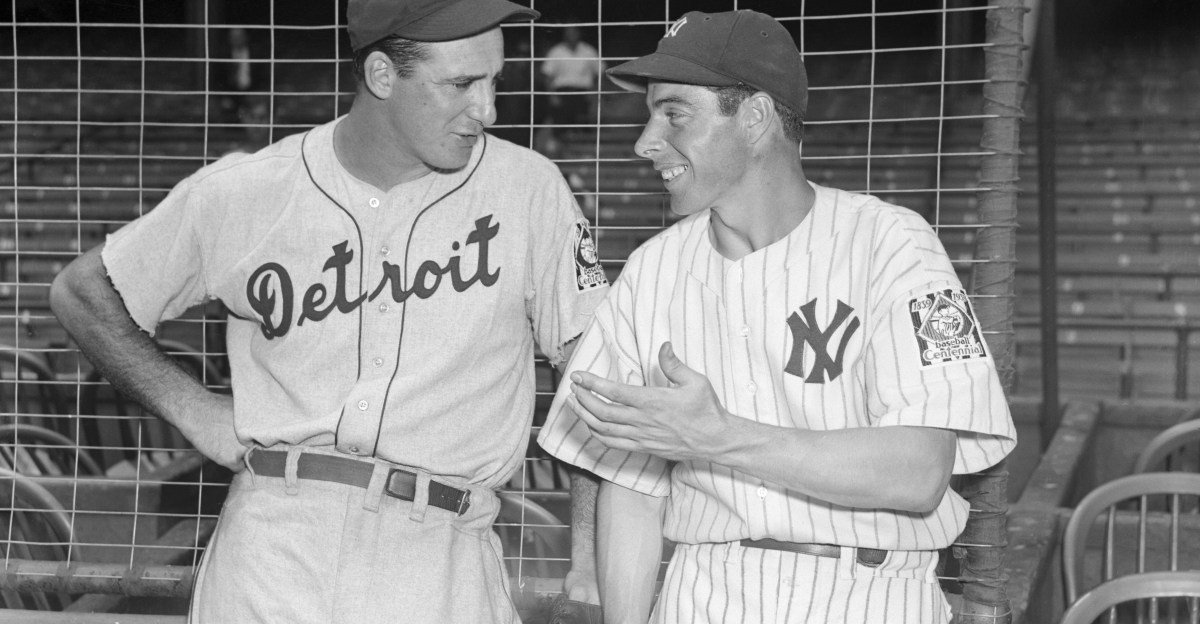
So what we have here is a terminus ante quem for the use of Bronx Bomber in relation to the Yankees. But we can also conclude from this that, even if this is the first use in the Times, this is not the origin of the term. McGowen does not explain the term, and already has it capitalized, suggesting that his audience would have been familiar with the term. If we expand our search from just the New York Times to all historical newspapers from the state of New York (shoutout to Andrew Mearns for having access to that database), we get two earlier uses of the term “Bronx Bomber.” The first, in 1930, refers to a boxer from the Bronx named Al Singer. More interestingly, the second use — on August 7, 1935, in The Glens Falls Times — refers to… Detroit Tigers first baseman Hank Greenberg, who was born in Greenwich Village, attended James Monroe High School on East 172nd St., attended NYU after rejecting a contract offer from the Yankees (who already had Lou Gehrig manning first), and ultimately signed with the Tigers after the Giants opted not to give him a contract.
This would mean that the term predates the Joe Louis fight, but that its first use was unrelated to the Yankees, which ultimately means we can’t disprove the theory, but it does cast some doubt on it. It does, though, make the BR Bullpen account seem unlikely, as it seems hard to believe that, given how the term Murderers’ Row was treated, a nickname associated with those dominant squads would have been transferred to a player who never played for the Yankees.
So where does this leave us? Unfortunately, it seems that we can’t truly find the origin of the Bronx Bomber name, at least using the online databases that I have been able to gain access to. This is, alas, the reality of history as a field: sometimes, the evidence only exists after something comes into existence, not at its moment of creation. We can use the evidence we found to limit the parameters — the term could not have existed before 1923, exists in the baseball world in 1935, may or may not have ties to boxing, and is a known nickname of the Yankees by the 1936 World Series. But to get any more specific than that? Well, if you find anything, by all means, please let us know!