
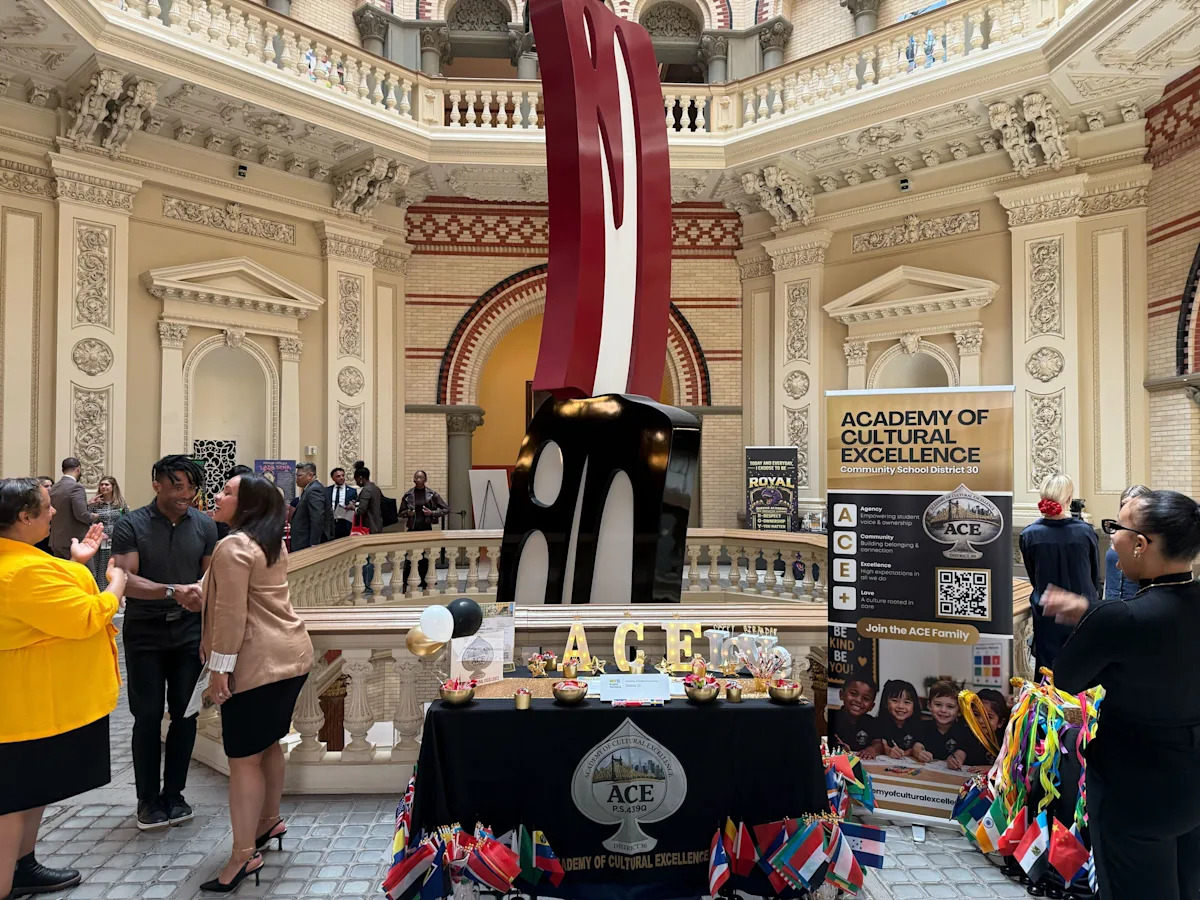
New York City is opening five new public schools in the fall, including a high school focused on hip-hop.
The schools will be spread across the Bronx and western Queens, with a priority on neighborhoods with overcrowded classrooms. Two of the schools are for students with significant disabilities.
“Each school brings something unique: different focus areas, grade levels and areas of specialization,” Chancellor Kamar Samuels said at the 2026 New Schools Fair on Tuesday in downtown Manhattan. “But together they reflect a shared, fundamental belief at New York City Public Schools — there is something for every student and every family.”
The latest schools join a growing list of 16 programs that have launched in recent years — seven this school year and nine last school year — despite there being fewer students to go around. Citywide, enrollment fell by 2.4% last fall, worsening years of pandemic-era declines. Local education officials have responded by closing or merging programs that have become too small to sustain.
Officials have explained the seeming contradiction as a strategy to recruit families to public schools by providing them with more choices. It also comes as the city faces a deadline to lower class sizes as required by state law, which will require more physical space in pockets of the five boroughs where schools are bursting at the seams.
“New schools give us a chance to think, ‘What else does the city need?’” Danielle Giunta, the chancellor’s first deputy, told reporters. “What is the feedback we’re hearing that parents want and would be interested in staying with us, coming back to us?”
“New schools [are] part of the conversation and broader strategy work that we’re doing to meet all of those things that sometimes feel like they’re in conflict,” Giunta said. “We’re trying to keep our families heavily invested in our public schools, because we believe in them profoundly.”
The Bronx School of Hip-Hop
The Bronx School of Hip-Hop is opening in Claremont with between 115 and 125 ninth graders, adding grade levels each year until it’s a full high school. It’s the birthplace of hip-hop’s first public school focused on the music and culture.
“At the core of what we’re talking about here is hip-hop culture being used as a vehicle for learning,” said Jason Reyes, the school’s founding principal. “This is not just performing arts. It’s that and students really digging deep into literary analysis. A good example would be, I’m looking at Kendrick Lamar’s album, ‘To Pimp A Butterfly,’ and I’m comparing that to, let’s say, ‘Catcher in the Rye,’ understanding rhetorical devices.”
“And mathematics, you might see students understanding pattern recognition in music, and then creating an algebraic equation.”
Reyes said students will graduate ready to go into the billion-dollar hip-hop industry or apply to college. As the first cohort of students get older, he’s looking to partner with CUNY’s Lehman College and Bronx Community College to offer college credit in areas such as audio engineering, video production and graphics, and business. The Bronx School of Hip-Hop counts Melle Mel, Grandmaster Caz and Special Ed among its advisers, and is aiming to team up with more artists after the school opens its doors.
Through the hip-hop curriculum, the principal hopes to attract students who struggle with attendance or concentration in the classroom: “Students are disengaged when they don’t see themselves in the learning,” Reyes said. “This school is designed for this generation.”
Schools for students with significant disabilities, budding artists
The other new school in the borough is the Bronx School of Arts & Exploration, a District 75 school in Highbridge for students in kindergarten through eighth grade with significant disabilities. The school places an emphasis on the arts and helps young people develop their independence.
In Queens, the city is opening several schools: the Academy of Cultural Excellence, a prekindergarten and elementary school in Long Island City with a focus on projects and the arts; Queens Academy for Innovative Learning, in Astoria, another District 75 school for students with significant disabilities in grades six through 12 focused on STEM; and West Q Elementary, an elementary school in Woodside centered around neighborhood-based projects and multilingualism.
The launch of two District 75 schools comes amid a systemwide push to offer special education programs to students with disabilities who might have otherwise enrolled in private schools, with their tuition funded by city taxpayers, a line item in the city budget that has been ballooning in recent years.
“This school is being designed for students on the autism spectrum, so really tight routines and structures,” said Jenna O’Shaughnessy, the founding principal of Queens Academy for Innovative Learning. “Our mascot is going to be a ‘Royal Raptor.’ The reason we picked the Royal Raptor is because raptors are known for their intense focus and their determination, which is exactly what our students will need.”
No school on artificial intelligence
Notably absent from this year’s fair was a planned school in downtown Manhattan focused on artificial intelligence, Next Generation Technology High School. Samuels pulled the proposal last week amid backlash over its embrace of AI and screened admissions process, though officials have shown interest in reviving those plans after a systemwide AI policy is in place.
“We always want to make sure that we’re listening,” Shawn Rux, who leads the department’s Office of New Schools, told reporters at the fair. “So we’ll continue to reflect, and we’ll continue to consider what works best moving forward.”