
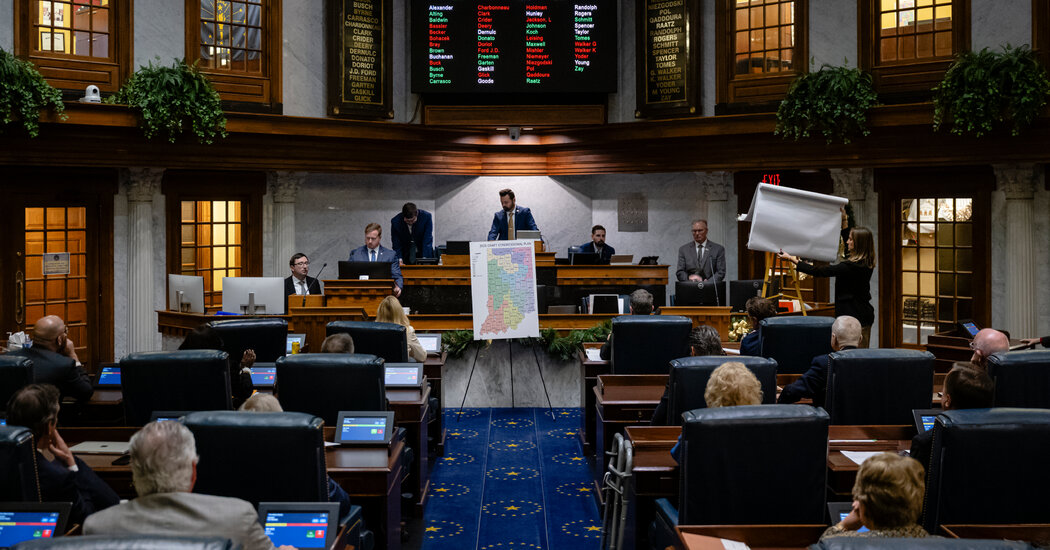
President Trump’s effort to oust Republicans deemed insufficiently loyal faced a key test on Tuesday as Indiana voters decided whether to back state senators who opposed redistricting and whom the president wanted out.
Mr. Trump’s political payback campaign, which will extend later this month to intraparty clashes in Georgia, Kentucky and Louisiana, comes as his poll numbers sag.
Also on Tuesday, Ohio voters were picking candidates for a Senate race that is seen as essential for Democrats hoping to win control of Congress. And in Michigan, Republicans were hoping to flip a crucial State Senate seat in a competitive district.
Taken together, Tuesday’s elections will offer a window into Mr. Trump’s influence as the war in Iran and high gas prices are raising alarms for Republicans and fueling Democratic optimism about the general election in November.
With polls in much of Indiana set to close at 6 p.m. Eastern, here is what to watch for:
Indiana Was an Outlier
Several Republican-led states quickly fell in line last year when Mr. Trump demanded redrawn maps to improve Republicans’ chances in Congress in the midterms. But Indiana was different.
Republicans hold large legislative majorities in Indiana, but a critical mass of state lawmakers opposed the idea. They stuck to their stance even when the president threatened political retribution, and even as some Democratic-led states moved to redraw their own maps to the Democrats’ benefit.
When lawmakers returned to Indianapolis in December, the House approved a new map, which would have positioned Republicans to flip the state’s two Democratic-held congressional seats. But the Senate said no, and a slim majority of Republicans joined all Democratic senators to vote the bill down.
State Senator Spencer Deery, a Republican running for re-election against a Trump-backed challenger, made the case to voters that redistricting outside the usual decennial schedule went against the intentions of the country’s founders and was risky for his party.
“Not only was this clearly wrong from a constitutional and moral and ethical standpoint,” he said in a recent interview, “but it also was really bad politics.”
Trump Tried Carrots, Then Sticks
At the first signs of resistance, Mr. Trump and his allies tried to win over skeptical lawmakers. Vice President JD Vance flew to Indianapolis. White House staffers reached out individually. Mr. Trump spoke on a group call.
Those efforts won some converts, but not enough. Before long, the tone shifted, with the president calling out senators by name and promising to back challengers to those who bucked him.
“Any Republican that votes against this important redistricting, potentially having an impact on America itself, should be PRIMARIED,” he wrote in a November social media post that referred to two senators as Republicans in name only.
Incumbency vs. Endorsement
Many of the Republicans who went against Mr. Trump’s wishes are staunch conservatives with long track records. Many are running for re-election with coveted endorsements from groups focused on gun rights, law enforcement and agriculture.
But their divergence from Mr. Trump spoke to a larger, long-festering divide in the Indiana Republican Party between more establishment-oriented politicians and those who have embraced Mr. Trump’s political style.
Lt. Gov. Micah Beckwith, a Republican who supports redistricting, said the incumbents who defied the president were misunderstanding the political stakes of this era.
“I don’t want just conservatives,” Mr. Beckwith said. “I want conservatives who are willing to fight for conservative values. And I think that’s what President Trump is saying, too.”
Local Races With National Intrigue
The decision of whether to oust the incumbents will come down to several thousand Republican voters in each of those districts, who will decide how much importance to place on the president’s endorsement.
Johnny Smith, a Trump supporter and a Republican member of the Attica City Council, donated to Mr. Deery’s Trump-backed challenger, Paula Copenhaver, who chairs the Republican Party in his home county.
But Mr. Smith also described Mr. Deery as “a good dude” who works hard as a senator. As of late last month, Mr. Smith was not sure how he would vote.
“Maybe if somebody didn’t know them as well, that Trump endorsement could carry more weight,” Mr. Smith said, adding that “there’s a lot of people that are just on the fence.”
A Marquee Ohio Senate Matchup
The primary race for Ohio’s Senate seat is not likely to be competitive: Sherrod Brown, a Democratic former senator, is expected to face Senator Jon Husted, a Republican, in November.
But the primary will kick off what could be one of Democrats’ best opportunities to flip a critical seat in a Republican-led state as they aim to regain the Senate majority.
Though Ohio has become a solidly Republican bulwark in recent years, Mr. Brown, who was a senator from 2007 to 2025, is more of a household name than Mr. Husted, who was appointed last year to replace Mr. Vance. In a national environment tilting in their favor, Democrats see the seat as a key pickup opportunity.
Prominent Trump Allies in Ohio Face a Test
In the Ohio governor race, Vivek Ramaswamy, an outspoken Trump ally who ran for president in 2024, is expected to face Dr. Amy Acton, a Democrat and former state health director. Mr. Ramaswamy is well funded and popular with the MAGA base, but he is prone to headline-generating controversies that could prop up Ms. Acton.
The outcome in a competitive House primary is more in doubt. A crowded field of Republicans is vying to challenge Representative Marcy Kaptur, a Democrat who is the longest serving woman in Congress. The redrawing of her district was seen as making her more vulnerable.
Foremost among the Republican challengers is Madison Sheahan, the former deputy director of U.S. Immigration and Customs Enforcement, who centered her campaign around her efforts to carry out Mr. Trump’s deportation agenda. That could make her an appealing opponent for Ms. Kaptur, given many voters’ antipathy toward aggressive measures federal agents have used.
Control of the Michigan Senate on the Line
Michigan Democrats are trying to hold their slim majority in the State Senate by defending a vacant seat in a swing district that includes Saginaw.
Voters there have been without representation since January 2025, when Kristen McDonald Rivet, a Democrat, resigned after winning election to the U.S. House.
Gov. Gretchen Whitmer, a Democrat, waited months to call a special election, leaving in place a one-seat Democratic majority in the Michigan Senate. If Republicans flip the seat, it would leave the Senate in an even partisan split, with the lieutenant governor, a Democrat, holding the tiebreaking vote.
Both parties were eager to demonstrate strength in the district, which includes some of the most intensely fought territory in statewide and presidential elections. Voters in Michigan, a swing state, will elect a new governor and a new U.S. senator in November.