
For years, Carlos Morales’s cart in Jackson Heights has become “working for everyone” — a local staple in the diverse neighborhood. But despite a new mayoral administration vowing to support street vendors, Morales is worried: “Now there are many vendors outside on the street. So now it’s more competition.”
Morales is among the 25% of New York City’s 20,500 mobile food vendors with permits. A percentage set to grow following the passage of the Street Vendor Reform Package, which will increase the supply of permits and make operating without a license subject only to fines. It was legislation Zohran Mamdani backed from the campaign trail.
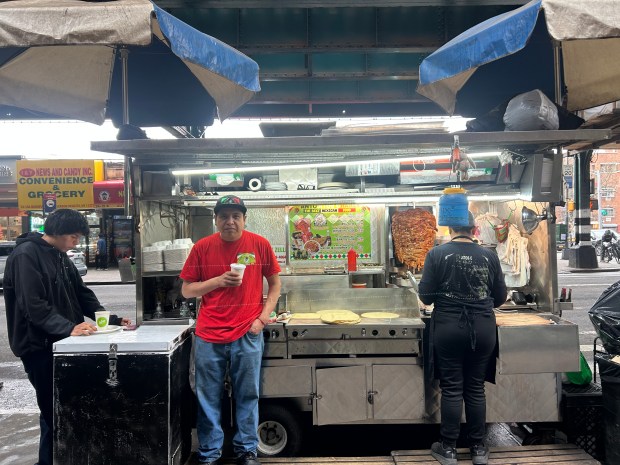 Carlos Morales is among the 25% of New York City’s 20,500 mobile food vendors with permits. (Lauren Ong)
By prioritizing entry over stability, the city is creating a two-tiered system where the newly legal compete with a legacy class still burdened by the debt and history of the old underground permit market.
Morales recalls the days of paying $20,000 a year for a permit, costs that once cut his profits by nearly 50%, and now finds himself competing with vendors who never had to pay that tax to enter the market. Reform is framed as expanding opportunity, but for the vendors who paid $20,000 a year to play by the rules, it looks different: new entrants get a clean start while they’re still carrying the debt of a system the city itself enabled — that’s not reform, that’s amnesia.
Mamdani has cast the problem in populist terms: “Chicken over rice now costs $10 or more. It’s time to make halal eight bucks again,” he said on X. It’s a good line, but it’s also the wrong diagnosis. Prices aren’t high because vendors are gouging anyone, they’re high because operating a cart in New York is expensive, and has been for a long time.
Farid Zamanzada, who runs a breakfast cart in Morningside Heights, put it plainly: “Twenty years ago, chicken and rice was five, six dollars. Now it’s $10 or even $12.” That’s inflation, rising supply costs, and decades of regulatory burden passed down to the customer. Chasing a lower price point gives the mayor a viral moment while vendors lose sleep over something else entirely.
Rifts Ahmad works a halal cart in Queens, where chicken rice has been held at $9 for the past year. He loves his job, but his biggest frustration is the state of the sidewalk around him: “No cleaning.” Ahmed Moustafa, who operates a halal cart near Yankee Stadium, is still crawling out from the pandemic. “The people in the street don’t buy because it’s expensive,” he said, adding that operating costs have increased 15% since the pandemic. No viral video changes that math.
Recently, Mamdani’s administration launched the Office of Street Vendor Services, a dedicated agency serving as a resource hub for vendors. A genuine step, but a contradictory reality has been playing out on the streets.
The NYPD issued more than 3,600 criminal summonses to street vendors last year. The Street Vendor Project found vendors in Manhattan and Brooklyn were charged for failing to display their license, post food prices, and keep distance from a bus stop or fire hydrant — all violations that would now be civil under the new law. Mamdani has not explained this. That silence matters.
Mamdani has made vendors central to his political identity. Whether he’ll extend them that same respect — not as symbols, but as workers still waiting — remains to be seen.
Kim, Ong and Smith are students in the opinion writing seminar at Columbia University Graduate School of Journalism. This op-ed and four others that the Daily News is publishing were written as part of an assignment about what Zohran Mamdani’s political vision actually looks like on the ground.