
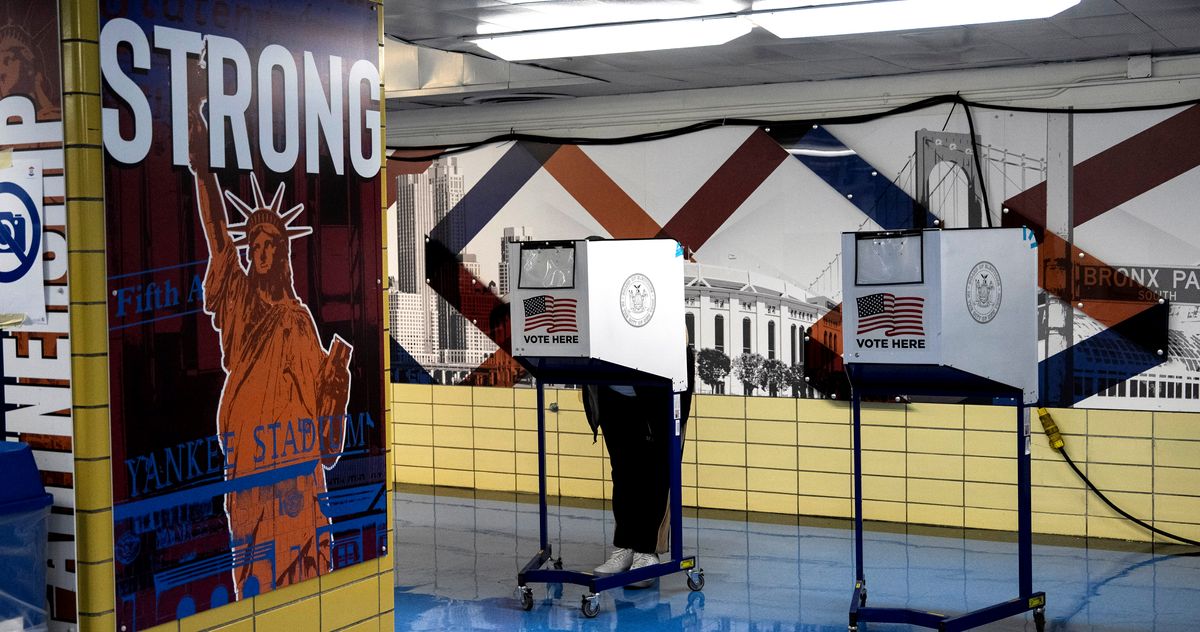
Photo: Christian Monterrosa/Bloomberg/Getty Images
The recent gutting of the 1965 Voting Rights Act by the Supreme Court’s conservative majority will injure American democracy in ways that go far beyond the outcome of this year’s midterm elections. And the damage will be felt in New York, where decades of discrimination and political trickery has long placed three of the five boroughs — Brooklyn, Manhattan, and the Bronx — under the same federal scrutiny of election practices as notorious states like Mississippi and Louisiana.
“The Voting Rights Act is arguably, in terms of our politics, the most important law Congress has ever passed, and the court has really made it pretty toothless,” Professor Jamal Greene of Columbia Law School told me. “The first moves that we should expect are the dismantling of majority-minority districts that had been built because of compliance with the Voting Rights Act. Some of that’s already happened, for example in Florida, and we can look forward to it happening probably in Louisiana and Alabama and Mississippi. Since that compliance is no longer necessary, those districts are very likely to be dismantled by Republican legislatures in southern states.”
Until now, the VRA required state legislatures, mostly in the South, to comply with a broad “totality of circumstances” test — subject to review by the U.S. Department of Justice — to ensure that state officials were not diluting the voting power of racial minorities. The law banned state legislatures and local boards of election from using literacy tests, poll taxes, burdensome registration requirements, and other forms of vote suppression. It also outlawed the practice of carving up Black communities into multiple, mostly white districts to minimize Black voting power, a practice called “cracking.”
But in Louisiana v. Callais, a majority of the Supreme Court explicitly eliminated the “totality of circumstances” test. Voters who have been disempowered must now demonstrate in court that state lawmakers or local election officials are operating with a specific, provable intention to discriminate based on race, as opposed to race-neutral criteria like maximizing the number of Republican seats.
Writing for the majority, Justice Samuel Alito argued that “our Nation has made great strides in eliminating racial discrimination in voting. And if, as a result of this progress, it is hard to find pertinent evidence relating to intentional present-day voting discrimination, that is cause for celebration.”
Alito’s willful naïveté was exposed as a sham within hours of the Callais decision. The nation got a first taste of what the new voting-rights system will look like as Republicans in Tennessee, which is about 17 percent Black, gleefully announced their intention to dismantle the sole Democratic congressional district in the state by carving up Memphis, which has one of the most concentrated Black populations (64 percent) of any big city in America, second only to Detroit.
“A completely red Tennessee is VITAL to saving our Republic,” Andy Ogles of Tennessee, a Republican congressman from Nashville, wrote on his Facebook page, calling for a round of cracking. “DRAW THEM OUT.” Ogles is the same Neanderthal who made headlines earlier this year by suggesting on social media that the Justice Department should deport Mayor Zohran Mamdani and by tweeting “Muslims don’t belong in American society. Pluralism is a lie.”
Under Alito’s newly announced Supreme Court standard, power-hungry bigots like Ogles can now attack Black voting power with legal impunity by claiming their actions are based on a hunger for partisan power (“DRAW THEM OUT”) rather than their underlying bigotry (“Pluralism is a lie”). The court is taking a big step backward: The entire purpose of the VRA was to outlaw the endless gamesmanship by local politicians bent on reducing or canceling minority voting rights.
“It is the rare legislature, as the history of voting discrimination shows, that cannot camouflage racial targeting with race-neutral justifications,” Justice Elena Kagan wrote in a stinging dissent, predicting that the Callais decision has “laid the groundwork for the largest reduction in minority representation since the era following Reconstruction.”
Smug New Yorkers should not write these developments off as the ugly recrudescence of southern racism; the VRA has also been a way to control one generation after another of New York’s homegrown political tricksters.
As recently as 2016, more than 100,000 registered New Yorkers were “mistakenly” purged from the city’s voter rolls in a way that disproportionately disenfranchised Latino voters. It was a reminder of past misdeeds like a 1989 purge of 300,000 voters; an important 1958 case brought by a Bronx Puerto Rican, Jose Camacho, that outlawed the printing of election materials in English only; and an ugly 1908 incident in which New Yorkers were required to reregister to vote every year, but registration was limited to Saturdays and a single Monday that happened to be Yom Kippur, a clear effort to disenfranchise Jewish voters.
A landmark 1967 case called Cooper v. Power successfully used the VRA to undo New York’s long-standing practice of cracking Bedford-Stuyvesant and other Central Brooklyn neighborhoods into multiple, mostly white congressional districts. The following year, a new court-ordered district consolidated Bed-Stuy and enabled Shirley Chisholm to become the first Black woman elected to Congress. (The plaintiff in the case, Andrew Cooper, went on to publish a community newspaper, the City Sun, where I got my first job in journalism.)
Demolition of the VRA means, among other things, that local Democratic operatives will be free to resume the tricks and traps of the past. In fact, Democrats are already vowing to fight the Callais decision by initiating a new round of gerrymandering. Representative Hakeem Jeffries, leader of the House Democrats, has reportedly begun looking into ways New York might create new Dem-leaning districts. But the damage done by the Supreme Court’s evisceration of the Voting Rights Act in Callais goes far beyond flipping a few seats in this year’s midterms.
The problem is not mere gerrymandering: The Supreme Court has all but blessed a broad, poisonous attack on the rights of minority communities nationwide. “I will be interested to see, for example, whether time will vindicate the majority’s view that the ‘great strides’ made in African American office-holding, ‘particularly in the South,’ will hold up after the issuance of this opinion,” Justice Kagan predicted in her dissent. “My own guess is not.”
Wholesale disenfranchisement of the sort Kagan warns about is very likely, and it’s a fool’s errand. This year marks the 15th anniversary of the Occupy Wall Street movement and six years since the killing of George Floyd triggered the biggest street demonstrations in U.S. history. Those who think tens of millions of voters are going to quietly watch their rights get stripped away are in for a big noisy surprise.
Sign Up for the Intelligencer Newsletter
Daily news about the politics, business, and technology shaping our world.
Vox Media, LLC Terms and Privacy Notice