
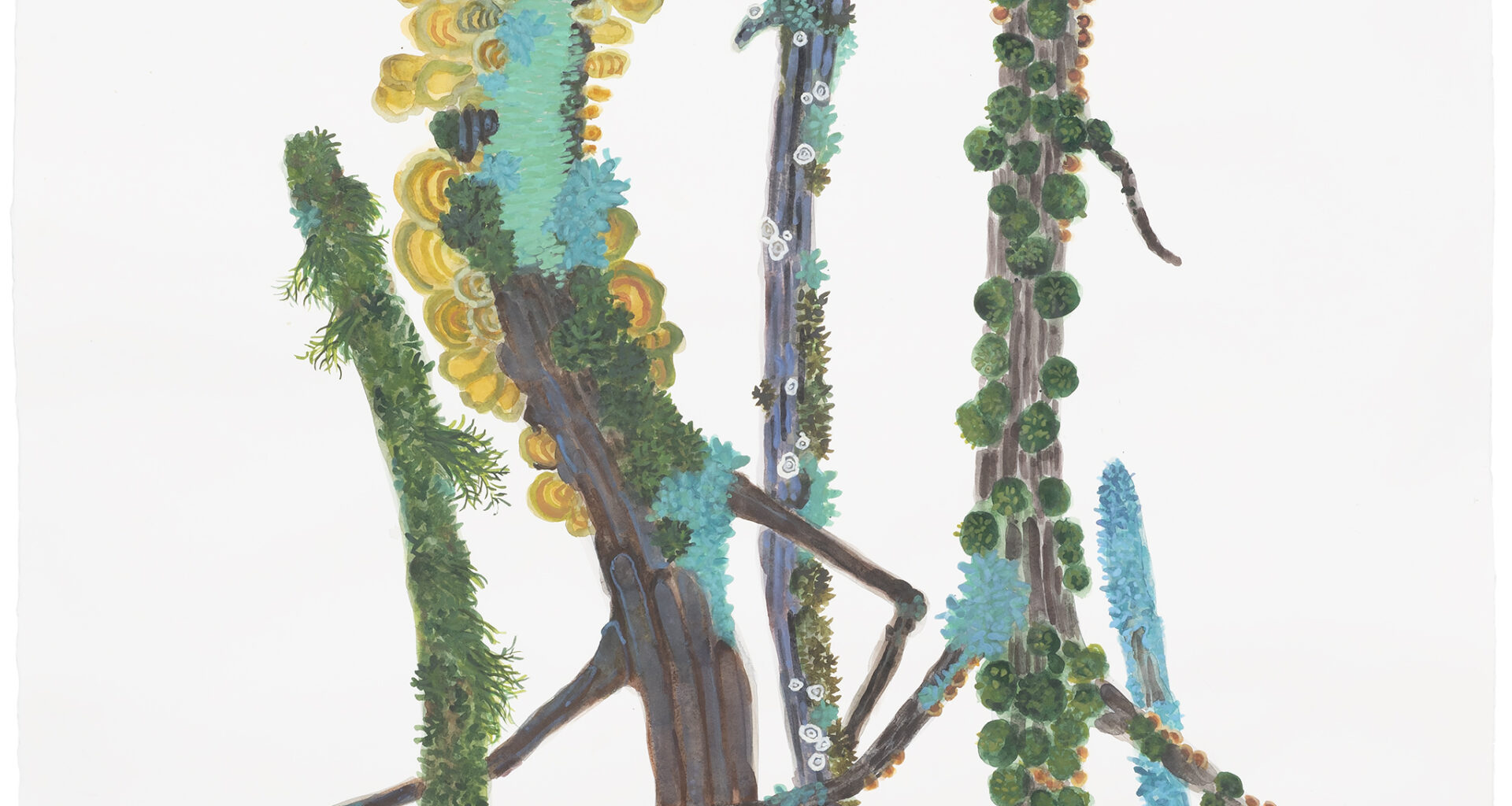
The Arboreal Life
Kathryn Markel Fine Arts
April 2–May 9
New York
You don’t have to squint to get a glimpse of the subtextual human figure lurking throughout Katie DeGroot’s tree paintings in her current exhibition, The Arboreal Life. The two narrow trunks in Chit Chat (2026) lean toward each other with familiar intimacy, their slender branches touching like the casual embrace of a long-married couple. The solo specimens in Opinionated and Opinionated II (both 2025) appear to be engaged in a heated disagreement, replete with finger-pointing and postures associated with righteous indignation. Things get even more animated in Family Matters (2025), where a tangle of branches from different species brings to mind the tenderly complex overlap between parents, offspring, and their assorted kindred arrangements.
DeGroot spent her adolescence and early adulthood in the Chicago area, and much of the art that she produced in her formative years was heavily informed by the figurative tradition loosely associated with the acclaimed Hairy Who generation. In fact, it wasn’t until she left New York City to live on her great-grandparents’ farm in upstate Fort Edward, when the sudden shortage of live human models in the deeply rural region made a change in direction necessary. On regular walks in the wooded areas adjacent to her home, DeGroot began noticing that certain tree limbs had such striking forms that it was as if they had personalities. With the artist’s help, branches were soon finding their way back to her studio, where she began developing compositions based on the way they seemed to intermingle, leading to the striking Cocktail Party Vlll (couples) (2023) arrangement in her last exhibition in 2024.
DeGroot’s eye is invariably drawn to the linear twists and abrupt angles of the boughs she assembles, but she is still more besotted by their colors and textures. Dead insofar as they are no longer attached to living trees, the branches are richly adorned with fungi, mosses and lichen, whose subdued palette gives the artist plenty of room to luxuriate over the details of all that fluorescence. Her preference for using opaque watercolors, which she deftly combines with the translucent variety, enables DeGroot to achieve a difficult balance between close observation of nature and the sort of poetic license that can transform each stick into a distinct individual, whose unique features the artist might return to over and over again.