
Heads
Jarvis Art
March 18–May 9, 2026
New York
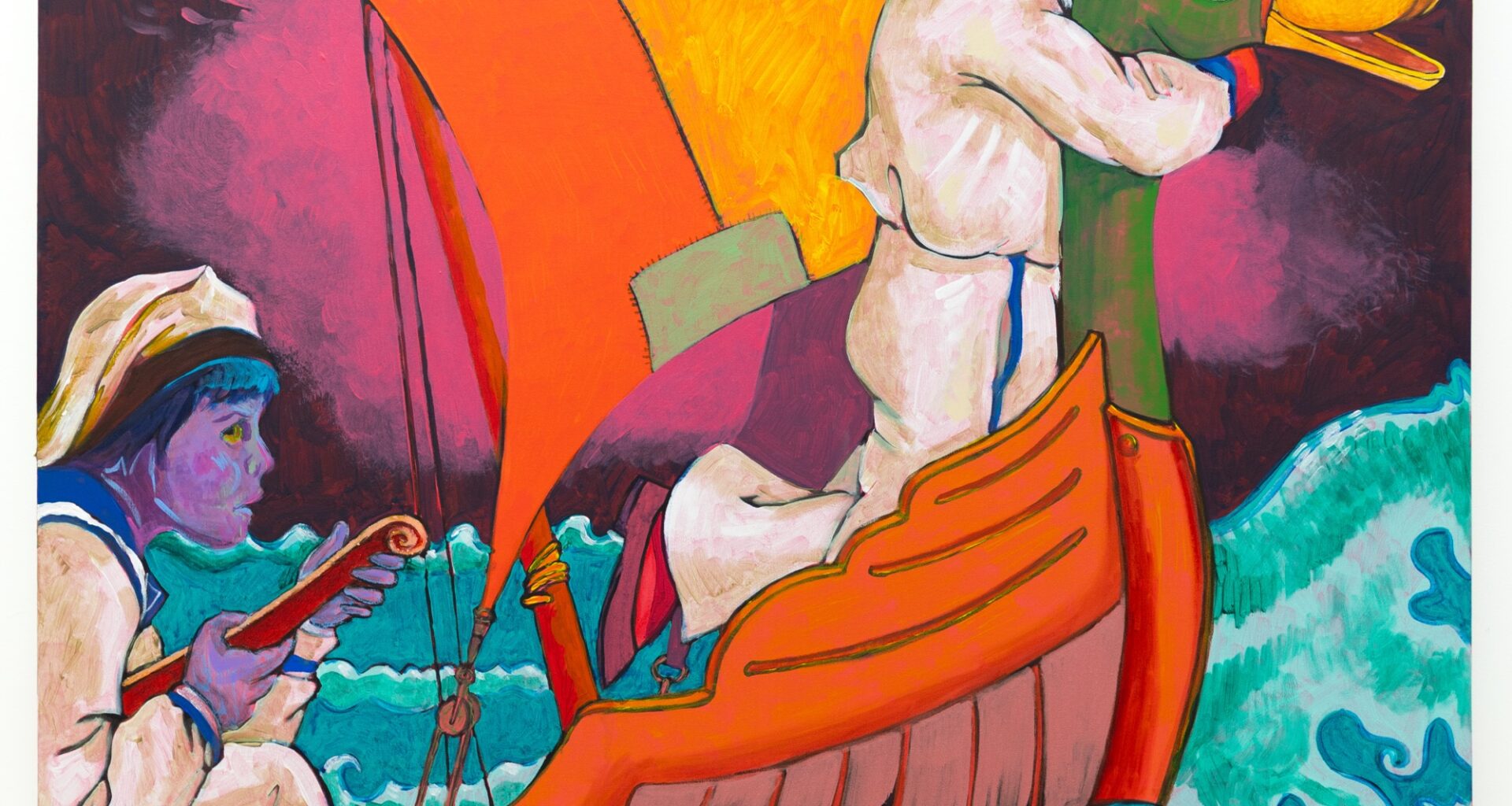
Archie Rand: Heads at Jarvis Art includes twelve figurative paintings executed between 2024 and 2025. Ranging in their thematic content, they countenance both the worldly and wondrous. At times, Rand dovetails these two poles, as in the fantastical Duck (2025), where a lavender- and claret-skinned sailor duo buoys aboard a tawny wooden sailboat across cresting cyan waves. The boyish skipper casts his right arm around the prow, from which a carved figurehead of a green mallard duck arcs upwards, its golden beak indicating an off-canvas subject toward whom the juvenile captain waves. The more quotidian Piano (2024) posits the eponymous instrument and its bench in a tangerine lambency. In the background, rolling honey-flaxen towers fulgurate across the plum skyline. With the exception of a lone clawed piano leg that rests on a small crystalline shard of reflective land, the instrument stands braced on an azure outdoor plain painted flat enough to prohibit any indication of grass blades.
While many of Rand’s best-known past works have been anchored in liturgical, scriptural, or literary imagery, this most recent suite is, with the exception of Goldilocks (2025), more untethered. This is not to suggest that there is no throughline with his extant work—each figure is set aglow in blush and cerise skin, with verdant jade plains casting his character studies in rich, highly saturated gradients. Rand’s acerbic greens, magenta, and violets are archetypal of his sustained chromatic tuning. In subject and color, his approach is keenly reminiscent of the fantasy comic imagery of Ralph Bakshi, Philippe Cazaumayou, Nicole Claveloux, Richard Corben, Philippe Druillet, and Jean Giraud (also known as Moebius). Rand, despite being flanked by Color Field painters and geometric abstractionists during his youth, was broadly sympathetic to this comic tradition.
Given his lurid colors and loose facture—for, though Rand outlines his characters, his fence-hopping boys and Phrygian-capped townsmen’s skin are flurriedly figured in soft impressionistic strokes—one is tempted to compare him to modernist expressionists like Ernst Ludwig Kirchner and Eduard Bäumer, or heirs of this tradition like Christian Ludwig Attersee. His antecedent work escaped such comparisons precisely because of its thematization of biblical stories. His newer images, however, are mostly depurated of identifiable allegorical context. Yet they are also imbued with a sense, though only a sense, of plausible referentiality—that is, they strike one as if they could have been lifted from illustrative accompaniments to medieval tales. Such connotative lures can hardly be escaped when standing before Duel (2025), where a cherry-caped, would-be duelist, caught in a quiescent moment, palms his chin. Behind him, a gilded green knight erectly stands atop a tessellated floor, his trailing sword indicating an impending battle.
In a review of Rand’s 2025 exhibition, Sons, at Contemporary Fine Arts in Berlin, where the artist exhibited an earlier suite of works, Andrew Paul Woolbright espied the artist’s appropriation of “commercials and advertisements, and the pulp pages of comic books,” likening his practice to “painting as retrieval from the ten cent pages.” It is not immediately clear that in this latest series, Rand seeks to present even tenuously identifiable referents. But one can certainly engage in genre-painting the likes of pulp noir or science-fiction fantasy without appropriating specific instances of that genus. Reflecting on his more textually anchored work in a February 2016 conversation with perhaps the most assiduous writer to contend with Rand’s oeuvre, Barry Schwabsky, the artist remarked, “What I wanted to do was make the visual image so inherently iconographic that one would be attracted primarily to the visual, and then as an afterthought, sort of, pick up on what the text was.” In a way, Rand’s methodological interest in rending iconographic images from source material continues to undergird these later paintings. But (again, Goldilocks aside), this ambit is far more challenging if an artist eschews primary material to anthologize. This is also liberating, insofar as it allows Rand to engage in pure genre painting, producing science-fantasy and neon-bathed noir fragments.