
Over 600 people have signed an online petition calling on St. John’s University to stop the “displacement and downsizing” of the university’s Writing Center, which provides students with free consultations to assist them with written assignments.
Employees at the Writing Center said they were informed on May 1 that the center would be relocated to a “quiet study area” behind the Einstein Bros’ dining area on the St. John’s campus, which employees said would impact the visibility of the center’s services.
Owen Taylor, a St. John’s student who launched the recent petition, claimed the relocation would “greatly reduce foot traffic” at the center because students would find it much more difficult to locate the facility, which has received over 1,600 unique visits during the ongoing academic year.
“Walk-in appointments are a primary service of ours, and increased difficulty in locating the center would put a major dent in our service output,” Taylor said in the petition.
St. John’s University pushed back strongly, stating that the relocation of the Writing Center is part of a three-year strategic plan focused on three critical areas. The first area of that plan aims to implement a new academic advising model for all students, an enhanced structure for “at-risk students,” university spokesperson Brian Browne said.
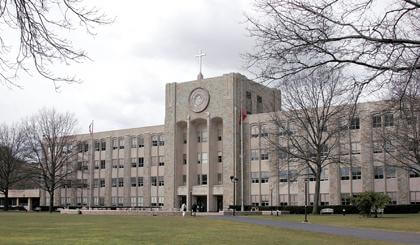
Browne added that a new blended model of academic advisement will take place at the St. Augustine Hall space currently occupied by the Writing Center. Browne further stated that the relocation would not impact the services offered by the Writing Center.
“The University Writing Center offers students support throughout the writing process by scheduling one-on-one consultations with student writing consultants,” Browne said in a statement. “The Center is also used for meetings and event space. The relocation space, although slightly smaller, will continue to offer the same engaging opportunities for our students and community members.”
He added that the decision came after several focus group discussions among undergraduate students.
But students and faculty pushed back against the move, stating that it would have a detrimental impact on the services offered by the Writing Center.
The online petition, which has received 636 signatures at the time of writing, said access to the new location is extremely limited. The petition states that students and faculty are required to pass through the Einstein Bros’ dining area in order to reach the new location, stating that the dining area is congested at all times of the day.
“If the Writing Center were to be relocated there, the traffic would consist of: Einstein Bros’ customers, students seeking to use the bathroom, students looking for printers, students using elevators, students looking to access the University Learning Commons, and the University Writing Center’s clients,” the petition states.
The petition further argues that the new location would downsize the Writing Center to a space roughly half the size of its current capacity, impacting the ability of the center’s 26 employees to provide one-on-one consultations and other services.
“The structure of the quiet study space aligns with the name itself, it is a secluded, largely window-less squared surface that promotes an isolated, independent and silent environment. All adjectives which are contrary to the Writing Center’s core collaborative, lively and community-based activities,” the petition continues.
The petition alleged that all 26 Writing Center employees learned of the relocation shortly before noon on May 1, with a team of designers showing up within an hour to start the redesign process.
David Farley, an associate professor at St. John’s, also alleged that faculty and writing staff at the university only learned of the relocation early on May 1.
Farley and St. John’s faculty are currently locked in a dispute with St. John’s after the university’s President Rev. Brian Shanley announced in February that St. John’s would no longer recognize the long-standing faculty unions. The St John’s chapter of the American Association of University Professors and the Faculty Association recently filed an unfair labor practice charge against university leadership over the issue.
Among other issues, faculty and students have claimed that the move would lead to program elimination and “academic contraction,” with opponents claiming that the move will prevent faculty from having a voice in academic decisions at St. John’s.
Farley said the university’s decision to relocate the Writing Center is “emblematic” of the kind of decision making that would take over at St. John’s if the faculty loses its voice.
“We expect to see more and more of this,” Farley said. “Administration can also expect to see more and more turnout and pushback from faculty, and now from students as well, who are intimately aware of what the loss of this beloved space means for the St. John’s community.”
St. John’s has maintained that the decision to end union recognition was necessary to advance the university’s “organizational mission.”
“This will allow St. John’s the flexibility required to innovate while continuing to support our faculty and, most importantly, deliver on our promise to our students,” a university spokesperson said in a statement in February.
The decision would allow St. John’s to remain “steadfastly” dedicated to its Catholic and Vincentian mission, the spokesperson added.
“As the landscape of higher education undergoes a profound transformation, our commitment to providing an exceptional and sustainable educational experience consistent with our mission requires us to be agile and innovative.”
In an updated statement on March 11, a St. John’s spokesperson said the university was working directly with its faculty and adopting a “direct-engagement model that is the standard for the overwhelming majority of universities nationwide.”