
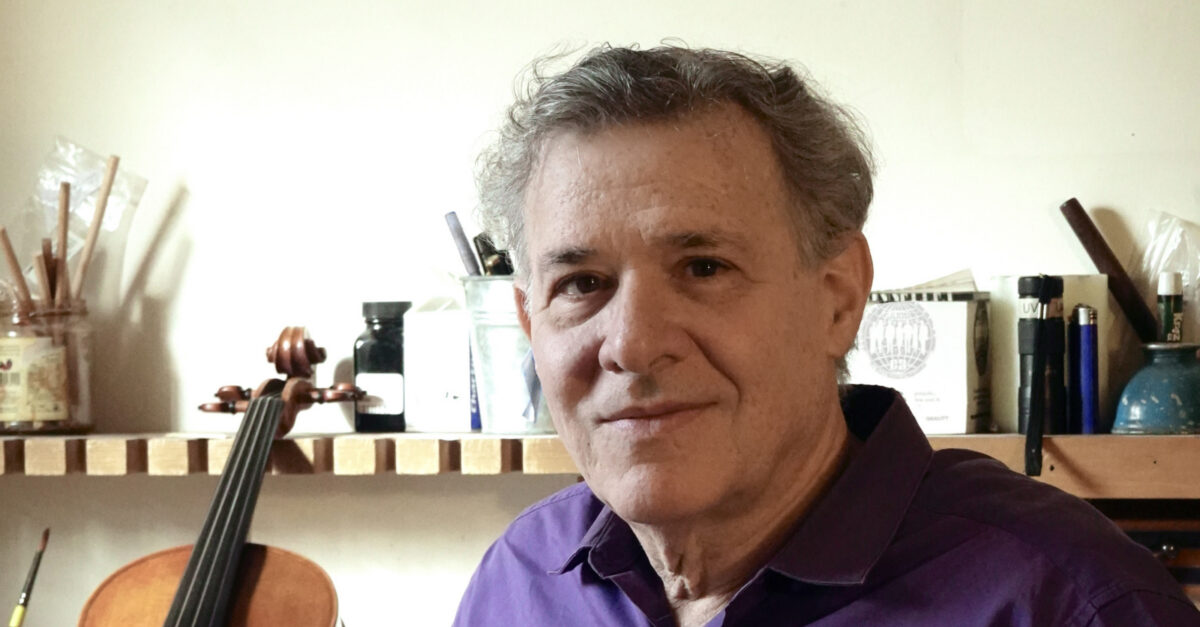
Brooklyn-based violin maker Samuel Zygmuntowicz has made instruments for many of the most prominent musicians of our time, including those at the Chamber Music Society of Lincoln Center. He is the honoree of the CMS Spring Gala on May 19, 2026. Below, he speaks to CMS’ Nicky Swett.
You started making violins as a teenager. It’s common for people to start playing an instrument young, but it’s less typical to start making them at a young age. How did you wind up doing this so early on?
Samuel Zygmuntowicz: I’ve been involved in making things from my earliest memories. I was a sculptor, if you can call a kid a sculptor. I was always working with clay and drawing. I had my microscope and I read a lot. I read about a violin maker in a book when I was about 12 or 13, and it really captured my imagination. That turned out to be very fortuitous. It fits my rather scattered but very specific interests: it’s got artistic skill, it’s got engineering analysis, and it’s got a very defined goal, which really attracted me.
What generally brings a new client into your shop?
Usually they’ve heard an instrument of mine, and it interests them. I try to have a few instruments here in my shop, and the beginning of the process is kind of like a fitting. I observe which instruments they respond to most. They will tell me, “This one seems very strong, but this one seems a little easier to play. I like the feeling of the neck on this one.” Every musician is coming to me to solve a problem for them. They might not even express it as such, but it’s my job to find out what could work for them that they don’t have right now. It’s usually that they have an instrument that is not as satisfying as it could be—or maybe they just have to give their Stradivarius back in another year! When players are young, there are opportunities to borrow instruments. It’s a great experience for them, but those loans come to an end. Also, as they develop as artists, they’ll find that what they want is more specific than whatever old Italian they’ve been lent.
For example, for a long time, [CMS violist] Matthew Lipman was playing on a very fine old Venetian instrument made by Matteo Goffriller. He loved it, and everybody thought he sounded great. Initially, the problem was he couldn’t keep it forever. Then, when we looked at it in more detail, we found that the Goffriller had great focus and projected well, but the sound wasn’t that broad and reverberant. We worked together, and I asked, “If you could wish for your ideal instrument, what would it be?” You can’t complain to Stradivari, but to me, you can complain as much as you want! It’s my job to optimize the instrument.
Many CMS musicians play on your instruments. Why do you think that has happened?
My relationship with CMS was not a planned thing. It happened bit by bit, but it has created a unique circumstance. You have people playing at a high level in a concentrated community where they’re continually mixing and matching their ensembles. The instruments I make go into that little hot house and everyone else hears them. So when someone comes to me from CMS, they come in knowing the range of instruments I’ve built and what their colleagues are playing. It means that there’s a context for what they’re asking for.
Every instrument you hear at CMS has its own story. For example, [Co-Artistic Director] David Finckel’s cello was made in 1992. It was a copy of the Stradivarius that Msitislav Rostropovich played on. David and I visited Rostropovich together and measured his Strad—it was quite an excursion—and David has happily played that as his principal instrument since then. But some of the clients with whom I’ve been working the longest, like David, see other things that I make and wonder what else I could do. He recently got a new cello that I finished in January 2026. I’ve been developing as time has passed, and he wanted to see what I could make for him now. It’s a rich environment to work in, but also quite daunting. I have to learn from and to compete with every instrument that has ever been made by me and by everybody else!
CMS violinist Chad Hoopes plays a violin you made in 1991 for Isaac Stern, who spent much of his career playing a 1740 Guarneri del Gesù. It’s common for soloists to commission contemporary instruments that they use alongside their antique ones. What do newly built violins add to a player’s possibilities?
It’s a rough-and-tumble life for an instrument in the hands of a traveling soloist! Having your instrument sniffed by TSA agents; bumping around the back of a taxi; going to countries with unpredictable customs policies. It’s not a terrible thing to have an instrument that is similar to your violin that you can take when you don’t want to take your Strad.
There’s a mystique to old instruments, just as there is to old composers and old music and violinists from another generation. This feeling of heritage is one of the things that makes the world of classical music so rich. But we are also living in our own time. And when you have your own instrument made, you can come in and you say, “I need something that’s a little smaller” or “Can you make the neck thinner?” or “I want it to speak quicker and I’ve got to cut through these very dense textures.” It’s very empowering to have an instrument that is yours, that you make the decisions about. I feel like I can help to give musicians agency so they can think about their relationship to the instrument differently.
In your shop, you have assistants who do some of the work on instruments. What are the elements you always do yourself, and what is your favorite part of the instrument-building process?
I’ve always done all my varnishing and my own arching [the process of shaping the curves of the instrument]. Arching, in particular, is very hard. I want it curved in this direction, then like this, and then recurved like that. It’s very much a feel thing and I’m discovering it each time as I work on it. I can’t delegate it because I don’t know what I want until I do it. It also evolves over time with my instruments, and I need that interaction with the material to create the intangibles that you can’t define.
As you describe it, it sounds like the clay sculpting you did as a kid!
It’s like a type of sculpture that unfolds in many dimensions. It’s not just making the outer shape, but relating the outer shape to the inner shape, and then understanding how those surfaces are going to vibrate when they get an impulse from the bow. If it’s very flat, it’s quite flexible; if it’s very curvy, it’s more like a bell. You’re predetermining where things can bend, where they’ll be stiff, where the energy will escape. It’s a sculpture in sound, in vibration, and in energy. There’s a chain of intent and energy that goes from the brain of the player, who moves their hands, to the brain of the listener who hears it. I’m not being mystical about it: you could track it neurologically, acoustically, in airwaves, in the movement of the wood. It’s my job to modulate that transmission of energy. When I’m making changes, I’m not making changes to a physical object only. I’m making changes to a dynamic transmitter of energy.
The CMS Spring Gala on May 19 includes a cocktail reception, a chamber music performance featuring musicians playing on Samuel Zygmuntowicz’s instruments, and a festive seated dinner with the artists. For information on tickets and tables, please call (212) 875-5216.