
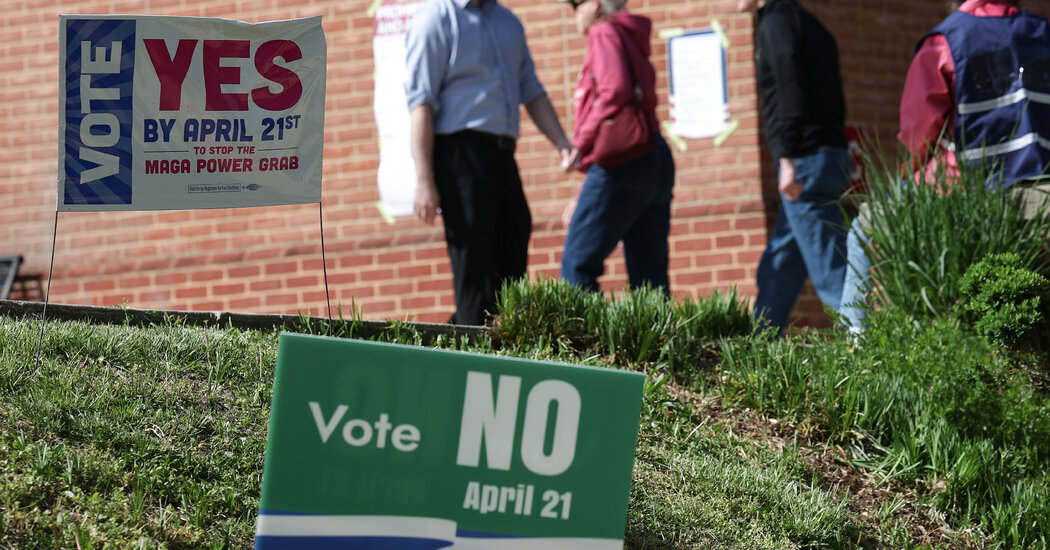
The Virginia Supreme Court on Friday struck down a voter-approved measure allowing Democratic state lawmakers to gerrymander the state’s House map before the midterms.
The 4-to-3 ruling was a huge blow to Democrats’ efforts to keep up with Republicans in a nationwide redistricting battle. It came just 17 days after Virginia voters passed the referendum, which could have paved the way for Democrats to flip up to four Republican-held seats in the state in November.
Here are four takeaways on the decision:
Democrats face yet another big setback in the gerrymandering war.
After the referendum passed by about three percentage points last month, it appeared that Democrats had fought Republicans to a rough draw in a nationwide mid-decade gerrymandering battle that Republican state lawmakers in Texas started last year at President Trump’s urging. Frustrated Republicans were wondering if it was all worth it.
Not so anymore.
A U.S. Supreme Court decision in late April that weakened the landmark Voting Rights Act has emboldened Republicans in Tennessee, Alabama and Louisiana to try to redraw congressional districts to their advantage. Republicans in South Carolina have also started exploring the possibility of new maps ahead of the midterms.
And after the decision out of Virginia on Friday, one of Democrats’ biggest successes in the gerrymandering chess match has been wiped away. The Democratic-drawn map would have left the state with only one safe Republican seat. The House delegation currently comprises six Democrats and five Republicans.
“Huge win for the Republican Party, and America, in Virginia,” Mr. Trump wrote on social media.
Republicans have reclaimed a gerrymandering advantage, but that might not save them in the midterms.
Nationally, the contours of the map are getting tougher for Democrats, but the midterm picture for Republicans remains far from rosy.
When the dust settles on the redistricting fight ahead of the midterms, Democrats could end up losing at least half a dozen safe seats, and possibly more, depending on factors including the passage of new maps in the Southern states favoring Republicans.
But that tells only part of the story in the battle for control of the House.
Republicans are battling headwinds posed by Mr. Trump’s poor approval ratings, the unpopular war in Iran and rising energy prices.
Many swing-district Republicans have been fretting about how the war will affect their chances in November. The conflict has alienated some leading conservative voices, and Republican candidates have been exasperated by Mr. Trump’s fight with Pope Leo XIV over the war.
Virginia’s top court said the referendum was set too late.
In its decision, the Virginia Supreme Court said the problem with the referendum was that state lawmakers first voted to begin the process after early voting started in last fall’s legislative contests.
The process needed to be set in motion before the election began, according to state law. The legal arguments turned heavily on the meaning of an election: Did the election start on Election Day, or at the start of early voting?
The court said it started with early voting.
It noted that by the time state lawmakers voted on the referendum, more than 1.3 million ballots had been cast in the November 2025 election.
The court’s move was unusual because it came after voters had already weighed in directly on the referendum. But the court’s majority said in its opinion that it was simply following the request of the Democratic-controlled state government by waiting to resolve the issue after the referendum.
“It is fair to ask whether we could have or should have reviewed the constitutionality of the proposed amendment prior to it being presented to the voters,” the court’s majority opinion said, but it noted that “Throughout this litigation, the Commonwealth has insisted that we cannot lawfully decide this case prior to the referendum.”
In Virginia, there was some precedent for the court’s move. In 1958, the Virginia Supreme Court reversed a referendum concerning bonds.
The legal battle might not be over.
Late Friday afternoon, lawyers for the state of Virginia said in a filing to the Virginia Supreme Court that they intended to file an emergency petition to the U.S. Supreme Court, which is deep into its term.
The U.S. Supreme Court has a conservative supermajority, but has shown tolerance in recent years for partisan maneuvering in gerrymandering. It has already upheld a Republican-drawn congressional map in Texas and a Democratic-drawn map in California.
But legal experts said Democrats could face a challenge in persuading the court that it should consider the matter: The Virginia case turned on state law, rather than federal law.
Richard Hasen, an election law expert at the University of California, Los Angeles, said lawyers for the Virginia government could argue that the state court was interfering with the power of the state legislature, but he called the argument a “long shot.”
The office of Jay Jones, the Virginia attorney general and a Democrat, said it was considering its legal avenues for a challenge.
Maureen Edobor, an election law expert at Washington and Lee University School of Law, emphasized that the U.S. Supreme Court had repeatedly shown openness to allowing last-minute redrawing, and compared the Virginia effort to the one in California. But, she added, given the court’s conservative tilt, “I don’t think it looks good for the Democrats.”
Nick Corasaniti contributed reporting.