
New York City Ballet’s spring gala was a little different this year. At the David H. Koch Theater on Thursday, along with the usual donor-thanking speeches, Jimmy Fallon did an impersonation of Mick Jagger with Jagger standing beside him. The star violinist Hilary Hahn was down in the orchestra pit. More important, there was a major premiere, the sophomore effort by an increasingly important choreographer: Tiler Peck.
Peck herself is a rarity: a star ballerina, still in her performing prime, creating major ballets for her own company. Her first work for City Ballet, “Concerto for Two Pianos,” which debuted in 2024, was accomplished right out of the gate — sparklingly classical, uncommonly musical. It was no fluke. Her new piece, “Symphonie Espagnole,” is bigger and better.
With a cast of 40, the ballet is big in a particular way. Classical in style, it has a structure favored by City Ballet’s founding choreographer, George Balanchine. Each of the first four movements of Édouard Lalo’s “Symphonie Espagnole”— a concerto-like work requiring a virtuoso violinist (Hahn at select performances) — features different lead dancers, and then the whole cast comes together for the stage-filling finale.
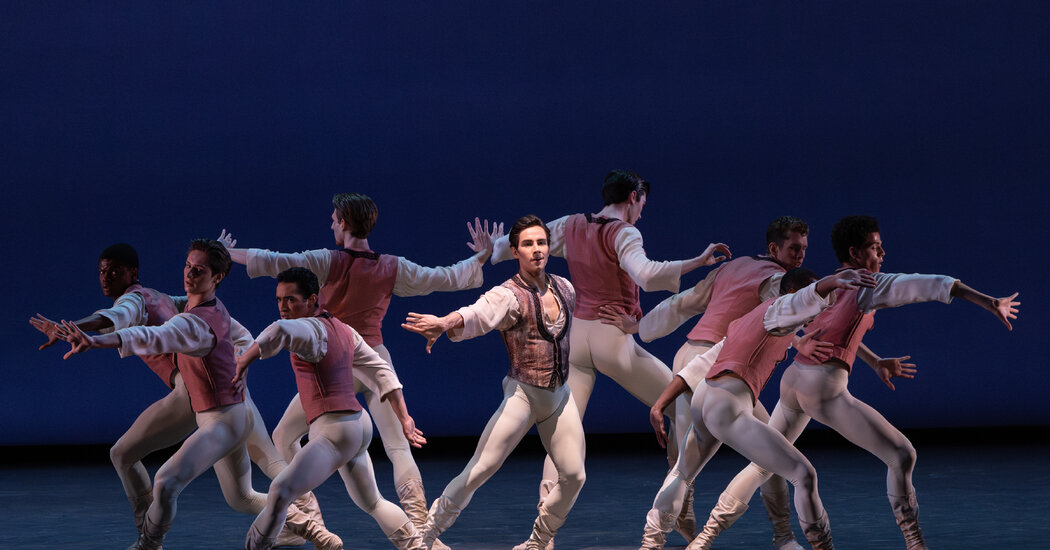
Peck knows how this works. She opens with a frisky lead couple (Emma Von Enck and Joseph Gordon), and gives the next two movements to a woman (Kloe Walker) backed by women and then a man (Roman Mejia) backed by men, before sinking into a pas de deux (Mira Nadon and Ryan Tomash) accompanied by three couples.
Deploying the conventions adeptly, Peck adds her own touches. The costumes by Robert Perdziola put one group of women in tutus and another in flowing dresses, where most classical ballets chose one mode. Peck borrows formations from Balanchine as Balanchine did from Marius Petipa, but she selects some unusual ones, like putting a lead dancer on one side of the stage and the corps dancers on the other. And she develops her own ideas, often having the corps echo the lead’s steps, sometimes in a domino succession that can usher the lead right off the stage.
For all its exciting scale, what’s most remarkable about the ballet is actually its restraint. Peck uses Spanish spice sparingly — a few finger snaps, some tasteful stamping — and the style flows from the music through the limbs, giving a swoony accent to the torso, a full-body snap to sudden twists. The details shimmer. Brandon Stirling Baker’s characteristically sensitive lighting helps all this stay clear but subtle.
And that subtlety is in exciting tension with a continual push toward density and difficulty. Peck is clearly trying to showcase the company’s classical technique, and the steps for everyone are hard. To the leads, she gives aspects of her own dancing prowess. Von Enck gets her speed, matching the fleetness of the solo violin. Walker, a corps member in a breakout role, gets her upper body amplitude and plush.
Nadon, already a major ballerina in her own right, takes Peck’s continuity of impulse into her own deepening elegance. That’s lovely to see, but what’s more surprising is how Mejia, Peck’s husband, is given qualities that are traditionally seen as more feminine. Even in bravura steps, he and the men around him move with pastel softness and delicate, beautiful ease.
The finale is a thrill, but just as its final pose takes a moment to settle into place, so “Symphonie Espagnole” is a portrait of a choreographer still adjusting, still learning. She’s working out proportions, where to follow her impulses and where to resist them; there’s too much in some spots, not enough in others. But something that Hahn said about the violin part — that it’s virtuosic but so well written that you can just run with it — is true of Peck’s choreography. She can push the envelope without losing the flow.
Hahn’s comment came during one of City Ballet’s “See the Music” segments, in which the orchestra is raised and the music director, Andrew Litton, talks about one of the evening’s scores. In this case, the score was “Symphonie Espagnole,” and Hahn was a terrific addition, illuminating and casually eloquent.
Then came Fallon and Jagger and a video connecting “Symphonie Espagnole” to the program’s other ballet, Balanchine’s “Diamonds.” While the performance of “Diamonds” wasn’t brilliant — Chun Wai Chan was great, but Isabella LaFreniere was lacking in mystery — it was a reminder that Balanchine sets the high bar against which all works at City Ballet must ultimately be judged. What “Diamonds” has that “Symphonie Espagnole” doesn’t isn’t just a surer sense of proportions. It’s poetic suggestion and resonance. “Diamonds” evokes not only the steps, structures and musical acuity of ballet tradition but the whole culture behind them.
“Symphonie Espagnole” isn’t art of that caliber, but it’s nevertheless an achievement worth applauding and seeing again. It’s a keeper.
New York City Ballet
Through May 31 at the David H. Koch Theater; nycballet.com.