
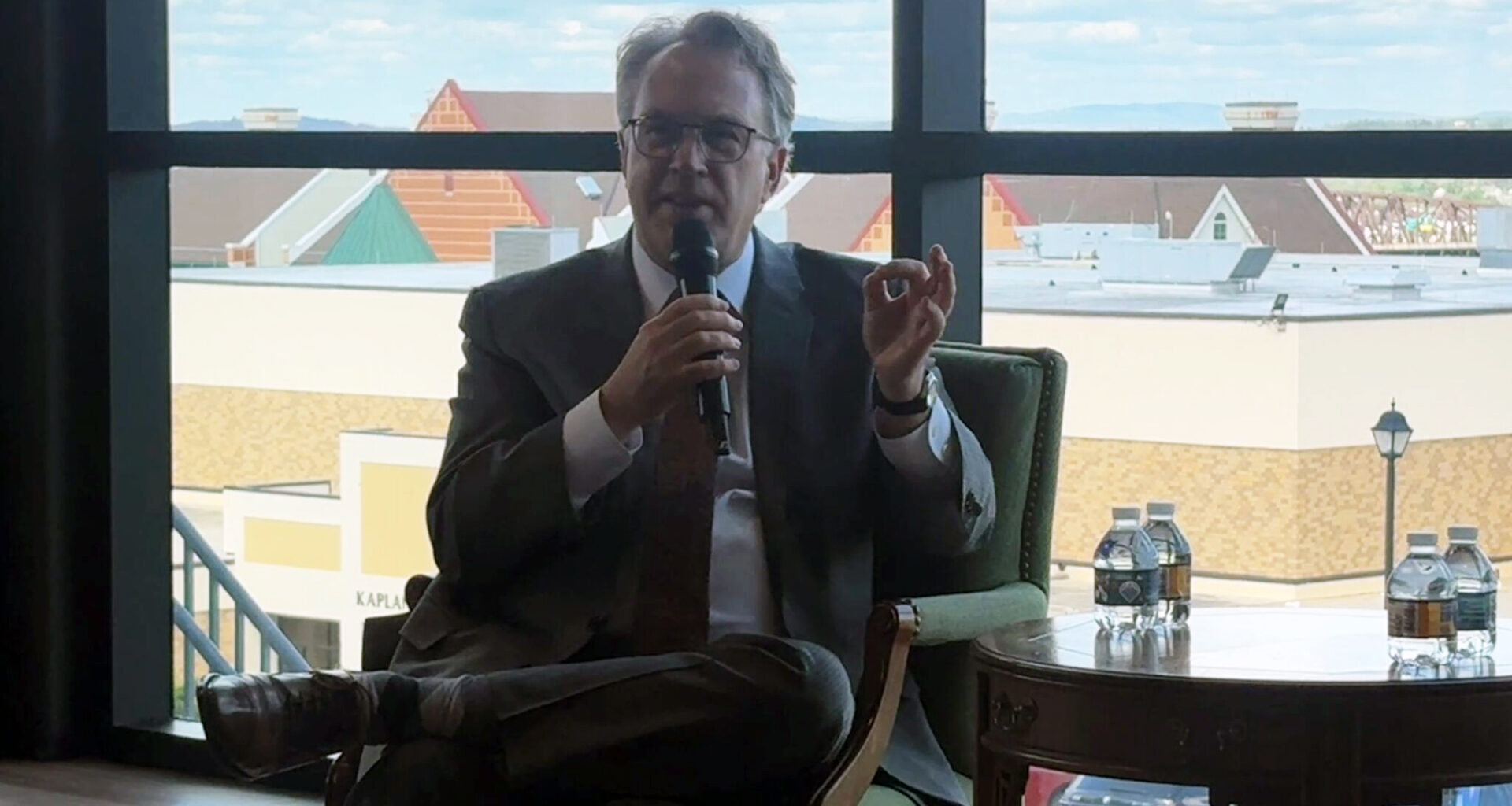
Federal Reserve Bank of New York President John C. Williams discusses the local and national economy at an event in Newburgh on Thursday.
Roger Hannigan Gilson/Times Union
NEWBURGH — One of the country’s most prominent financial policymakers visited Orange County on Thursday for a discussion on the national economy and the Hudson Valley’s economic challenges.

John C. Williams, president of the New York Federal Reserve, spoke about housing shortages, affordability pressures, demographic change and artificial intelligence during a wide-ranging discussion with Adam Bosch, outgoing executive director of the think tank Hudson Valley Pattern for Progress, in front of local officials and business leaders. The event was part of a daylong visit that also included a stop at Legoland New York in Goshen, focused on tourism.
Article continues below this ad
Williams leads one of 12 regional Federal Reserve banks that, along with the Washington-based Board of Governors, form the Federal Reserve System. The New York Fed covers New York state, 12 northern New Jersey counties, Fairfield County in Connecticut, Puerto Rico and the U.S. Virgin Islands.
In remarks during the discussion and in an interview with the Times Union, Williams described the national economy as showing “remarkable resilience.” He said inflation had been easing before “being interrupted” by tariffs and rising energy prices, but pointed to steady GDP growth and a strong labor market. The GDP grew 2% in the first quarter of 2026. Inflation reached 3.3% in March, up from 2.4% in February, largely driven by rising energy costs, according to the U.S. Bureau of Labor Statistics.
A consistent theme in his conversations across Orange County, Williams said, was the high cost of housing. The Hudson Valley’s housing market surged during the pandemic as remote work prompted an influx of new residents, fueling bidding wars and tightening rental supply. By 2025, a single full-time worker earning average wages could not afford a one-bedroom apartment in any county in the region without spending more than 30% of their income.
Make the Times Union a Preferred Source on Google to see more of our journalism when you search.
Add Preferred Source
Williams said the problem was fundamentally about supply, with New York facing particular constraints, including permitting and local approvals.
Article continues below this ad
“You definitely hear it’s a challenging process — it takes a long time in terms of getting those approvals,” he said. “So when you hear the red tape arguments, I think that’s true in the New York area.”
He also pointed to NIMBYism — “not in my backyard” opposition — as a barrier to new housing development. Asked whether local control over permitting should be reduced, Williams declined to weigh in.
Williams also addressed demographic shifts in the Hudson Valley. At least 50 schools in the nine-county region have closed since 1999 due to population changes. Columbia County is the second-oldest county in the state, with a mean age of 50.4 years.
The Fed president said Americans are living longer and healthier lives, and more people are choosing to work past the traditional retirement age of 65, which could help support labor force growth.
Article continues below this ad
Responding to an audience question about the national debt — now larger than GDP — Williams said it is not currently disrupting financial markets. He noted that U.S. Treasury securities remain in strong demand and are widely trusted. And while he said long-term deficits will eventually need to be addressed, he added that doing so “takes political will” and described the debt as “not an immediate issue.”
Asked by a Times Union reporter about artificial intelligence and its impact on jobs, Williams said the long-term effects remain uncertain. While AI is likely to automate lower-level tasks and serve as an “equalizer” by allowing more people to write code without advanced technical training, Williams suggested it could also reshape education and labor demand, potentially elevating liberal arts, more skilled trades and “soft skills” like communication and leadership as automation expands.
The theme of adaptation ran throughout Williams’ remarks. He praised efforts to repurpose vacant industrial buildings in Newburgh and cautioned against nostalgia, instead urging openness to change.
Article continues below this ad
That perspective extended to AI.
“I think the only thing that can go really wrong (with AI) is if you say: ‘I don’t want to learn this, I don’t get this AI stuff,’” Williams said. “I think that will reduce one’s ability to get a good job.”