
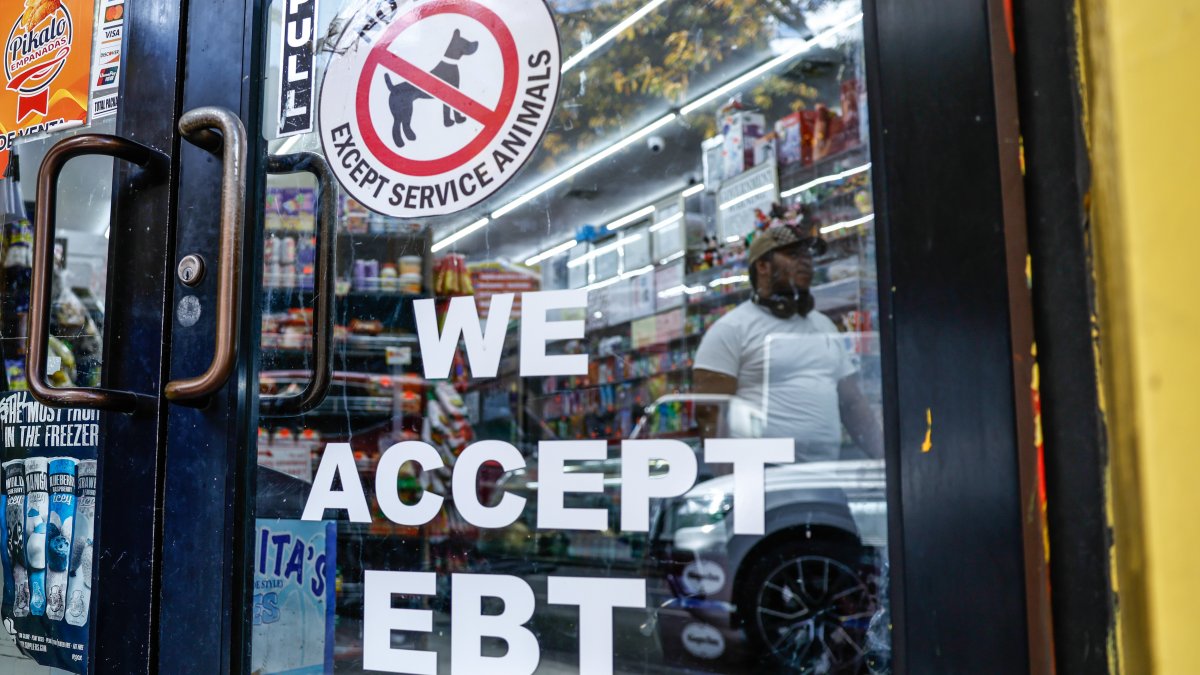
Gov. Kathy Hochul declared a state of emergency for New York on Thursday, days before SNAP benefits and other assistance are set to dry out amid the ongoing, and historic, federal government shutdown.
The Democrat also pledged more financial assistance — $65 million in new state funds — to support food banks, soup kitchens, and more outlets trying to help families get emergency food assistance if it halts on Saturday.
It would be the first time in U.S. history that a federal administration has stopped food assistance during a government shutdown. And it comes just a few weeks before Thanksgiving.
Hochul’s newly announced infusion comes on top of a more than $40 million investment announced over the last week and a half, bringing the total allocated state funds to this SNAP response to $106 million, her office says.
The additional investments hope to provide about 40 million meals to New Yorkers. New short-term crisis response positions are also expected within the Empire State Service Corps to help address shortages.
“The Trump Administration is cutting food assistance off for three million New Yorkers, leaving our state to face an unprecedented public health crisis and hurting our grocers, bodegas and farmers along the way,” Hochul said in a statement. “Unlike Washington Republicans, I won’t sit idly by as families struggle to put food on the table.
“Today, I’m declaring a state of emergency and am committing additional state funds for emergency food assistance to ensure New Yorkers don’t go hungry,” she added.
Some other states have rolled out similar assistance efforts. About one in eight Americans buy groceries with SNAP benefits. A halt to SNAP benefits would leave a gaping hole in the country’s safety net.
Earlier this week, New York and 24 other states sued the Trump administration, demanding the release of emergency SNAP funds. Here’s a look at what would happen if that doesn’t happen.
Democratic officials sue
Tuesday’s legal filing from attorneys general from 22 states and the District of Columbia, plus three governors, focuses on a federal contingency fund with roughly $5 billion in it – enough to pay for the benefits for more than half a month.
President Donald Trump’s Department of Agriculture said in September that its plan for a shutdown included using the money to keep SNAP running. But in a memo last week, it said that it couldn’t legally use that money for such a purpose.
The Democratic officials contend the administration is legally required to keep benefits going as long as it has funding.
The agency said debit cards beneficiaries use as part of SNAP to buy groceries will not be reloaded as of Nov. 1.
With their own coalition, 19 Republican state attorneys general sent Democratic U.S. Senate Minority Leader Chuck Schumer a letter Tuesday urging passage of a “clean continuing resolution” to keep funding SNAP benefits.
SNAP benefits could leave millions without money for food
Most SNAP participants are families with children, more than 1 in 3 include older adults or someone with a disability, and close to 2 in 5 are households where someone is employed. Most have incomes that put them below the poverty line, about $32,000 in income for a family of four, according to an analysis by the Center on Budget and Policy Priorities.
The average monthly benefit is $187 per person.
Beneficiaries say that without the aid, they’ll be forced to choose between buying food and paying other bills. Food banks are preparing for a spike in demand that they’ll have to navigate with decreased federal aid themselves.
The debit cards are recharged in slightly different ways in each state. Not everyone receives their benefits on the first day of the month, though many beneficiaries get them early in the month.
States expect retailers will be able to accept cards with balances on them, even if they’re not replenished.
Some states seeking to fill void of SNAP benefit cuts
State governments controlled by both Democrats and Republicans are scrambling to help recipients. But several say they don’t have the technical ability to fund the regular benefits.
Officials in Louisiana, Vermont and Virginia have pledged to provide some type of backup food aid for recipients even while the shutdown stalls the federal program, though state-level details haven’t been announced.
More funding for food banks and pantries is planned in states including New Hampshire, Minnesota, California, New Mexico, Connecticut and New York.
The USDA advised Friday that states won’t be reimbursed for funding the benefits.
Republican South Carolina Gov. Henry McMaster announced Tuesday that the state is opening a nonprofit fund typically used for disasters to give grants to food banks. But the fund is empty and will need immediate donations. Last year, it raised $6 million for Hurricane Helene relief. Each month, more than $100 million in SNAP benefits are delivered in South Carolina.
In Pennsylvania, where a budget stalemate has held up more than $25 million in aid to food banks, Democratic lawmakers are pushing for $60 million in emergency aid for food banks and meals on wheels programs.
The Trump administration is blaming Democrats, who say they will not agree to reopen the government until Republicans negotiate with them on extending expiring subsidies under the Affordable Care Act. Republicans say Democrats must first agree to reopen the government before negotiation.
Food aid for mothers and young children
Another food aid program supporting millions of low-income mothers and young children already received an infusion to keep the program open through the end of October, but even that money is set to run out early next month.
The Special Supplemental Nutrition Program for Women, Infants and Children helps more than 6 million low-income mothers, young children and expectant parents purchase nutritious staples such as fruits and vegetables, low-fat milk and infant formula.
The program, known as WIC, risked running out of money in October because of the shutdown. The Trump administration reassigned $300 million keep the program afloat. But it was only enough for a few weeks.
Now, states say they could run out of WIC money as early as Nov. 8.
___
Mattise reported from Nashville, Tennessee. Mulvihill reported from Haddonfield, New Jersey. Contributors include Jeffrey Collins in West Columbia, South Carolina, and Margery Beck in Omaha, Nebraska.
___