
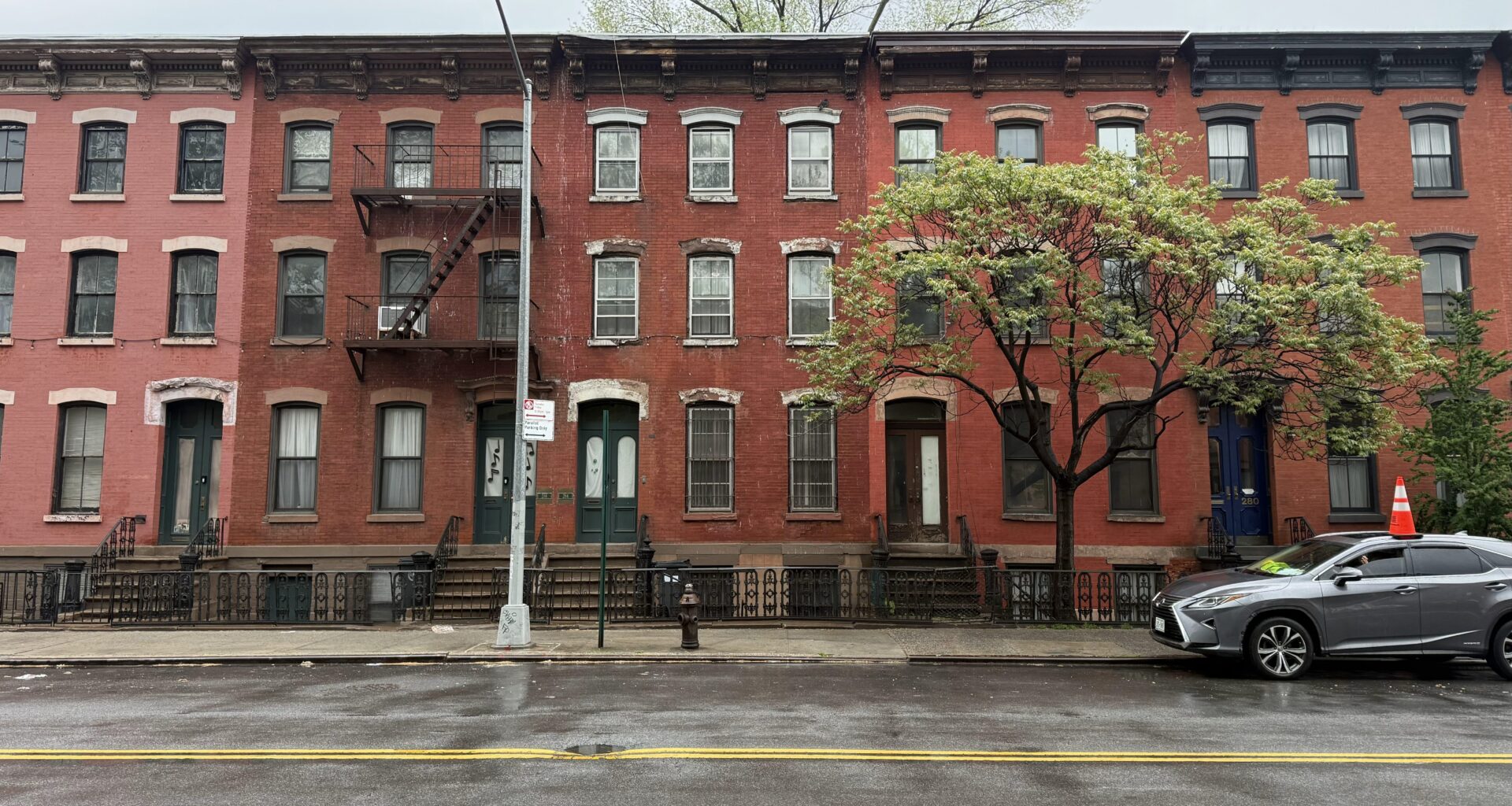
They look like the kind of row houses that make Greenwich Village and the Upper West Side so picturesque—elegant stone facades, rounded archways, pops of stained glass, and cast iron railings on stoops and balconies.

But this four-block span of loveliness, built between the 1860s and the 1890s, is part of the Mott Haven neighborhood of the South Bronx.
Though it’s just across the Harlem River from Manhattan, Mott Haven is an enclave that still lives with its 1970s reputation of brokenness. Not many New Yorkers know of its remarkably well-kept Gilded Age houses whose lines, shapes, and colors create a rhythm of flow and beauty.

All this harmony is centered around Alexander Avenue between 137th and 141st Streets. In the late 19th century, this stretch earned the nickname “the Irish Fifth Avenue” for the well-off second- and third-generation Irish immigrants who made their homes here.
Alexander Avenue was also known as “Politicians’ Row” and “Doctors’ Row,” which can give you an idea of the elite professionals who occupied the parlors and bed chambers of these fine houses.

The houses are a far cry from the rural Mott Haven of the early 19th century, when the Bronx was part of Westchester County. In 1828, the landowning Morris family sold a vast tract of countryside to ironworks pioneer Jordan Mott, who invented the first “practical” coal oven.
“Mott was the first major industrialist to locate in The Bronx,” states the 1966 Landmarks Preservation Commission (LPC) report on Mott Haven. “Although the Morris family sold Mott the land for his foundry, his industrialism was resented as a crass intrusion into the quiet, rural countryside.”

That didn’t stop Mott, who renamed the area after himself and reshaped the riverfront by building canals where ships could deliver raw materials to his foundry.
He also took advantage of his proximity to the new New York and Harlem Railroad line, according to the Historic Districts Council.
With business growing, his foundry (at left) attracted workers—particularly unskilled immigrant laborers, many of the them Irish, who came to live in newly christened Mott Haven.
The first of the row houses, numbers 276-274 between 139th and 140th Streets, went up during the Civil War (second photo). They likely weren’t occiupied by the unskilled laborers.

“This row represents an important bit of urban design because, although the concept of ‘suburbs’ had not really developed in the 19th century, the owner foresaw that this prlmarily rural area would one day become strictly urban and, accordingly, constructed his houses in a uniform row,” notes the LPC report.
“The houses were built in tho local vernacular with French Second Empire influence and were designed as a block front, rather than as distinct, individual houses.”

After the 1874 annexing of Mott Haven and other Bronx neighborhoods to New York, as well as the arrival of the Third Avenue El in the 1880s, more rows went up. Numbers 263-273 are a Victorian Gothic riot aligned at the cornices and slate roofs.
It’s almost unreadable now, but on the tower at the end of the row (third photo) is a pediment that once spelled out “tower block” in terra cotta.
Another row of 12 (fifth photo), described as “French neo-Grec to Queen Anne,” span numbers 277 to 299. “All the paired stoops, except those at Nos. 281-283, retain their original iron hand railings and imposing cast iron newel posts,” per the LPC.

The Irish Fifth Avenue remained prominent as the 1900s began, and new rows joined older houses. Three churches framed the row: St. Jerome’s, a Catholic church; Alexander Avenue Baptist Church; and St. Mary’s Episcopal Church.
By the early decades of the 20th century, population density brought tenement buildings, and soon the doctors and politicians were relocating from their row houses.

Families of various ethnicities, including a sizable number of Puerto Rican residents, began replacing the Irish.
The two black and white photos show the former Irish Fifth Avenue around 1940. In the second photo, St. Mary’s church is visible on the left; the church and the row adjacent to it would eventually fall to the wrecking ball and be replaced by one of the many high-rise NYCHA buildings that now ring Alexander Avenue.

These days, there’s a small-scale vitality to this stretch of Alexander Avenue. Not all the houses are in perfect shape, but almost all retain their historical detail, which allows curious New Yorkers to time-travel to Irish Fifth Avenue in its heyday.
It’s not just the historical backstory that gives the row its appeal but the symmetry and harmony of so many homes.
“Despite the fact that designs range through a wide variety of revival styles and include those buiIt in the local vernacular, there are common denominators of scale, materials, and the high quality of craftsmanship, which give the district a remarkable degree of unity,” states the LPC report.
[Fourth image: PICRYL-Public Domain Media; sixth photo: NYC Department of Records & Information Services; seventh photo: NYPL Digital Collections]
Tags: Doctors’ Row Mott Haven, Irish Fifth Avenue Mott Haven, Most Beautiful Row Houses Bronx, Most Beautiful Row Houses in Bronx, Mott Haven Historic District, Mott Ironworks history Bronx, Politicians Row Mott Haven, South Bronx Row Houses
This entry was posted on May 11, 2026 at 2:52 am and is filed under Bronx and City Island. You can follow any responses to this entry through the RSS 2.0 feed.
You can leave a response, or trackback from your own site.