
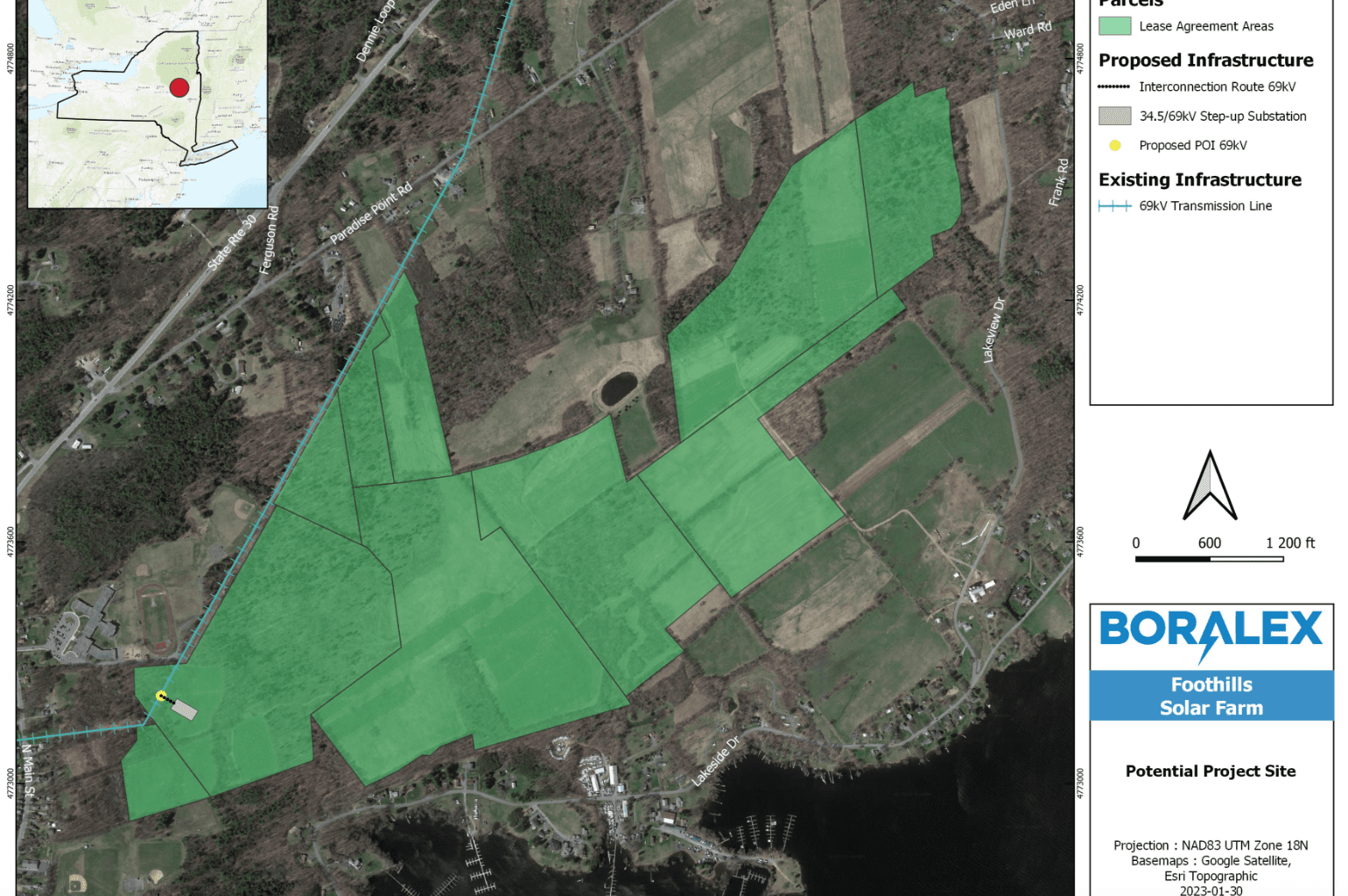
High tariffs, federal and state policy changes and increased costs of connecting to the electrical grid have suspended the largest permitted solar project in the Adirondack Park.
The planned 40-megawatt facility is slated to harvest the sun’s power on about 200 acres of the Close brothers’ 800-acre dairy farm, a fifth-generation operation that overlooks Great Sacandaga Lake in the town of Mayfield.
Canadian solar developer Boralex received its permit through the state Office of Renewable Energy Siting and Electric Transmission (ORES) last April. The permit for the project, called Foothills Solar, requires commercial operation within seven years.
But site work has been stagnant, and Boralex spokesperson Zack Hutchins confirmed that conditions to build are not ideal at this time.
“We want to make it happen,” Hutchins said. “We’re just dealing with the realities right now of the costs associated with this type of development.”
Farmer Jon Close, who has a lease with Boralex to supplement the income of his 70-cow dairy, said the economics of the solar project is another side effect of “the way the world is” these days. He likened the project to making stew in a crock pot and waiting for some of the ingredients to cook a while longer.
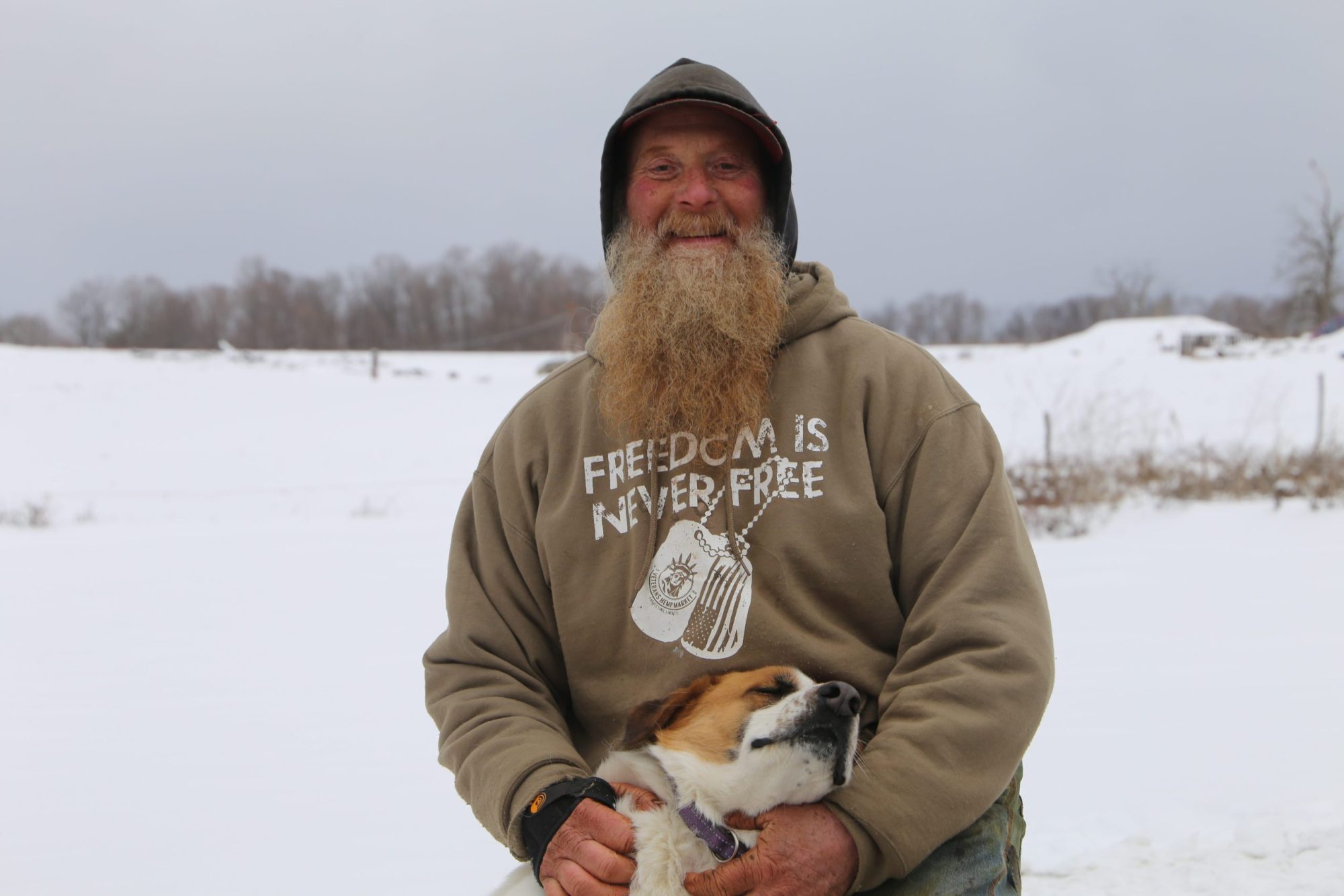 Jon Close, a fifth-generation dairy farmer in Mayfield, is leasing some of his land on Great Sacandaga Lake to host the largest solar project proposed yet in the Adirondack Park. Photo by Gwendolyn Craig
A bottleneck of renewable projects
One of the problems: A flood of projects in various stages of development, all jockeying for access to the state’s electrical grid.
The New York Independent System Operator (NYISO) is a nonprofit organization that keeps track of the state’s electrical grid.
NYISO conducts engineering and electrical studies of major projects connecting to New York’s grid to ensure the grid capacity is there and determine what infrastructure might need upgrading. Before the state passed the 2019 Climate Leadership and Community Protection Act, NYISO had just a few projects to review each year.
But once the state became a staunch promoter of renewable energy projects, NYISO became flooded with hundreds of projects to study, all at different levels in the review process. Some developers didn’t even own the land or have a lease in place for where they were proposing a project.
Marguerite Wells, executive director of the Alliance for Clean Energy New York, said energy developers were “throwing spaghetti at the wall to see what stuck.”
“NYISO was tired of having a backlog of projects that were not real, and yet they were having to spend time and effort studying them as if they were real, only to discover that the developers had already walked away and weren’t serious anymore,” Wells said.
New fees around grid connections
As a result, NYISO began a new process called a cluster study. The two-year review involves looking at all energy projects intending to connect to the grid. There are fees to join the study and steep fines for leaving the study. The financial collateral is intended to focus NYISO’s time and effort on serious projects and weed out the more speculative ones.
The first round of projects are currently in the second year of the cluster study.
Kevin Lanahan, senior vice president of external affairs and corporate communications for NYISO, said: “Improvements to the Cluster Study process continues to be a top priority for the NYISO.”
Wells said the changes have helped the state hone in on projects that are ready. This summer, New York will see the most construction of renewable energy projects in its history, she said.
Rising costs from tariffs, inflation add to grid charges
With its ORES permit in hand and Close waiting for panels to arrive, it’s hard to put the Foothills Solar project in the speculative category. But without the grid study, Boralex is unable to bid for a contract with the New York State Energy Research and Development Authority (NYSERDA) to move forward.
For Boralex, the changing process has meant more money for a smaller return at a time when high tariffs and inflation are impacting development across the board.
While the 40-megawatt project is twice the size of the next largest permitted solar facility in the Adirondack Park, by statewide standards, the project is small.
No matter the size of a project, the costs for grid upgrades don’t scale, Hutchins added. Foothills Solar was originally part of NYISO’s first cluster study, but Boralex backed out.
“For a 200-megawatt project like one of the ones we’re developing up near the Canadian border, the interconnection costs can be near or similar to a 40-megawatt project like Foothills Solar,” Hutchins said. “A 200-megawatt project can absorb that cost farther than a 40-megawatt one can.”
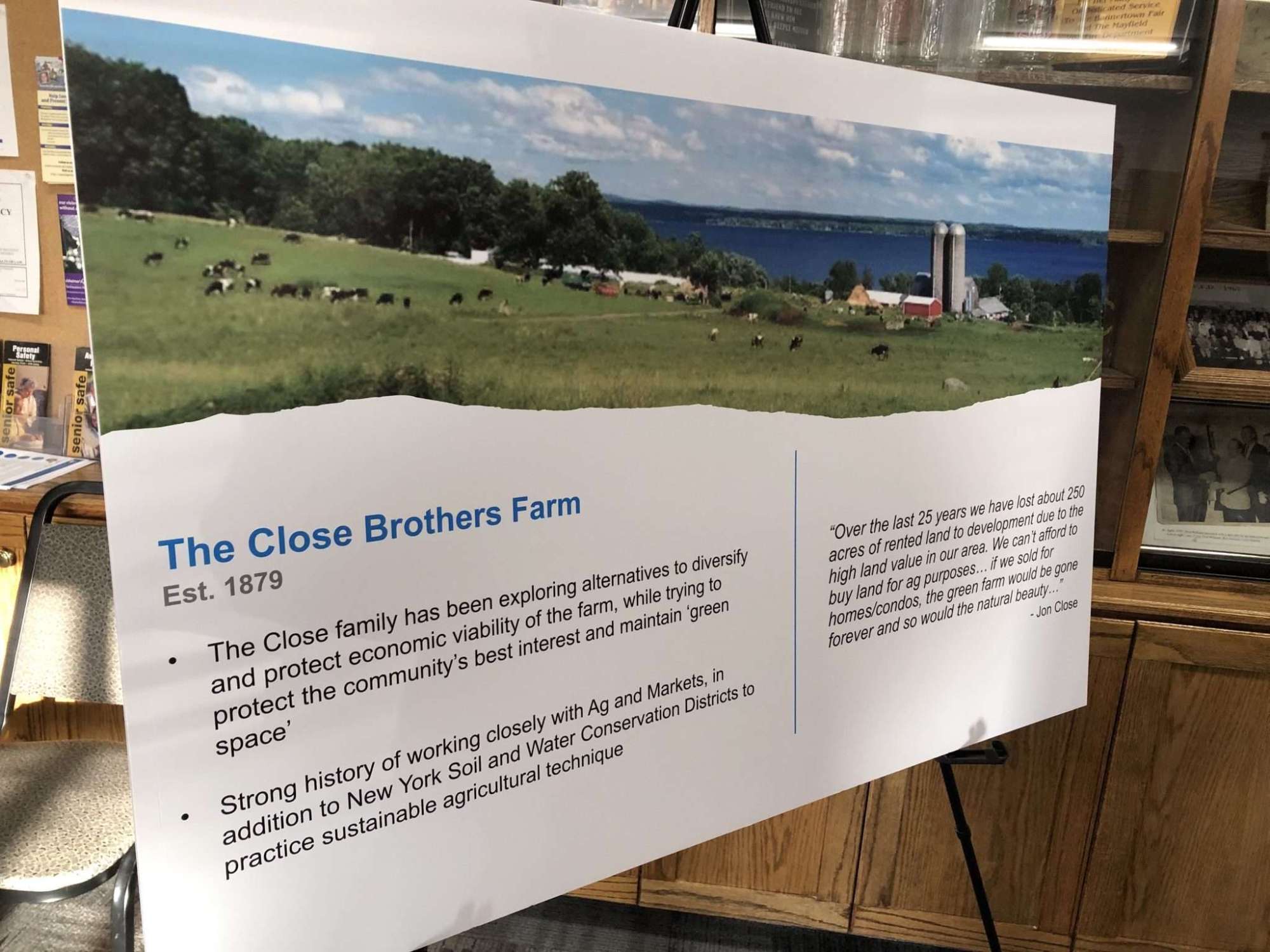 A poster board during an open house on a 40-megawatt solar project shows the Close Brothers Farm in Mayfield. Photo by Gwendolyn Craig
Hutchins hopes that the renewable energy industry, the state and utility companies can work together on minimizing the cost of upgrades or finding a way to share the costs across projects.
Wells said ACENY is currently studying why so many projects withdrew from NYISO’s first cluster study, suspecting the study began to show a high price tag for connecting to the grid. Wells said she’s unsure why utility companies have quoted such high costs. In some cases she thinks they have quadrupled in price from what she normally would have expected.
“If that trend continues, we’re not going to build any more projects, Adirondack Park or not,” she said.
On Thursday, Close said he was looking at the sun shining on Great Sacandaga Lake. He’d been up early preparing to plant corn. Inflation and tariffs have hit his farming business, too. He has added beef cows to the mix. Selling milk isn’t enough on its own at his dairy’s size, and Close doesn’t want a bigger herd.
He said he’s optimistic that Boralex will get panels up soon.
“Everybody’s in the same boat,” he said. “We just all are going to have to get through it.”