
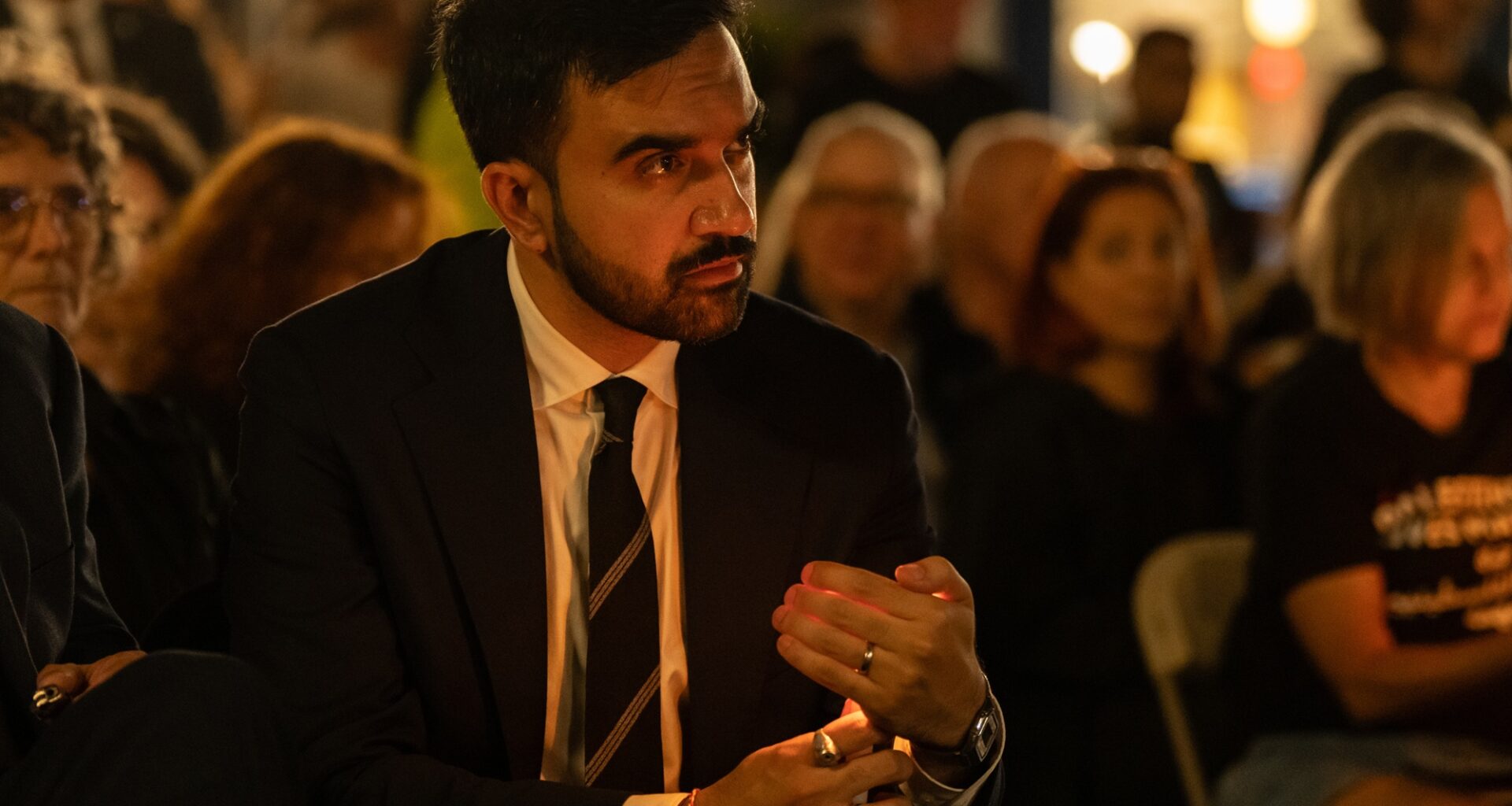
“I will be the mayor who doesn’t just protect Jewish New Yorkers, but also celebrates and cherishes them,” said Zohran Mamdani during New York’s first general-election debate for mayor. Since he launched his campaign in October of 2024, however, Mamdani has faced a barrage of criticism, apprehension, and even attempts to demean his character in response to his views on Israel.
Mamdani’s platform has focused narrowly on innovative policies to make New York, one of the world’s most expensive cities, more affordable and inclusive for all. From rent freezes to raising the minimum wage, free child care for all to hiking taxes on corporations and the one percent, Mamdani consistently presents an articulate progressive vision for the city’s future. The excitement created by his campaign, for which an astonishing 90,000 volunteers have walked precincts and staffed phone banks, has reverberated across the country. But in New York—the historic gateway for immigrants from across the world—support for and opposition to the regimes from which those immigrants came, and New Yorkers’ ties to friends and relatives in other countries, have long been part and parcel of the city’s politics.
Unlike his opponents in the mayoral race, Mamdani has offered perspectives on Israel, Zionism, and antisemitism that have upset and even alarmed some voters. Although he has never denied that the state of Israel has a right to exist, he simultaneously has not affirmed that it should exist as a Jewish state. Mamdani is forthright in his opposition to Israel’s use of violence against the Palestinian people, and has classified the ongoing war in Gaza as a “genocide.” He also has not swayed from his support for the boycott, divestment, and sanctions movement, which aims to pressure Israel so that the state may comply with international law. When it comes to New York’s institutional ties to Israel, Mamdani wants to deviate from the past practice of the city’s mayors, who supported initiatives such as the NYC-Israel Economic Council and the NYPD’s police exchange programs. Perhaps the most remarkable promise Mamdani has made is to arrest Israeli Prime Minister Benjamin Netanyahu if he ever enters the city.
Instead of marketing himself as an ally to Israel, Mamdani has instead channeled his energy into targeting many of the everyday concerns of Jewish New Yorkers. According to data released by the NYPD, Jews were the primary target of hate crimes reported (hate crimes remain largely underreported across the board) in the city in 2024, constituting nearly 54 percent of the hate crimes counted. He has called for increasing funding for hate violence programs from $3 million to $26 million. He has also signified support for the implementation of the “Hidden Voices” program, which would teach students from kindergarten through 12th grade about Jewish Americans in U.S. history. On the second anniversary of the October 7th attacks, Mamdani released a statement mourning those killed in both Israel and occupied Palestine, and he has repeatedly expressed a continued commitment to condemning antisemitism across the country.
But connecting with voters in an effort to reconcile his opposition to Zionism with his opposition to antisemitism and his support for the city’s Jewish population has not been an easy task. Mamdani’s campaign has been met by significant resistance from Jewish leaders and organizations that take issue with his stance on Israel. A letter signed by over 1,000 rabbis that called for voters to stand up against Mamdani made headlines, arriving in the wake of Rabbi Elliot Cosgrove of the Park Avenue Synagogue’s classification of Mamdani as “a danger to the security of the New York Jewish community.” Dozens of other individuals have expressed their disdain for Mamdani, with no shortage of commentary online about the subject. In recent weeks, these voices have dominated the public conversation about the city’s mayoral race, but the truth about Jewish New Yorkers’ positions on Mamdani is much more complex. In a Fox News poll taken just before the general-election debate, 42 percent of Jewish voters surveyed supported Cuomo, while Mamdani trailed just behind with 38 percent.
That should come as no surprise. Jewish Americans have widely differing viewpoints when it comes to Israel, particularly during the past two decades when that nation has been dominated by right-wing sectarian governments, and most especially during the past two years of the Gaza war. Moreover, New York has long been home to incredibly diverse Jewish communities, most particularly to Reform and secular Jews with progressive viewpoints, as well as to the world’s largest concentration of ultra-Orthodox Jews outside of Israel. Allies such as Brad Lander, the city comptroller who cross-endorsed Mamdani in the primary election, have been acting as the key to the locked door of Jewish communities who are more apprehensive about supporting Mamdani’s candidacy. “Mostly what I’ve done is make introductions so that he could fulfill that pledge he made on the night of the primary to go meet and engage with them, and listen to people,” Lander told the Prospect.
Lander and Mamdani, along with U.S. Rep. Jerry Nadler (D-NY) attended Yom Kippur services hosted by Lab/Shul. They visited Williamsburg, Brooklyn, where they joined the Satmar Hasidic community (whose opposition to Zionism makes it an outlier among the ultra-Orthodox) in observing Sukkot, and attended a vigil on the night of October 7th. Although these efforts, alongside his appearances at events hosted by various Jewish institutions, have garnered mixed results, Lander believes that Mamdani has left a consistent impression on attendees: “He’s picked up some votes, but I think even more than that, he’s put down and built up a platform in an effort to bring people together after the election.”
Instead of marketing himself as an ally of Israel, Mamdani has channeled his energy into targeting the everyday concerns of Jewish New Yorkers.
This has been a vital aspect of Mamdani’s outreach to Jewish voters who have been reluctant to cast their votes for his campaign. It’s a matter of building connections that will last far beyond next week’s election—relationships that can be strengthened over time. Some of these attempts have been highly creative, such as sending out an open letter that was published solely in Yiddish-language newspapers. The campaign’s endorsements from major Jewish progressive figures such as Bernie Sanders, Nadler, and former Manhattan Borough President Ruth Messinger have helped Mamdani cement links with Jews on the left.
Messinger, who was the Democratic nominee for mayor in 1997, and thereafter served as the president of the American Jewish World Service, endorsed Mamdani after the primary. She readily acknowledges that Mamdani is green, but clearly believes he has potential to be an excellent mayor if elected. “In supporting him as strongly as I do,” she told the Prospect, “it’s because I believe he understands the challenges and is committed to building the kind of administration that will do this work.”
Lander emphasized that Mamdani is not opposed to including people who hold various perspectives on issues related to Zionism and Israel in his possible future administration. On the contrary, “he’s been clear that folks with those points of view [perspectives on Israel that do not align with his personal view] are welcome in his administration … He’ll be looking for the best and the brightest and a broad coalition.” There’s room for differences in Mamdani’s potential leadership of the city, Lander said: “You build coalitions and governments across these kinds of disagreements.”
Beyond the interiors of synagogues and community spaces, progressive Jewish advocacy groups have immersed themselves in canvassing campaigns to garner more support for Mamdani from Jewish New Yorkers. Organizations like Jewish Voice for Peace and Jews for Racial & Economic Justice (JFREJ) have sent canvassers out to communities across the city in hopes of bringing Mamdani’s vision for New York to people’s doors. Audrey Sasson, executive director of JFREJ, a nonprofit dedicated to ensuring that the city is equitable and accessible to all, told the Prospect about the outreach being done by the group’s organizers: “We’ve knocked on 6,000 doors and dialed 52,000 numbers. We have over 450 JFREJ volunteers canvassing.”
That outreach has produced fruitful conversations about the mayoral race, said Sasson. “We’re having these really deep conversations at the doors and on the phone that are about wrestling with whatever questions they have … just creating space for people to express what’s most important to them in this election and offering up our perspective on some of the thornier questions that have come up in this election, really talking about our proactive vision of Jewish safety that comes through building a real multiracial democracy.” The conversations, said Sasson, “get to the heart of what are people’s fears.”
Less than a week away from the election, Mamdani is continuing to face significant challenges, but his prospects still look bright. His campaign has brought us to a pivotal moment in American politics, testing the appeal of a progressive and egalitarian politics—when advanced by a charismatic advocate—to voters. At the core of his attempts to connect with Jewish New Yorkers is a vision that has resonated across the lines of race, religion, and ethnicity.
“It’s not a question of him persuading Jewish New Yorkers that he’ll keep us safe,” said Lander, but rather of inspiring the conviction “that the vision of a welcoming, diverse, immigrant-inclusive, multiracial, democratic city is what will keep you safe, what will keep all New Yorkers safe.”
Recommended Reading