
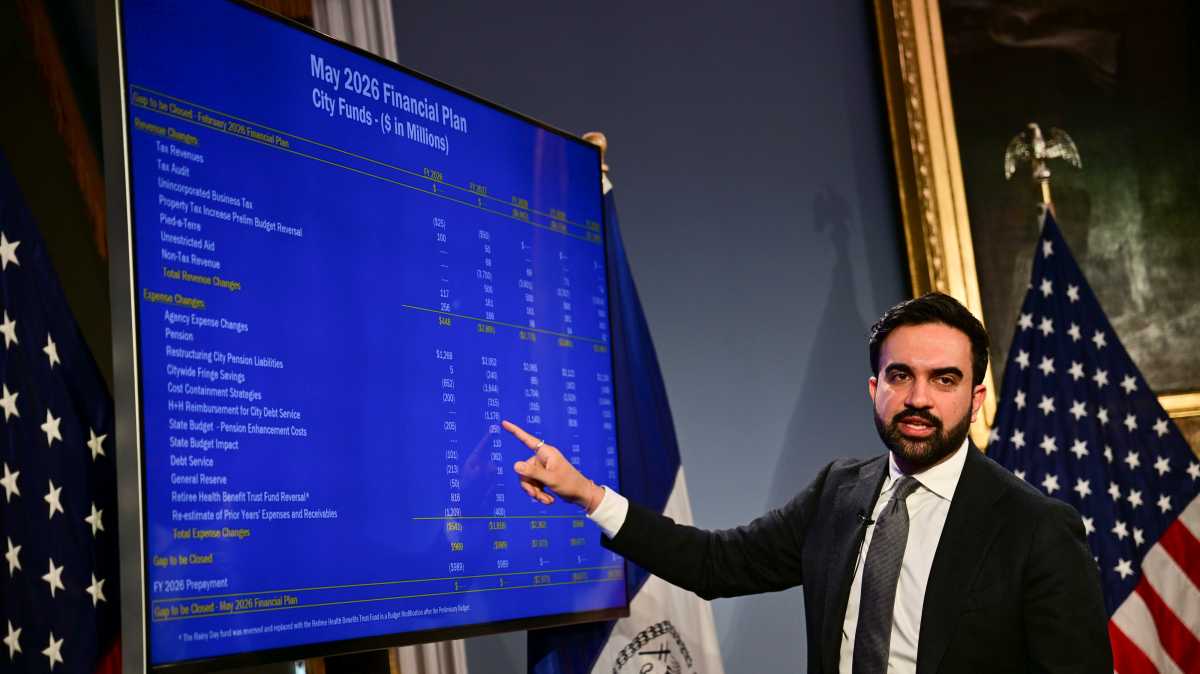
Back in January, just weeks into his administration, Mamdani told New Yorkers the city was caught in a massive budget hole of $12 billion. He blamed the former Adams administration for underbudgeting in previous years and suggested that there were just two ways out of the hole: Finding savings, and raising taxes on the wealthy.
On the savings front, he got to work and directed agencies to trim the fat, appointing “chief savings officers” in each city agency to identify areas that could be cut. Within weeks, Mamdani reported several reductions in the budget deficit; by the time he announced his preliminary budget on Feb. 17, the gap was down to $5.4 billion.
But in that same announcement, Mamdani insisted that the rest would need to be paid for with tax hikes — either through higher taxes on the rich with Albany’s approval, or through a 9.5% property tax increase on every New York City property owner. Almost immediately, Gov. Kathy Hochul and City Council Speaker Julie Menin channeled their inner President George H.W. Bush and effectively told him, “Read our lips, no new taxes.”
Nevertheless, Mamdani stuck to his guns and kept pushing for property tax hikes as a “last resort” if Albany didn’t “tax the rich.” Hochul acquiesced, but only slightly, in approving the pied-a-terre tax on the uber-wealthy for second homes in New York City worth more than $5 million. But a broader, more damaging tax increase on the wealthy or corporations was avoided.
Instead, Hochul — in her re-election year — figured out another way to address New York City’s budget crunch, and in the process showed Mamdani how to get things done as a common-sense executive.
On Tuesday, the governor delivered another $8 billion in aid to the city over the next two years through a combination of pension fund restructuring and an easing of state spending mandates, including tweaking the class-size mandate that would have forced the city to invest millions at a time when it didn’t have the money. That, combined with other cost savings that the City Council identified in its preliminary budget, effectively closed the city’s deficit.
It also ended Mamdani’s pursuit of significant tax increases on anyone, at least for now.
New Yorkers should feel encouraged today that common sense prevailed in this crisis, and that Mamdani eventually embraced the guidance both Hochul and Menin gave him. This is not the time for reckless spending or taxation — not with inflation out of control, skyrocketing energy prices and a two-tiered economy teetering on the brink of recession.
Working together, the mayor, governor and speaker got the job done for New York City — achieving fiscal balance without adding to the taxpayers’ burden or gutting essential services. Common sense, the best sense, prevailed.