
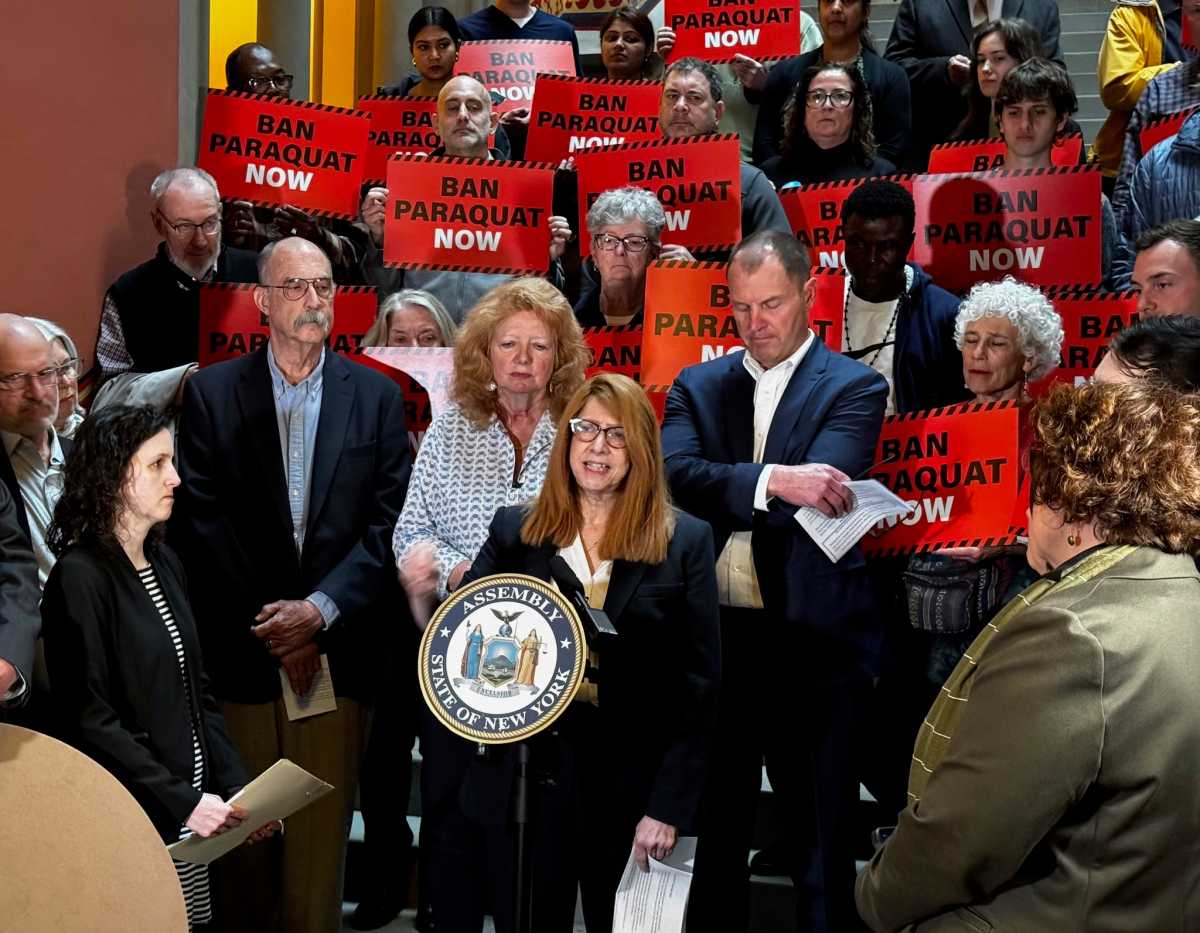
New Yorkers and health advocates rallied at the State Capitol on Wednesday, calling for the passage of legislation that would ban the use of a herbicide many health officials deem toxic.
The herbicide paraquat, researchers and lawmakers said, has been linked to Parkinson’s disease, a neurodegenerative movement disorder that affects around 1.1 million Americans. Numerous studies, including one from UCLA Health in 2024, have shown the connection between paraquat — a common ingredient in many weed killers — and Parkinson’s disease.
“Ambient paraquat exposure assessed at both residence and workplace was associated with [Parkinson’s], based on several different exposure measures,” the study’s results showed. “The [Parkinson’s] patients both lived and worked near agricultural facilities, applying greater amounts of the herbicide than community controls.”
Assembly Member Linda Rosenthal (D-Upper West Side) introduced A.1007A in the State Legislature on Jan. 30, a bill that would prohibit the distribution, sale and use of pesticides containing paraquat. She said the May 13 rally was organized as the bill continues to build momentum among her colleagues.
“It came out of committee last week, and it’s on the floor. It’s moving, and we’re going to try our best to get it going here,” Rosenthal said.
The assembly member explained that paraquat is primarily used by fruit growers to prevent weed growth, adding that many other countries have already banned the chemical.
“More than 70 countries, including the countries where paraquat is manufactured, ban its use,” she said.
China has banned paraquat for use in its country, yet it is a prime manufacturer of the restricted-use chemical.
In 2021, the U.S. Environmental Protection Agency (EPA) decided to keep allowing paraquat in the U.S. despite public concern and studies linking it to health risks. A lawsuit challenged the decision, and in 2025, a court paused the case so that the agency could reconsider the risks, according to lawmakers.
Jessica Hernandez, legislative director of the Environmental Working Group (EWG), a nonprofit that aims to protect environmental health, told amNewYork that time is of the essence to ban the chemical.
“New York should not have to wait for federal action when the science is clear, and the risks are real,” she said. “A paraquat ban is the only way to protect those who grow our food and the communities who live near farm fields.”
How does one get exposed to paraquat?
Paraquat lingers in dirt for years. It can drift through the air as a gas to communities miles away from where it was originally used, according to EWG.
“Once it’s been sprayed on crops, paraquat builds up in the environment and takes years to break down in soil,” a recent EWG press release said. “Having settled in the soil, it then drifts as contaminated dust, putting neighbors at risk, even those who don’t work in agriculture.”
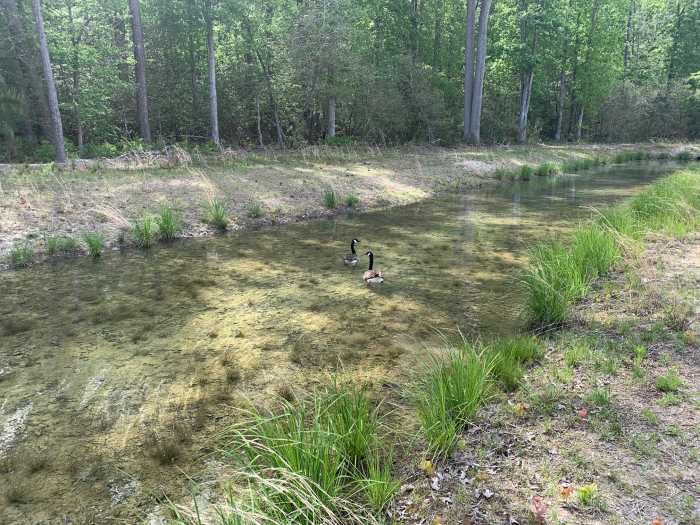 Two geese enjoy a swim in water lined by weeds and plants.
Herandez said that Rosenthal’s bill, along with a similar one in the State Senate, is important because it protects communities from the dangerous chemical.
“Paraquat is so dangerous that it is banned in the countries where it is manufactured and owned – yet it is still used in New York,” she said. “This bill is about protecting farmers, farmworkers and those families who live in rural communities from a chemical that should never have been allowed to remain on the market.”
Representatives from the Parkinson’s Foundation, who helped organize the rally, said they are fully supportive of Rosenthal’s bill.
“The Parkinson’s Foundation urgently calls on the New York State Legislature to protect New Yorkers by banning paraquat,” Deborah Swerdlow, associate vice president of advocacy and state policy for the Parkinson’s Foundation, said. “Research has shown a strong link between exposure to paraquat and an increased risk of developing Parkinson’s disease. By passing this bill, New York lawmakers can help lead the way in moving us closer to a future where fewer people develop Parkinson’s disease in the first place.”
New Jersey, Pennsylvania and Virginia are among nearby states considering a ban or restrictions on the use of paraquat.