
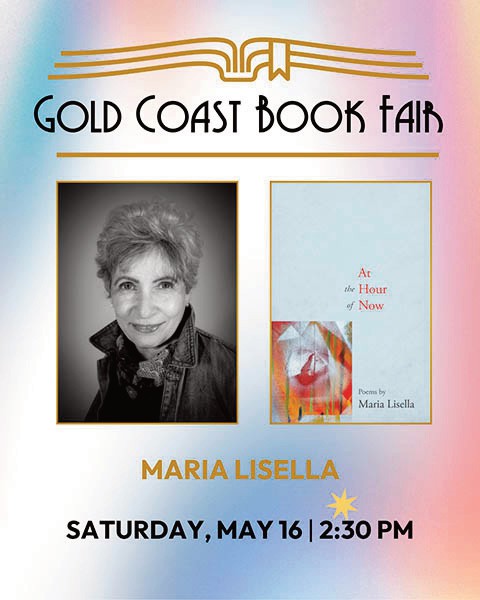

The sixth Queens Poet Laureate, Maria was awarded an American Academy of Poets Laureate Fellowship in 2020. Most recently, her work was aired on WNYC in celebration of National Poetry Month, and has recently appeared in The New York Times’ Metro Diary.
Lisella’s work is included in the bilingual anthology Di là mare/Across the Sea: Contemporary Italian and Italian-American Poetry (Bordighera Press, 2026). Her collections include: Thieves in the Family (NYQ Books), and two chapbooks Amore on Hope Street (Finishing Line Press) and Two Naked Feet (Poets Wear Prada). Poetry editor for Voices in Italian Americana (VIA), she curates the Italian American Writers Association NY readings (readings are also in Boston and Philadelphia). She is a travel writer by profession. You can find her work in Mom Egg Review, the Paterson Literary Review, and Lily Poetry Review.
 NB: Other than the amazing diversity, what do you love most about living in Queens (or Queens in general)? How has Queens changed over the years?
ML: I have traveled extensively and am always thrilled to return home to Queens, where, frankly, the rest of the world shows up sooner or later.
The beauty of Queens is its ability to transform itself; to absorb but not erase the new cultures and groups that arrive. Queens and especially neighborhoods like Astoria have become gateways for new arrivals. Newcomers bring spirit, and their energy imbues Queens with something incredibly special, and for the most part, their arrival seems to be appreciated by those who arrived earlier. Likewise, the waves of young people from across the nation have also brought new energy, especially entrepreneurial.
NB: What do you wish more people knew about being a poet? What is something you wish you knew before you became a poet?
ML: I wish I could dispel the fear around poetry: people say “You wrote a book? Oh, it’s poetry … no good.” I am guessing those folks were not introduced to it in an approachable way. But if you chat to those who do not write poetry, tell them perhaps what narrative poetry is, and how valuable it is as it is much shorter than a novel and manages to emote in fewer words. Most of all, poetry takes the edge off solitude, something most people can relate to. I am a bit of a late bloomer; writing poetry is on-the-job-training.
NB: What are some of your favorite places to read your poetry in Queens?
ML: Any of the Queens Public Library branches are great venues, as are other places: QED (Poets of Queens), Grove 34, Astoria Bookstore, Kew and Willow, Book Culture, 77 Espresso (First Tuesdays) … I don’t have a preference for place, it is the people who share the experience that count.
NB: How does Queens inspire you? What are some of your favorite places to be inspired in Queens?
ML: Neighborhoods inspire me – but so do Queens’ nature trails from Astoria Park to Alley Pond Park to Forest Hills Park – as urban as these places may seem, they are great healthy getaways from congestion and city life and within minutes of home. And frankly, bakeries, cafes, and the people who waltz in and out of them.
NB: Do you ever get stage fright/camera shy/performance anxiety or have advice about overcoming it?
ML: I think stage fright is a healthy response to performing – it keeps you alert, feeds your energy as long as you are not stymied by it. The only thing that makes reading or performing in front of an audience is practice. And have faith in the work; try not to explain each poem before you read it.
NB: What advice do you have for readers who are hoping to develop their writing or poetry practice? Is writing or artistic talent innate and/or can it be taught/developed? How important is daily practice?
ML: Big Questions … I don’t know if having a proclivity toward verbal talent is innate or as a result of one’s environment or both. Recently, I met a young woman you wrote about at Gian Piero’s bakery on 30th Avenue and we addressed these very questions together: the answers always seem to be ordinary – read, read, read, then write. Find a community to write with – although I found this a challenge in my own development as I saw writing as primarily a solitary experience. Since I also write commercially, I would say it helps me warm up my skills to write creatively. COVID offered me a chance to learn how to write with others; and also gave me opportunities to lead workshops primarily comprised of non-writers or those who do not define themselves as writers.
I love writing in La Gata Golosa too … the music is Colombian, the atmosphere is uplifting, you feel like dancing or simply letting your fingers dance along the keys.
NB: How to find best places to publish?
ML: It is a matching/dating game … Read poetry widely; pay close attention to the acknowledgment pages, especially if the author’s work is similar to your own. Further, take a few trips to Poets House at Battery Park as it is a great resource that carries just about every journal in the country; peruse as many journals as possible to find the best match for your work.
NB: What advice do you have about rejections?
ML: Everyone has a strategy: mine is based on dating: “You open the envelope or the email, the rejection arrives, and you say, ‘Next.’” That’s the healthiest advice anyone ever gave me … just keep thinking “Next,” because somewhere out there, a journal will love what you have written. Don’t dwell on the rejection; and don’t tell yourself “…they rejected me…” they did not, they rejected your work. My simplest advice: De-personalize the experience.
NB: Can you tell us more about your new book of poetry, At the Hour of Now?
ML: I’m really thrilled with my second full-length poetry collection published by Bordighera Press for many reasons: my first collection Thieve in the Family focused more on family, growing up, and traveling while this one represents an entirely different period of my life. It covers the passages of time: caregiving, step parenting, loss, grief and most of all hope. I’d like to let these quotes say it all:
Wally Lamb, author of The River is Waiting wrote: “The best poetry illuminates life and Maria Lisella’s At the Hour of Now sheds light on grief, mental illness, ethnicity, and family. There is wisdom in Lisella’s vividly rendered verse. She brings to it the knowledge that, although expectations may ensnare us, hope never will. I was deeply moved by this collection.”
I also liked this quote from award-winning poet, Jennifer Franklin, who writes: ‘This is an unforgettable book from a poet at the peak of her poetic powers.’”
NB: What changed since your tenure as Queens Poet Laureate 2015-2019?
ML: I received a Poets Laureate Fellowship from the Academy of American Poets in 2020. Just 23 poets in the U.S. were chosen and that became a major game changer for me. It arrived on the heels of the loss of my poet husband, Gil Fagiani, so in a way it literally saved my life – at least my creative life.
From there, I learned how not only to write with others and alone but to lead workshops for creative people who did not define themselves as writers. I lead many workshops through the Queens Public Library, Hill and Heights, the Writers Guild, and SAGE through the Teachers & Writers Collaborative.
NB: Can you give us an update on the Queens Poet Laureate position?
ML: Not long ago the Queens Gazette was the only community paper to support the quest for a call for the Queens Poet Laureate Honorary position that has been on hold for the past seven years. Sources say the three initiators of the position: the Queens Public Library, Queens College, and the Borough President’s Office have been unavailable to address this quandary with any of the Queens Poets Laureate Emeritus. Until then, the jury is out: the position is being held captive on the administrative level. The ideal, democratic scenario followed during Melanie Katz’s tenure followed the protocol initiated by BP Claire Shulman – applicants presented their work and met with a dozen heads of Queens cultural institutions versus being appointed by a political appointee.
NB: Do you have any events or projects coming up that you’d like to promote?
ML: Lots of events have cropped up since my book was published … I consider it all good karma. Since I am a late bloomer, I tend to share as much as possible with other writers. Recently, I was interviewed on Storytelling on Orchard Street, hosted by Peter Solomita; I read at a PIACERE (Progressive Italian-American Cultural Exchange).
What is coming up that is free and open to the public: from Wednesday, May 14-17, the 13th edition of LIC Arts Open, which kicked off at the NY Irish Center and will culminate with a Poetry Festival for the first time on Sunday, May 17, 12-3pm at The Local NY, 13-02 44th Avenue, Long Island City. Visit www.licartists.org/licao-events-exhibition-schedule
Additionally, the Gold Coast BookFair will take place just outside of Queens in Oyster Bay, NY featuring a Poetry Corner I’ve been lucky enough to be asked to present my work on Saturday, May 16, at 2:30 pm.
To listen to Lisella read her work, visit Queens Public TV: qptv.org/content/queens-creative-maria-lisella or Storytelling on Orchard Street: www.youtube.com/watch?v=8WTR9xyXn0I or visit poets.org/poet/maria-lisella
—Nicollette Barsamian
The Local-Express interview series was originated on July 3, 2013 by Nicollette Barsamian.