
By Ryan Schwach
An entirely different type of starting gun was fired at Aqueduct Racetrack this week as the state began soliciting public feedback about what to do with the massive plot of state-owned land when it becomes empty later this year.
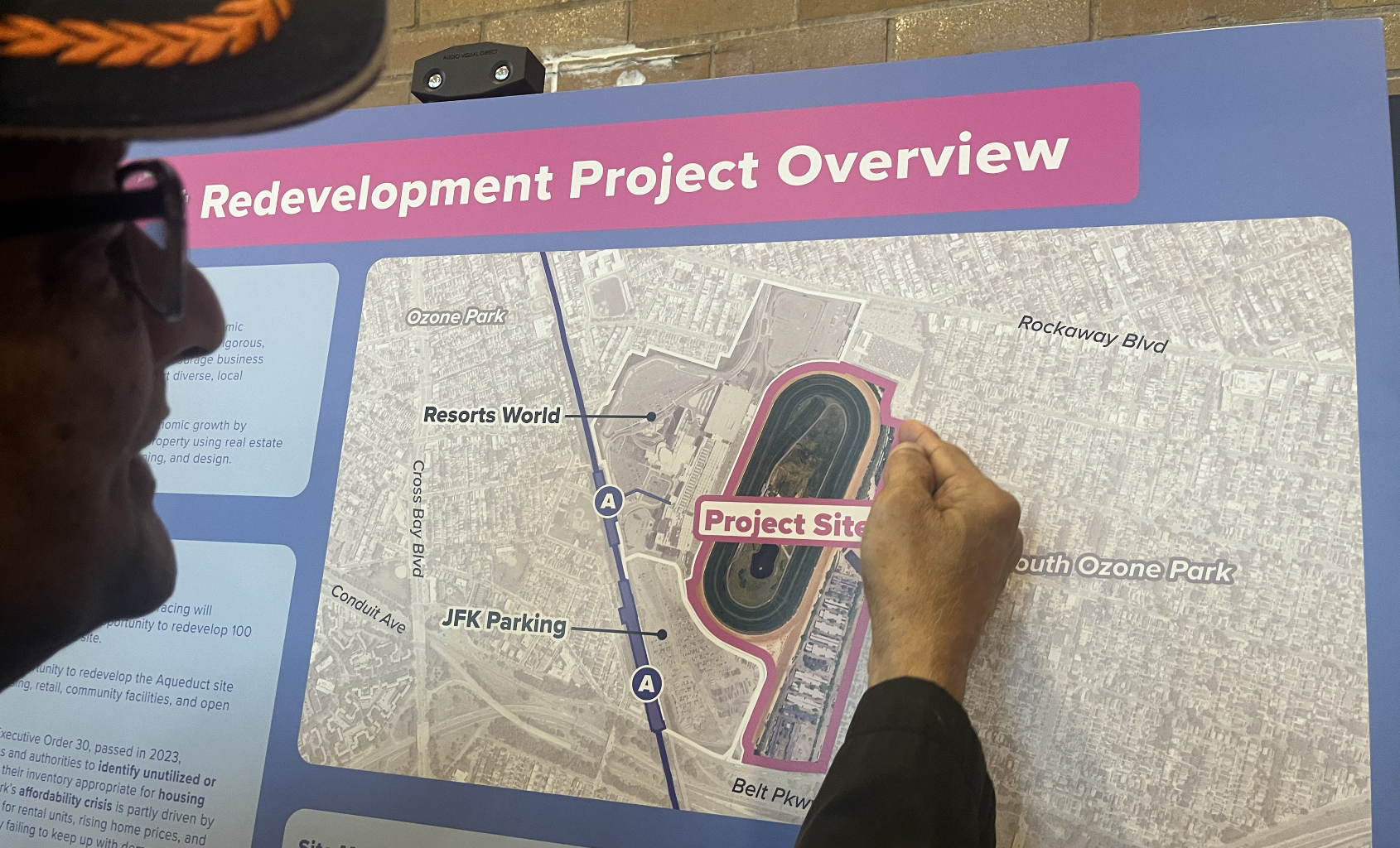
The state held its first feedback session in Queens on Tuesday as it begins to craft its plan to redevelop the 100-acre site, which will become vacant when Aqueduct Racetrack combines with Belmont in Long Island this summer.
However, community members and local officials were torn over what exactly should be done with the massive site.
It’s all but certain that housing will be part of the state’s development plan for the site, but how much housing and what goes up alongside it is still entirely unknown, and neighbors and community leaders have varying ideas.
Most of the locals who attended Empire State Development’s first public workshop on the Aqueduct redevelopment plan on Tuesday night at John Adams High School said housing was a top priority. Others suggested the state build open space and other community-centered resources.
Members of the community board that represents the areas around the racetrack want Resorts World, which operates the casino next door to the track, to have a part in developing the land and turning it into a touristic destination. Fresh off expanding their racino into the city’s first full-fledged casino, Resorts World is also hoping they can be the ones to develop on the land.
Local electeds also want to see the site become a new economic engine for Queens.
Mani Jadunath came to the workshop with his grandson just to make sure his house wasn’t being torn down.
“My backyard is next to the racetrack and we were concerned that they may want to move us from that area,” Jadunath told the Eagle.
He lives on 114th Street, directly adjacent to the site.
Thankfully, his home won’t be affected, but whatever winds up being built at the site certainly will concern the Ozone Park local of 30 years.
He said the community needs housing “first and foremost.”
“People are living in basements, garages — we need more housing,” he said.
His 18-year-old grandson, Avinash Dhanraj, said he wants more places for the community to enjoy.
“Parks and green spaces could be beneficial, especially because a lot of people might want activities to do in the neighborhood,” he said.
Most of the locals expressed the need for affordable housing and community spaces on Post-It notes on boards and maps of the site ESD set up to garner feedback.
“We need affordable housing for us,” said Tneka, an organizer with 1199SEIU and housing-advocacy group Queens Power.
The group was among the loudest pro-housing voices involved in ESD’s development of Creedmoor, a similar state effort that is further along in the planning stage.
“We really need that everywhere, because we work here, but we can’t afford to live here,” she said. “That’s a big problem, and it puts a lot of strain on everyday working people.”
Beyond housing and other basic community needs, some had more grand ideas.
Resorts World has expressed interest in using the site to build workforce housing for their on-site employees, rather than affordable housing.
“We would love nothing more than to have all of our new employees be able to work, live and play in the community,” said Stefan Friedman, a spokesperson for Resorts World. “I’ll leave it up to people far smarter than I to talk about the wisdom of having affordable housing next to a casino.”
Friedman said Resorts World would be interested in doing more than just housing on the site, but that the workforce housing would be the “centerpiece.”