
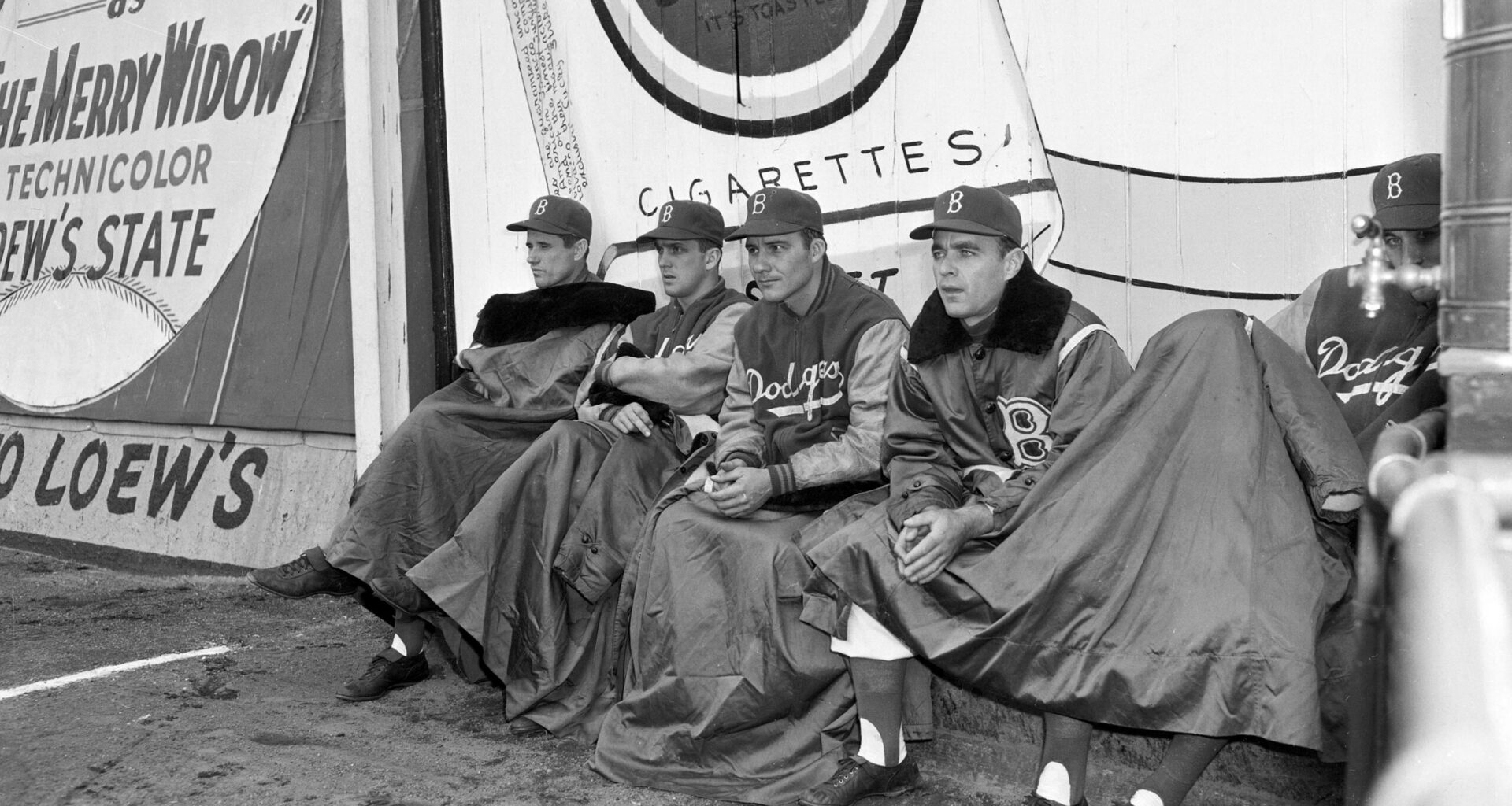
So, at whom does the fickle finger of fate point as the May choice for my article? It seems that Rube Walker gets the nod. He was the only modern-day Dodger born in May. It was on its 16th day, in the year of our Lord 1926. Well, almost the only one. Mace Brown did a one-season stint for the Bums. He, too, was born in May, lived till age 92, gave up a famous home run that cost the Pirates the pennant, but being such a short-timer, he’s out.
I could choose Dixie Walker, who died in May, but I didn’t like him, and I did like Walker, although truthfully, as a kid, what I noticed about him most were what to me looked like Dumbo’s ears. Yet, ears or not, and always a backup to Roy Campanella, Walker was the epitome of the baseball player who didn’t play much but was a key component of a team’s success. Let’s start his journey.
Rube became Rube because he idolized a minor-league mentor named Rube Robinson, but he was also sort of a rube. He came from Lenoir, North Carolina, not a stop you’re likely to see off the interstate, because even today, the closest interstate is about 20 miles away. When Walker was born, they were just building U.S. 321, a route running from the North Carolina line to dots on the map like Trade, Tennessee, and Mountain City, Tennessee. The 1930 census, the census after his birth, shows Lenoir with a population of 6,532. Mountain City’s was around 1,600, and Trade wasn’t even incorporated.
He grew up on a farm and did farming chores through his late teens. His full name was Alford Bluford Walker, not exactly a name that rolls off today’s tongues, but boy, did he love baseball. Like in the bygone lives of many of America’s country lads, baseball found a way into almost every day. Walker’s dad, a semi-pro ball player, would bring home from work scraps of cloth, fiber, and thread that became homemade baseballs.
Walker was not a pitcher, but he had an innate sense of the mental side of pitching, and he used it in his career to help his young stable of arms mature. Part of that was discipline. Society for American Baseball Research tells us that when he became a pitching coach for the Mets, he established what was called “Walker’s Rule.” No pitcher could throw a ball without permission from the coach. He taught them to think.
He taught them patience. Baseball is like life. It is very unpredictable. Walker learned a lesson that so many young ball players learn. You can be a hitting phenom in the minors, but that doesn’t necessarily translate to the majors. It is a lot different playing in front of 40,000 fans versus in front of 400 — or 40. Games in minor league ballparks don’t generate much noise. In the majors, you have to learn to block out the noise because you can come up to the plate to deafening roars. The minor league parks are small. They are great places to watch a baseball game, but their band-box size can be disheartening for youngsters who are seeking the roar of the crowd that comes with that big break. In the smaller parks, it is a lot easier to pick up the ball as it leaves the pitcher’s hand. In the majors, you are often looking at a background of white shirts or a kaleidoscope of colors. A batter has to learn to watch the pitcher’s arm after he checks the positioning of the opposition in the field. And, oh yes, the pitchers in the majors are better, often way better. He taught those he mentored these lessons.
As a young minor leaguer, Walker was a good hitter. He hit for average and power, but when he was brought up to the bigs, he became only half a good ball player. Pitchers loved him as their catcher. Johnny Podres raved about Walker’s ability to handle pitchers. Unfortunately, he couldn’t hit a lick. His stats weren’t great. Over his 11-season major league baseball career, he posted a meager .227 batting average.
Walker’s hitting did manage to become a footnote in his career. Almost every ball player has one. For Walker, it was his triples. He only hit three in his years at the plate, but two of them were off Johnny Sain, the Braves ace, one of baseball’s best, who was part of the Braves fans’ chant, “Spahn and Sain and pray for rain.” Baseball Reference fleshes out the rest. In his 608 career games, he came to the plate 1,558 times. He managed but 35 home runs and knocked in 150 RBIs. For a catcher, who batted left and threw right, he didn’t have a great eye. He drew 150 walks against 213 strikeouts. Walker was an athletic 6 feet tall and weighing 175 lbs., but he was no threat to steal. To steal, you have to get on base, and that was his problem. His career total steals were three!
But he did do other things that were great, like the things he did with his pitchers in the bullpen. What was great was his “second season,” what he did after he stopped playing — but we’re not there yet. Though a fixture in the bullpen, he did get playing time when Campy needed a rest. He did have his moments. He was behind the plate for Bobby Thompson’s “shot heard ‘round the world.” He had called for an inside and high brush back pitch, to get Thompson off the plate and also to get him thinking about the safety of his noggin, but Branca missed his spot and served up a cream puff. There are those who say the Giants were sign-stealers and that Branca knew what was coming, but that version and Walker’s don’t jibe. Either way, the result was the same — Russ Hodges screaming, “GIANTS WIN! GIANTS Win!” Many athletes will say that they’d rather lose 9-0 and not make the playoffs than lose in a sudden-death moment when they were overcome so close. Take the game the Orioles lost last week 17-1. Nothin’ you can do about that. When you lose big, your playoff season is better: You got shelled and don’t look back. When you get close, really close, and that “W” suddenly becomes an L.” Your offseason is plagued with wouldas, shoudas, and couldas. That missed marked by Branca turned Brooklyn’s “W” into an “L.”
Campanella’s paralysis from a car accident opened the door for Walker. Year one in Los Angeles, he was the starting catcher, but by then his heart wasn’t in it. He was close with Campanella, and the crippling accident hit Walker hard. And then there was the hitting. It wasn’t good enough. Coming up behind Walker was a promising prospect, John Roseboro. Not only was he a good catcher, he could hit. The Dodgers released Walker to the consternation of two of LA’s greatest pitchers, Podres and Drysdale, and his close friends Gil Hodges and Pee Wee Reese. It was time for Walker to move on. His second season would begin.
It started with a parade of minor league jerseys. He managed teams in Houston and Saint Paul. He then ended up back in the Dodgers’ system, managing one of its affiliates, where he won the league pennant. At times, he was a player-manager. Then it happened. Hodges gave him a call. LA Dodger Talk picks it up from there. The piece calls Walker a “pitchers’ pitching coach.” Here’s their recount: “The Mets called him, and he was ready to start the 1965 season as a manager in the Mets organization when his coaching career took a sharp turn. Gil Hodges contacted Walker and asked him to become the pitching coach of the Washington Senators. Hodges had been traded to the Senators in late May of 1963 for outfielder Jimmy Piersall so that he could replace Mickey Vernon as Washington’s manager.”
The story continued. Hodges next became the New York Mets manager in 1968 and brought Walker with him as his pitching coach. Then came the idea that brought Walker fame, if not fortune. With Hodges’ backing, Walker changed the nature of starting rotations in baseball. It is a change that is still used in scheduling pitching rotations today. He revolutionized baseball by implementing a five-man pitching rotation. Before then, the gospel had been a four-man rotation. He was also fortunate to have inherited some of the finest young arms in the majors and more in the farm system.
His thinking was this. As a catcher, Walker had a firm belief that there were only so many pitches in an arm. He watched over his young staff like a mother hen. He was criticized a bit for babying his pitchers, but he saw it as a good trade-off for protecting those young arms. Based on his experience and taking the long view, he believed he had found a way to keep his pitchers stronger and healthier over the grind of the 162-game major league baseball season. History has proven him right. One can speculate that once the mantra about four-man rotations had been broken, the door opened for other changes, such as the number of pitches, 100, that most managers adhere to, and sometimes the number of innings, six, they’ll let a pitcher pitch.
Some of us get more time than others. Rube Walker went to the home plate in the sky on Dec. 12, 1992. Like so many ball players of his generation, he smoked and chewed. Lung cancer struck him down at 66. He is buried in his hometown whose 1990 population had grown to 14,192. That’s where he was comfortable.