
by Olivia Young
Fourteen trafficked toucans have fully recovered at the Bronx Zoo after federal authorities confiscated the birds at the United States-Mexico border last summer.
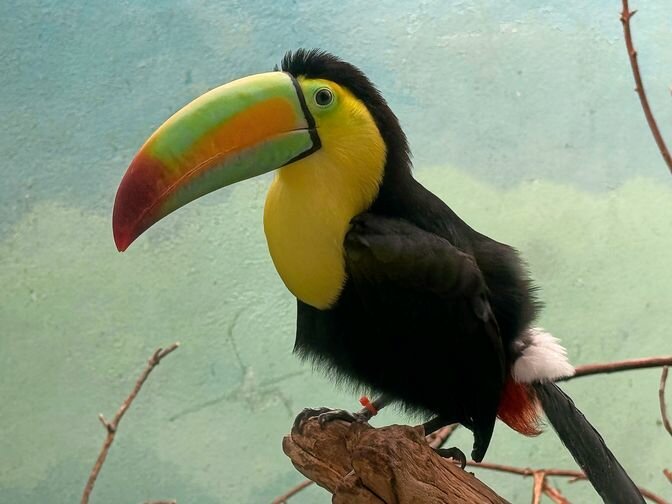
The keel-billed toucans, known for their yellow bibs and vibrant, multicolor bills, were found hidden in the dashboard of a vehicle, the zoo said. They arrived in the Bronx last July, where they underwent months of rehabilitation. The species is considered near threatened, and the news of their recovery comes on the heels of another positive development for at-risk species at the zoo — the birth of two endangered collared lemurs, announced May 4.
At just three to four months old, the rescued toucans were found sedated and bound at the Otay Mesa Port of Entry in California. All showed signs of severe stress, metabolic issues and malnutrition, prompting the U.S. Fish and Wildlife Service to contact the Bronx Zoo. Now, Chuck Cerbini, ornithology curator at the zoo, said the birds have transformed.
“They went from these sunken, stressed animals to behaviorally normal toucans — calling, displaying to each other, throwing their heads up,” Cerbini said.
After they first underwent physical exams, Cerbini noted that amid other health challenges, the toucans were extremely dirty — the result of improper housing without the opportunity to bathe, and inability to clean their own feathers. This took weeks to correct, Cerbini said, with help from a simulated rain shower.
Another visible improvement was in their bills, which originally appeared wrinkly due to a lack of calcium and Vitamin D. Baby toucan bills are especially pliable, making them susceptible to trauma, Cerbini said. But with the proper nutrition, the beaks were able to grow larger and stronger.
Keel-billed toucans are in demand in the global pet trade, an illicit industry that is only growing, the zoo said. Cerbini noted it is worsened by social media, where some users normalize keeping exotic animals as pets, and can easily advertise them online.
According to the Center for Biological Diversity, the U.S. exports more than 17 million live animals each year, and imports more than 90 million — encompassing mammals, reptiles, amphibians, arachnids, birds and fish. Aside from risking the wellbeing of animals, the trade contributes to the extinction crisis, introduces invasive species and spreads diseases.
Four of the rescued toucans will remain at the zoo, two of which can be seen at the “World of Birds” exhibit. The remaining birds are a prospective breeding pair, and are off exhibit to see if they hit it off.
The other 10 were transferred to institutions accredited by the Association of Zoos and Aquariums, which the Bronx Zoo collaborated with. As part of the Species Survival Plan Program, the toucans will contribute to educational programs and conservation breeding.
Also a part of this plan are the endangered collared lemurs. The baby lemur twins were born March 15, and recently made their debut in the “Madagascar!” exhibit. For the first few months of their lives, young lemurs cling to their mother, and hide in her fur, the zoo said in a social media post.
The process behind their birth was deeply scientific, and involves an organized team of veterinarians, animal care specialists and reproductive biologists, said Keith Lovett, vice president and director of animal programs at the Bronx Zoo. Lovett added it’s critical to develop what is called an assurance population, or a biological backup to avoid extinction if the wild lemur population continues decreasing.
The breeding program involves matchmaking the Bronx Zoo’s collared lemur with an outside lemur from another accredited zoo, making sure their genes are different from one another. Zoos do so by keeping studbooks, which are registries that track the family history and population changes of endangered species.
“Basic rule of thumb is, the more genetically diverse the population is, the more robust it’s going to be — usually a healthier population,” Lovett said.
Collared lemurs are also threatened by the pet trade, as well as bushmeat hunting — when humans hunt wildlife to eat their meat — and habitat loss due to slash-and-burn agriculture, according to the Duke Lemur Center. This is a method that involves cutting and burning forests to create fields, something that is required for traditional rice farming, among other things.
For the Bronx Zoo, helping threatened species survive and thrive is part of an ongoing mission. The zoo was established by the World Conservation Society with the goal of advancing wildlife preservation and promoting the study of zoology, according to the society. It is also responsible for the Central Park Zoo, Queens Zoo, Prospect Park Zoo and New York Aquarium.
Keywords
Bronx Zoo,
trafficked toucans,
keel-billed toucans,
wildlife trafficking,
exotic pet trade,
U.S.-Mexico border,
bird rehabilitation,
endangered species