
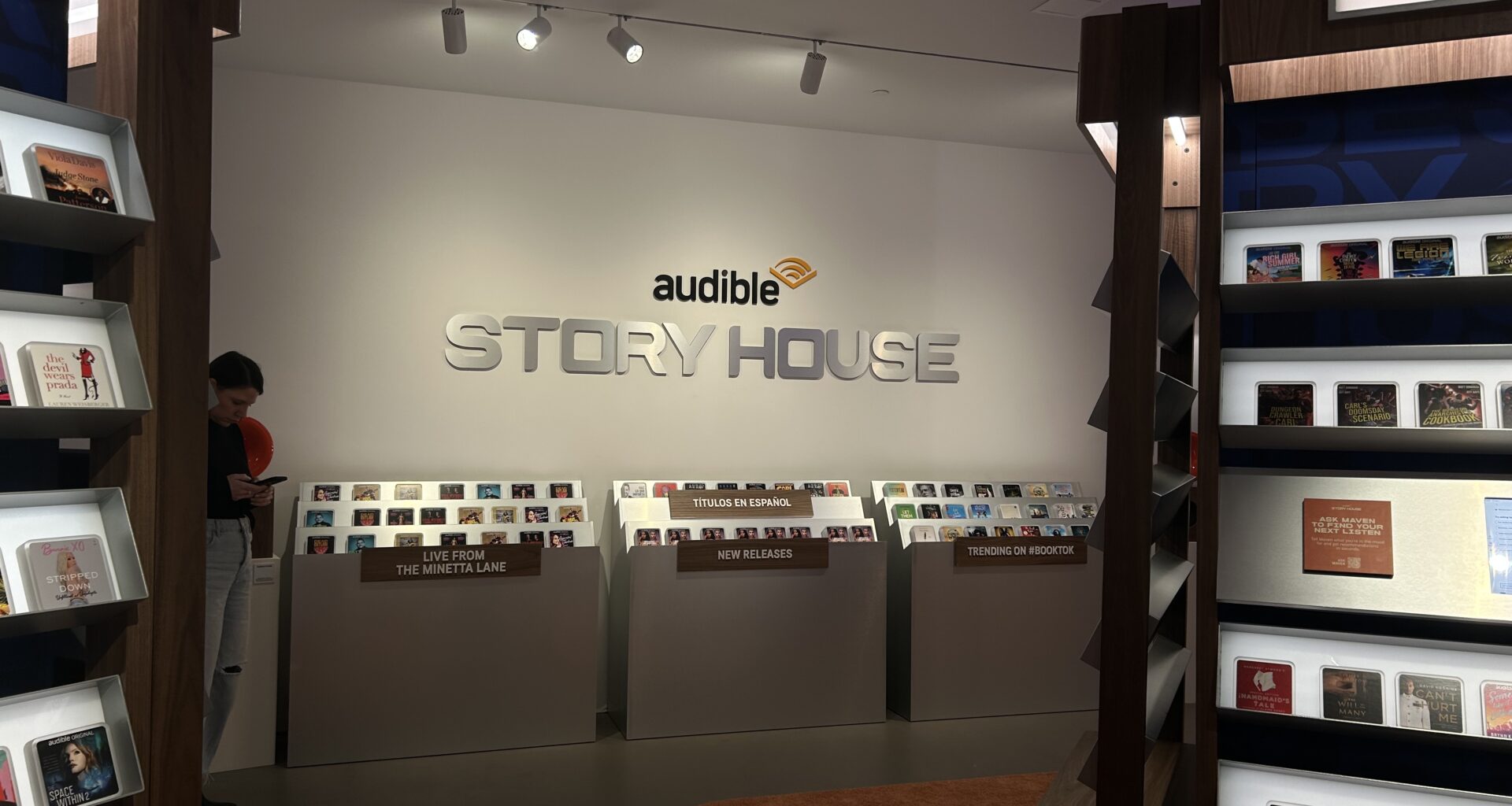
On May 13, a stream of excited Gen Z and Millennial book lovers in business casual—along with a few lost-looking Lower Manhattanites—filed through an orange curtain at the back of the Audible Story House, the audiobook streamer’s New York City pop-up open in the Bowery for the month of May.
The majority of the crowd had been convened by Lit Club NYC, an online-IRL hybrid community founded by Kelly Chervin, who was hosting the evening’s panel on literary fiction.
The panel was one of the ticketed events that Audible had been hosting almost daily in its space since it opened at the beginning of May. The programming, like the space itself, seemed designed to attract as many different guests as possible, ranging from a narrative nonfiction podcast talk, to an open mic, to a figure drawing class.
James Finn, Audible’s SVP of brand and content marketing, said that the goal of the space is to serve “everybody.”
“It’s those that have been dedicated listeners, those that are curious, those that have discovered a title or an author on TikTok,” and even families, who have been trickling in on the weekends, Finn said.
Indeed, the Lit Club lineup defied categorization in any one scene. Throughout the hour, author Mary H.K. Choi; musician and author Geoff Rickly; Substacker and book influencer Josh Lora; and Kimberly Bizu, creator of the Rich Little Broke Girls women’s empowerment community, discussed how literary fiction functions as a mirror for individual readers and their societies.
Chervin kept things participatory, but the space—somewhere between a 70s conversation pit and a spaceship, packed rows of clear plastic chairs—could feel impersonal. “Snap it up for vulnerability!” she exclaimed after Choi shared her experiences being an autistic novelist. At one point, Chervin called on an audience member to share their favorite literary fiction work, and they responded that it was George Orwell’s 1984.
A new kind of third space
Split between three floors, the Story House’s main hook was not its programming, but its novelty as a physical store for audiobooks. Lining the walls of the shop are “story tiles”—palm-sized, frosted glass squares stickered over with book covers—to represent various audio titles. Visitors can sample the tiles, which are RFID-equipped, in one of several padded alcoves about the size of a phone booth, or tap their phone to pull titles up in Audible.
If they have decision fatigue, guests can go upstairs to ask a “storytender” for a recommendation, and listen to their tile while sipping on a coffee from Williamsburg’s Land to Sea café, which collaborated with Audible on its Story House café. The Story House is open from 11am–7pm, Wednesday through Sunday.
“BookTok turned reading and listening into a social identity, and IRL fan gatherings are just surging,” Finn said of the inspiration for the Story House. “People are looking for that additional area where they can go and escape, but also connect with other folks in a good community setting.”
One visitor from Boston remarked that while the Story House felt slightly corporate—noting that Audible is, after all, a division of Amazon—it was surprisingly inviting.
To the extent that the goal was to attract as many people as possible to the space, the pop-up succeeded. As Finn said, it’s tricky to gauge whether interactive marketing pays off, especially because the Story House was open to the public, but said that “attendance has been really strong throughout the week.”
On an evening without any Lit Club programming, a few dozen guests milled around the space in pairs, letting their curiosity guide them in and out of the listening booths, feeling the tiles and tapping on the mounted tablets showcasing Audible’s page sync capability, which allows readers to simultaneously listen and follow along in their e-book. In one corner room overlooking the Bowery, a handful of people set down their shopping bags and lounged on a pile of blueberry-esque pillows.
Finn said Audible would consider opening Story Houses in other cities depending on how this one turns out, but he believes that making audiobooks social is the format’s next frontier.
People are “looking to get out of the house. They’re looking to get off the phone for a bit. So, I do think there’s an opportunity there,” Finn said, “and my assumption is the industry is really looking to see how this is coming together.”