
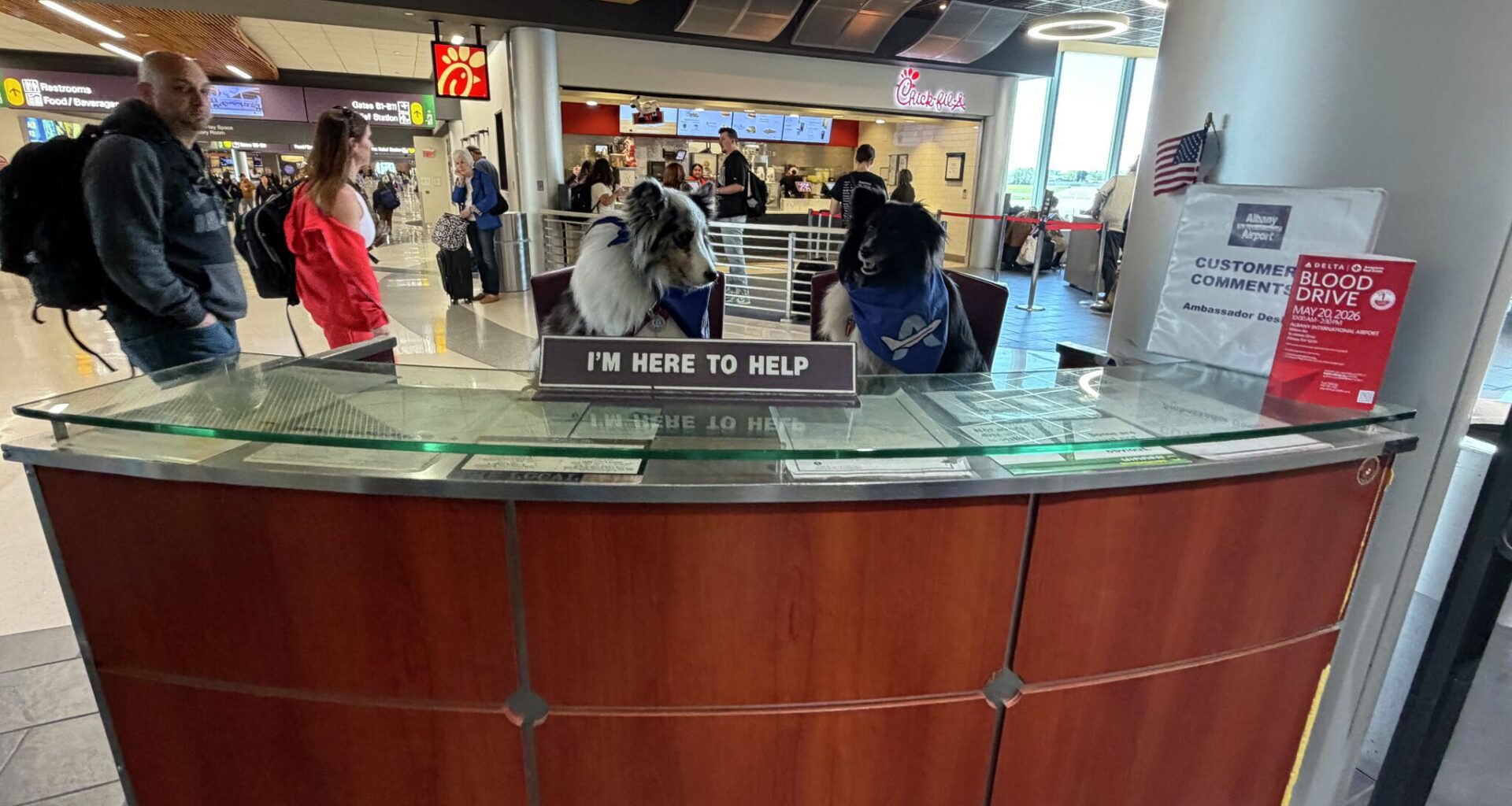
Therapy dogs, Rosie and Ferra, greet travelers as they come through TSA at the Albany International Airport.
Kristi Gustafson Barlette/Times Union
Airport volunteer Terry Brown talks with travelers at the Albany International Airport. His therapy dogs, Rosie and Ferra, comfort travelers and perform tricks — including math — as part of the airport’s canine program.
Kristi Gustafson Barlette/Times Union
Airport volunteer Terry Brown walks with his dogs Rosie and Ferra, certified therapy dogs with the airport’s canine program.
Kristi Gustafson Barlette/Times Union
For travelers moving through Albany International Airport, stress often arrives before the plane leaves the ground.

There are security lines, delays, gate changes and the general anxiety that can come with flying. But tucked between the rolling suitcases and departure boards is a group of volunteers working to make the experience a little calmer — one wagging tail at a time.
Article continues below this ad
The airport’s Canine Ambassador Service Program, launched in 1997, was among the first airport therapy dog programs in the country. Albany was the second airport to introduce the concept, following Los Angeles International Airport. Today, the Capital Region program includes 31 volunteer handlers and 36 certified therapy dogs who roam the terminal offering comfort, distraction and companionship to passengers and airport staff.
“The dogs change the mood almost immediately,” said Terry Brown of Latham, one of the program’s volunteer handlers. “People smile. They stop what they’re doing. Sometimes they tell you about a dog they lost years ago. Sometimes they just need a moment to breathe.”
Brown regularly walks the terminal with his two Shelties, Rosie and Ferra. Rosie, 9, has completed more than 600 therapy visits through the airport and other community settings, while Ferra, 8, has logged more than 450 visits. Brown is a retired copy editor and current military columnist with the Times Union.
But Brown said the program is about far more than greeting travelers.
Article continues below this ad
Make the Times Union a Preferred Source on Google to see more of our journalism when you search.
Add Preferred Source
“People travel for all kinds of reasons,” he said. “Sometimes they’re grieving. Sometimes they feel guilty leaving their own pets behind. Sometimes they’re just stressed or bored during delays. The dogs give them something positive.”
The importance of the program became especially clear during the COVID-19 pandemic, when therapy dogs were temporarily unable to work inside the airport.
When people started traveling again, regular travelers familiar with the dogs at Albany International were begging for the canines to come back, Brown said. The animals’ presence relieves stress when going through TSA checkpoints and the frustrations people face when they travel. It gives them an uplifting distraction. Often, he said, seeing the dogs prompts smiles and laughter. It makes the airport experience a pleasant one.
Article continues below this ad
“For every person who loves the experience of air travel, there is someone else who finds it stressful. At an airport that welcomes more than 3 million travelers each year, anything we can do to ease that stress and bring a little comfort to the journey matters,” said Matt Hunter, the airport’s spokesperson.
“(Our) beloved therapy dogs have brought countless smiles to our travelers’ faces and helped make the airport experience feel a little calmer, friendlier and more welcoming.”
On a recent weekday morning, passengers repeatedly stopped Brown and his dogs before the trio could make it more than a few feet through the terminal. People crouched down to pet Rosie and Ferra. Adults snapped photos. Others stood back and watched, lingering for a few extra moments.
“You can see the stress leave their faces,” Brown said.
Article continues below this ad
The airport’s therapy dogs are screened before joining the program. Each dog must be certified through a therapy dog organization, have updated health records and demonstrate the ability to remain calm in busy public settings and not react to other dogs — including service animals and dogs at the airport with law enforcement.
“We make sure they interact well with people and don’t react to public distractions,” Brown said.
Many of the dogs also perform tricks, something that is especially popular during delays and cancellations. Rosie and Ferra can respond to written commands such as “walk” and “wave” and solve simple math problems by tapping out answers with their paws — a skill Brown said developed accidentally while training one of his previous rescue dogs.
“I taught him to count using his paw because you can’t have a therapy dog barking in a hospital or school,” Brown said. “Then I realized he could add and subtract.”
Article continues below this ad
This sounds unbelievable, we know, but check out the video accompanying this story, and you’ll see the impressive skills — including the ability to figure out the square root of numbers — in action.
The program’s impact extends beyond passengers. Therapy dogs visit airport employees and support staff, who face their own long hours and, sometimes, stressful days behind the scenes.
For Brown, the work centers on connection more than anything else.
Article continues below this ad
“You never know what kind of day someone is having when they walk into an airport,” he said. “If the dogs can make it a little better, then we’ve done something worthwhile.”