
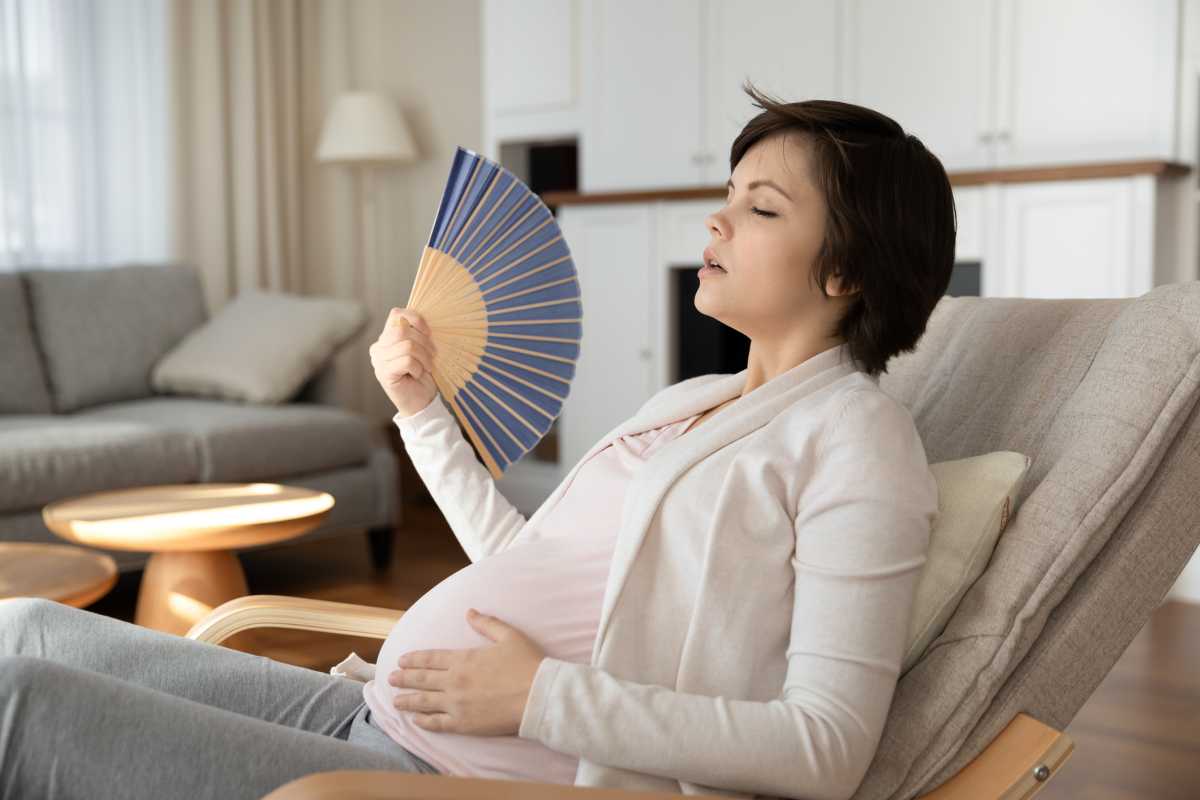
Walking home from her job in the Upper East Side to her Brooklyn apartment, Carson Bunting recalls the summer heat in 2025–the second hottest summer New York has ever seen–affecting her heavily. The reason why? She was pregnant. Bunting even would have to take breaks on her walk home to sit in a coffee shop and enjoy some water and air conditioning due to the heavy air affecting her.
Bunting is not alone in this, as maternal health during heat waves is a majorly underdiscussed issue. While many can factor in internal risks for pregnant people, many don’t stop to consider external factors, particularly heat.
 Carson Bunting during her pregnancy in summer 2025.Photo provided by Carson Bunting
In a study conducted by the Associate Director at the Office of Human Capital Management at the Yale School of Public Health, Claire Masters lists some symptoms pregnant people may face during pregnancy. This includes but is not limited to preterm birth, low birthweight, gestational diabetes, congenital anomalies, stillbirths, or preeclampsia.
“Pregnancy is a time that’s characterized even in normal circumstances by additional stress on your body,” said Masters. “To sustain a healthy child, you have to try and be healthy yourself.”
Masters explains that heat works differently in the body, especially in those who are pregnant. Due to this, different trimesters mean different thermal temperatures in the body. In the first trimester, heat may impact the healthy formation of the child or the DNA sequencing. In the second trimester, there may be more developmental issues including gestational diabetes. When it comes to the third trimester, some of the outside environmental factors may lead to pre-term births, specifically prior to 37 weeks.
Although it is difficult to study pregnant people directly impacted by heat, patterns can be noticed that gives explanations. “We can’t just expose women to excess heat,” said Masters. “You have to kind of find natural designs that work really well to see what the additive effect is of that heat exposure, and there are additional things that really muddy the waters.”
Bunting recalls feeling consistently lightheaded, sweaty and dizzy. “That kind of goes hand and hand with me just slowing down, which as a New Yorker I always wanted to be like go go go go,” she said.
According to the New York State Climate Impact Assessment, average temperatures in NYC are expected to increase four to six degrees in the next 20 years, and six to 10 degrees in the next 50 years. With this rise in heat, climate change is more apparent than ever according to scientists. Masters acknowledges that climate change factors are more than ever deterring younger generations from having children, whether in regards to fear of pregnancy risks or fear of their potential children’s future.
 New York summer of 2025.Photo by Jennifer Ward
With environmental risks for pregnant people increasing, many may be looking for solutions on what can be done to protect them. Masters says that a lot of people may call for obstetrician gynecologists (OBGYN) to provide more prenatal care, as well as guidance on how to keep your body healthy in the heat. “I don’t think we do enough to educate women and help them feel empowered about what to do in these situations,” she said.
Bunting acknowledges the luck she had, sharing that although she was affected by the heat that summer, she overall had a positive experience. She shared that her office allowed her to come into work out of dress code, allowing her to dress for the heat and comfortability during the peak of her pregnancy. She also had more flexibility with her hours, allowing her to avoid rush hour on the subway, avoiding a lot of the hottest underground moments. She also is thankful for a lot of shop owners, who allowed her to take breaks to sit, and would offer her cold water and check in on her.
To help support pregnant people as the summer heat increases, Bunting encourages people to give pregnant people more grace and education. Giving up a seat on the subway, ensuring AC is working on the subway and jobs being more lenient when it comes to dress code and working hours.
“I would encourage people to be a little bit more conscious of how crazy pregnancy is,” said Bunting. “I think a lot of people kind of know that pregnant ladies are a little bit more fragile, but I don’t think they take the second leap as to why.”