
Psychic Repair
SCAD Museum of Art
January–June 7, 2026
Savannah, GA
Emirati photographer and musician Farah Al Qasimi’s Psychic Repair explores self-presentation and consumerism. Her surfaces spill beyond the frame into staged domestic interiors that feel hyper-familiar and slightly off. Drawing on her experience as a Muslim millennial born in the United Arab Emirates, Al Qasimi brings her visual world to Savannah through this exhibition. Psychic Repair was strategically positioned to respond to place through the facilitation of SCAD Museum Associate Curator Brittany Richmond. Al Qasimi’s satirized images reveal Savannah as a constructed image shaped by its history and context of trade, tourism, and preservation that makes clear this exhibition could not exist in the same way elsewhere.
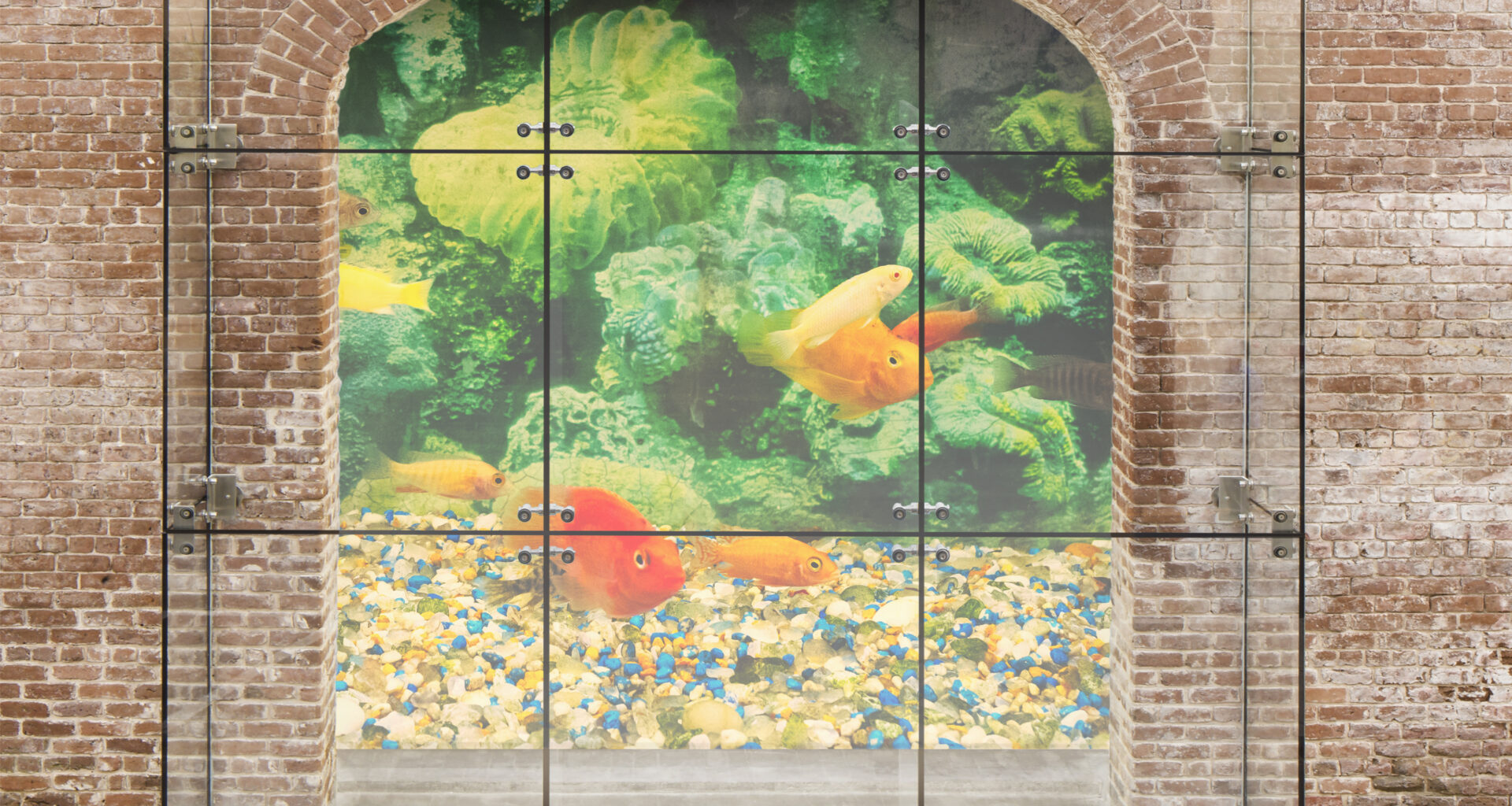
The museum occupies a former railway depot that exported crops such as cotton, indigo, and rice, as well as people through Savannah’s port economy. The building itself is constructed of Savannah Gray brick, an abundant material in the region, made by enslaved people on the Hermitage Plantation, from local clay deposits. On the building’s brick façade are also archway-shaped glass vitrines. With the unique combination of contemporary materials of glass, brick, and the vinyl installation of Al Qasimi, the space may initially read as anachronistic, but past and future collide creating a kind of digital, gothic futurism.
In the façade are four works made in vinyl: Beauty Salon (2024), Aquarium (2024), Clothing Store (2023), and Painting and Astroturf (2023). The first shows two faces whose eyes glare and follow the viewer. Their fair skin, light eyes, and glam eyeshadow contrast with pink and green floral motifs. This work looks like it’s pulled directly from a skin lightening cream ad, but the text has been removed. Aquarium casts the museum-goer as a voyeur within a fishbowl-like structure of looking. Clothing Store and Painting and Astroturf introduce the colors and motifs to the show.
In the interior of the building, flanked on both sides by slightly whitewashed brick arches, is a hallway gallery with a layer of vinyl, framed photographs on top, and cut-and-adhered smaller images that echo internet pop-up ads on the right wall. This is the first display that you see when walking from the previous atrium gallery. Al Qasimi cleverly appropriates these signifiers of the attention economy—retail displays and social media with seductive colors—drawing the viewer in. The layering of these photographs is from Al Qasimi’s archive of screenshots from her online shopping, online reviews, and pictures of places and everyday scenes from her visits with family in the UAE. On the left are four TVs with music videos that pull the viewer’s eye toward the moving image.
Throughout the exhibition, pastel pink and purple give the space an artificiality, as it is the same hue as plastic toys like Polly Pockets, which came out in 1989 and were popular during the ’90s and 2000s. In the exhibition, those colors are nostalgic, overdetermined, and charged with the afterlife of images on which many of us were raised. These colors signal the process of seduction while masking the more sinister force of consumption and excess. Commercialism bleeds into domestic interiors just like the commodities of people, cotton, indigo, and rice dictate the architectural features of Savannah’s Victorian homes.
According to the curator, Al Qasimi is influenced by childhood stories of djinn that adults would use as parables and tools of morality. The djinn stories and their influence permeate the idea of image-making in the exhibition. The most direct presence of these ghosts is in Medeyyah Through The Gate (2023), which is cropped, without a background, and looks like a monochromatic mirage with an ornate wrought iron gate behind which an almost imperceptible figure looms. The gate’s curlicue designs recall the Sankofa, which means going back and retrieving from the past. Its presence is a gesture that mirrors the exhibition’s broader concern with how histories persist and appear in the present.
The hiding under the bed theme comes through in Leopard Print Blanket (2022) and How I Learned to Stop Worrying and Love My Room (2016) music video. Both are autobiographical, indicating a safe space, within a domestic interior, from external forces. In key moments in the video, the artist emerges from under the bed wearing a hijab, another time with a blonde wig, and later, in a leather jacket and an inflatable guitar, epistolary lyrics addressing her mother, father, and others. In the middle of the music video, there’s an ad by and featuring the artist, which satirically promotes a skin brightening product. It shows Al Qasimi in a pink background, the wind blowing through her hair as she smiles at the screen. While the bedroom is positioned as a safe space, the ad in the middle of the music video shows that the bedroom is not out of reach of advertisement and societal influence. Instead, for many, the bedroom is the site of negotiating these realities, where getting ready and picking out clothes are politicized acts.