
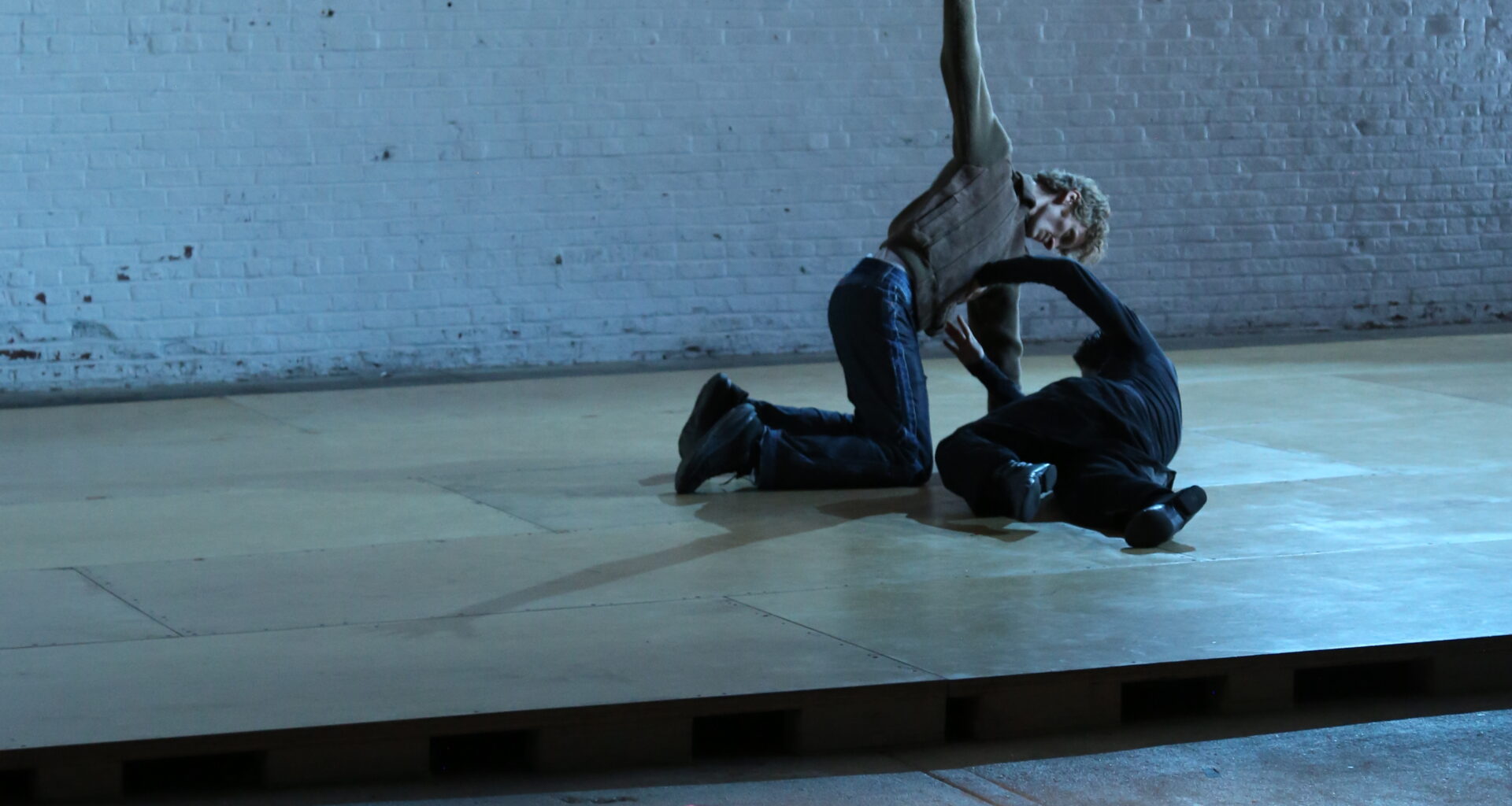
These world-instilling characters cross-pollinate, and throughout Control, continue to finely tune an erotic topography of desires that teeter at once between violence and love, reality and its reversal. At some points, time hangs on a thread, made acutely present in the precision of proportions between gestures and their weight. And yet, sometimes, time widens into something of a landscape, spacious and open. And then, without notice, slams shut—by the single clap of Prum’s hands, for example.
Around them, the early clatterings of instruments, as composed by Elson’s longtime collaborator, Matt Evans, tumble in. Their sounds, which in their plurality and openness resist the oneness of music per se, are instead like discrete accidents that by some unlikely magic begin to hang together. In time, they grow into a voluminous and propulsive whole that swells with charge and ominous expectation.
In a particularly striking moment before Control breaks, all four dancers join in a spacious diagonal line that extends across the space. Each appears beholden to their world. The scene is like a painting, wet with detail and implication as Elson demonstrates her striking ability to move this work between visual landscape and durational event at will.
Control culminates in Del Rosario’s solo. Her vitality and self-possession, as she takes center stage, swinging, lengthening, and rounding, build into the eye of an unyielding, feminine storm. The lights now dimmed, suzuki swiftly emerges from his shadow and begins again in his sharp and methodical movements some distance from Del Rosario’s turbulence. He loads a high step and when his foot crashes down, the lights blink shut.
Perhaps what I most appreciate about this piece is its commitment to building charge—and breaking it—from the ground up. Many dances I’ve seen over the last several years seem to skip these early stages and instead begin at the part where tension is meant to be at its most vivid. As a consequence to this flinching in the foundation, however, drama often feels hollow, imposed instead of enlivened. Here, Elson takes her time undressing. While some moments are brazen in their explicitness, sex is not taken for granted or used as a decoy. The work employs a steady gaze that does not shy when things become unsteady, but holds it there, dead-center, until a new energy breaches the scene, thus allowing for the possibility of satisfaction, too often assumed.
In fact, Control left hardly any room for a breath of boredom. It seared. Gyrated slowly, body upon body, world upon world. Elson, whose most recent work includes Distances (The Kitchen, 2025) and Part Song/Immortal Life (Danspace Project, 2024), has long demonstrated an interest in building tension-fueled dance works that tease out the edges of silence and duration. Here, she furthers that interest into an almost excruciatingly precise, pristine, and beautiful work as she manipulates the proportions of tension with an exacting, obsessive hand that evokes equal parts aggression and tenderness. In so doing, Elson showcases gripping dexterity in negative physical and psychic space, a finely tuned and deeply sensuous understanding of the polymorphic rhythms of reality as such.
Through Tess Michaelson’s work, she has become well acquainted with members of Control’s cast.