
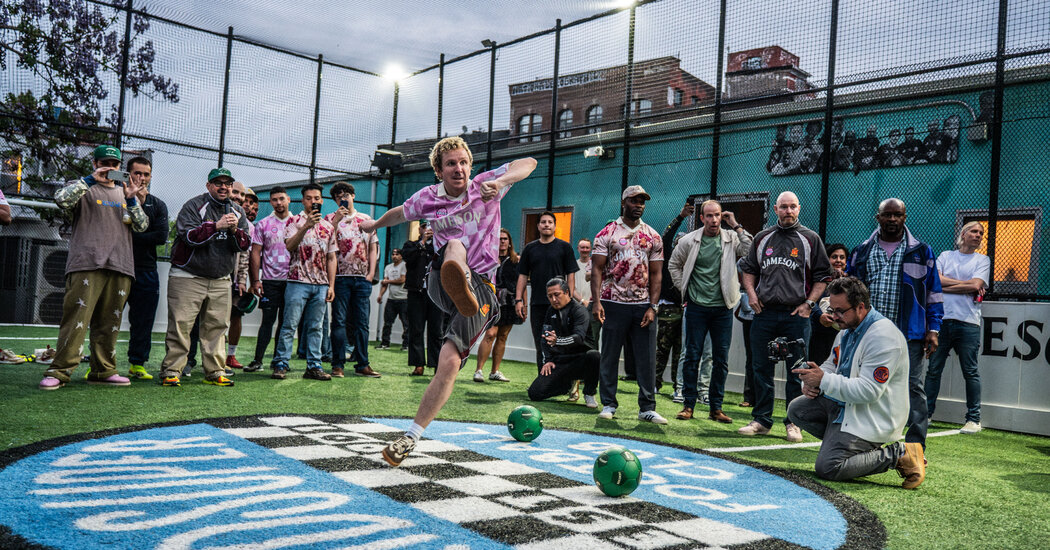
When Colm Dillane first saw the rooftop on the Williamsburg headquarters of his fashion label, KidSuper, he knew exactly what he wanted to do. Mr. Dillane, 34, dreamed of having his own soccer field since he was a child. “I grew up in New York playing soccer, and there just aren’t enough fields,” he said.
$1 million and two years later he debuted a 40-by-70-foot field with two 7-by-6-foot goal boxes. “I wanted it small enough that it was hard to score, but big enough that you could score,” said Mr. Dillane.
The sides are made from hockey rink walls, and the pitch is surrounded by a fence on all sides, even above, to keep balls off the street.
There is also an electronic scoreboard controlled by an app, an equipment room and a bar where players can cool off with a drink.
Adult and children’s leagues now play there almost every day, as do friends of the brand and employees. “It’s a job perk people seem to like,” said Mr. Dillane.
This is the summer of soccer in New York City with the 2026 FIFA World Cup set to sweep the region. As locals get excited about the sport, companies, government organizations, nonprofits and schools are working hard to make pitches available for play.
Some fields are for serious players and have advanced technology, while others are simple grass fields in public parks and schools.
“In New York City, which is a great melting pot with people from all over the world, we don’t really need to introduce people to soccer,” said Jennifer O’Sullivan, chief operating officer of the New York City Football Club, a professional soccer team. “What we need is green spaces for people to play.”
To prepare his roof Mr. Dillane had to move an air conditioning system, level the ground and add a support system. “Every square foot of this has to be able to take like a thousand pounds of impact because people are running on it,” he said.
Another challenge was getting permits for the construction and for the field’s use. He even had confrontations with a neighbor who didn’t want to live next to a soccer pitch. “He called the cops on us a lot,” he said laughing.
Mr. Dillane believes it was worth it. And others have noticed. “Some guy literally just called me to ask how he could build a soccer field on his ferry.”
Building soccer fields is complex, no matter how simple they seem, said David Salerno, park administrator for Randall’s Island Park, where four restored soccer fields opened this season.
For the last few years the space was used to house migrants, which was a challenge for the soccer community, said Eliot Katz, 47, who lives in East Harlem and works for NYC Footy, an organization that organizes soccer leagues. “For a couple of years we suffered from a loss of those fields that affected youth soccer, club soccer, high school leagues, adult leagues, recreational leagues and people who just go to Randall’s Island to have a barbecue and play pickup,” he said. “It is very helpful to have them back.”
The restoration cost $5 million. “When you have heavy machinery moving on them it’s going to cause an indention to the subsurface,” said Mr. Salerno. “In order to make them playable soccer fields again, we needed to come in and level it out and then put this new turf on top.”
“The new fields have a high quality turf and an improved layout with improved markings,” said Mr. Katz. “It’s an upgrade, and it’s so nice.” The only change he would make is to add lighting. A budget request has been submitted to the city.
Some privately owned fields have lighting and much more.
On April 22, the New York Red Bulls soccer team opened a new 80-acre practice facility with eight full-size outdoor soccer pitches in Morris Township, N. J.
Five of them are heated. “There are these small tunnels that go from a main line that connect to a boiler system. It heats the water and then pumps it onto the field, and then it comes back to the boiler room,” said Dan Shemesh, Red Bull New York’s Head of Facilities. “Not only does it melt the snow, but it also keeps the ground from freezing.”
While traditional soccer fields made of artificial turf have gravel underneath, these are lined with two inches of a carpetlike material that includes rubber pieces. “It makes it soft,” said Mr. Shemesh. “That means if you hit your head you’re not going to get a concussion.”
The facility cost over $100 million and includes classrooms, multiple gyms and wellness areas, a lounge and a gigantic laundry facility.
These features are one of the reasons Niko Valvo, a 12-year-old who has been training as a soccer player since he was two, is so excited to start at the Red Bull Academy, the group’s youth program, this summer. “They have things not many clubs in the world have, like a dedicated pitch for goalkeepers,” he said. “I’m excited. I told all my friends.” (Brazil’s soccer team is using the facility for the duration of the World Cup.)
Many of the city’s new soccer fields are being built in school playgrounds and yards.
New York City Soccer Initiative, a collaboration between the New York City Football Club, the Mayor’s Fund, the New York City Department of Education and corporate sponsors including Etihad Airways and Capital Rx, is building 26 mini soccer pitches at local schools.
“Once the World Cup is gone and all the excitement is over, we want to leave a lasting legacy of soccer,” said Ms. O’Sullivan. “You never know where the next Messi or Ronaldo is going to come from until you put a ball at their feet.”
The first one, at P.S. 211 in Corona, Queens, is complete, and another six will be done before the summer is over. The rest will follow by early next year. All are made of acrylic or artificial turf and accommodate five-on-five games.
Another initiative, paid for by Airbnb and run by the FIFA World Cup New York New Jersey Host Committee; New York City Public Schools; and the US Soccer Foundation, is building five permanent mini pitches at five schools across the Bronx, Queens, Brooklyn, Staten Island and Irvington, N.J.
Andrea Tucci, the principal of P.S. 112 Bronxwood, an elementary school getting a pitch, said there has been a lot of excitement since ground broke on their soccer field on May 8. “It kind of created this buzz around the building, and kids are now stopping in my office to ask about it,” she said.
In the past the school had a soccer team, she said, but they played in the gym.
“My 17-year-old daughter has been a goalie since she was three, and she’s like, ‘You don’t understand the importance of a good soccer field,’” she said. “The game is just so much better when you have a proper area.”