
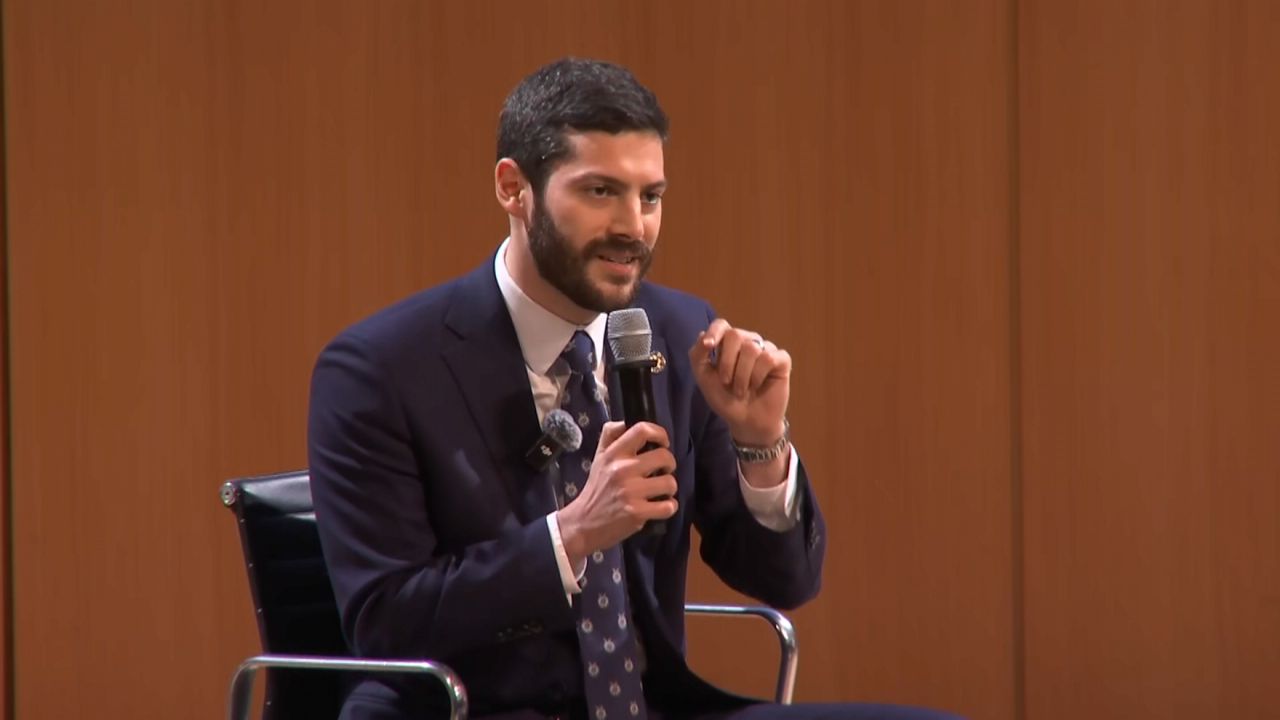
Silicon Valley billionaires are pouring millions into the race, both for and against Assemblyman Alex Bores.
What You Need To Know
Competing artificial intelligence interests have spent millions on the Democratic primary in Manhattan’s 12th Congressional District
A pro-industry super PAC has attacked Assemblyman Alex Bores, who passed state regulations on large AI models
In response, tech billionaire Chris Larsen, Anthropic employees and others have spent a combined $4.59 million supporting him
Bores’ signature legislation in Albany has been the RAISE Act, which created safety guardrails for large A.I. models — and seems to have made him some enemies.
After the Manhattan assemblyman announced his run for Congress, voters in Manhattan’s 12th Congressional District were inundated with negative ads. Some highlighted his past work at Palantir, the tech company that’s come under scrutiny for its work with U.S. Immigration and Customs Enforcement.
“ICE is powered by Bores’ tech,” one attack ad said.
The group behind the ads is Leading the Future, a pro-industry super PAC launched last summer by a group of tech billionaires. The group includes Greg Brockman, the president and co-founder of OpenAI, maker of ChatGPT — who along with his wife, Anna, provided $25 million; Silicon Valley investment heavyweights Marc Andreesen and Ben Horowitz, who gave $50 million; and, in an ironic twist, the co-founder of Palantir, Joe Lansdale.
Leading the Future’s number one target was Bores.
“A random legislator in New York state is not going to stop the AI apocalypse. They’re only going to harass and slow us down, and make us lose to China,” Lansdale told CNBC in an interview last November.
But the anti-Bores spending provoked a backlash.
“It was just really shameful what some of these A.I. players are doing,” said Chris Larsen, a Silicon Valley billionaire who founded the crypto company Ripple, among other ventures.
Larsen’s net worth is an estimated $12.3 billion, according to Forbes. He’s now spending $3.5 million of his money defending Bores.
“They’re trying to make an example out of him, that if you dare try to come up with reasonable guidelines and guideposts here, we’re going to destroy you. We’re going to take you out,” Larsen told NY1 in an interview. “We’re trying to show that, ‘OK, you’re being attacked, but [there are] other folks that want to support you and encourage you to come up with these reasonable guidelines.”
Larsen wasn’t the only one. Another group, Public First, got involved in the race through its affiliated super PAC, Jobs and Democracy, in response to Leading the Future’s attacks.
“They exist like a death star,” said former Oklahoma Rep. Brad Carson, who leads Public First. “They’ll go around and destroy people who stand up against AI. And we exist to try to fight back.”
According to the AI news site Transformer, which tracks the industry’s political spending, no primary race in the country has attracted more AI money than NY-12. And the $4.59 million that’s been spent supporting Bores now exceeds the amount spent opposing him, $3.27 million.
“I think there was a lot of people assuming he was going to get stamped out by a bunch of oppositional spending from this PAC that seems to have a limitless amount of money to spend,” Veronica Irwin, senior AI policy reporter at Transformer, said. “And that’s not what happened.”
Some of the pro-Bores spending has ties to Anthropic, the maker of Claude and a chief rival to Open AI.
One Anthropic employee, Daniel Ziegler, gave nearly $300,000 to yet another pro-Bores super PAC, Dream NYC.
Indeed, Leading the Future, the anti-Bores super PAC, says all that dark-money spending proves Bores is a hypocrite and a puppet for Anthropic.
“He is someone who’s aligned with one company’s view and vision, and we reject that,” Josh Vlasio, co-leader of Leading the Future, said.
All the attention does not seem to be hurting Bores, who’s become a poster boy for AI safety — the subject of profiles in the New York Times, Vanity Fair and the New Yorker and a guest on popular podcasts like “The Ezra Klein Show.”
“They want to make an example out of this race,” Bores said at a news conference last week. “And so I’m saying, ‘Let’s make it an example.’”
The forces now aligned behind him say the goal is to protect against AI’s worst potential outcomes, an issue now unexpectedly coming to define the race.
“The path that we’re on today, this arms race between these firms, is insane. We are a hundred percent on the gas and nobody’s steering the car,” Larsen said. “Clearly we need guardrails, we need sensible regulation, and frankly, Alex — that’s what he’s doing.”