
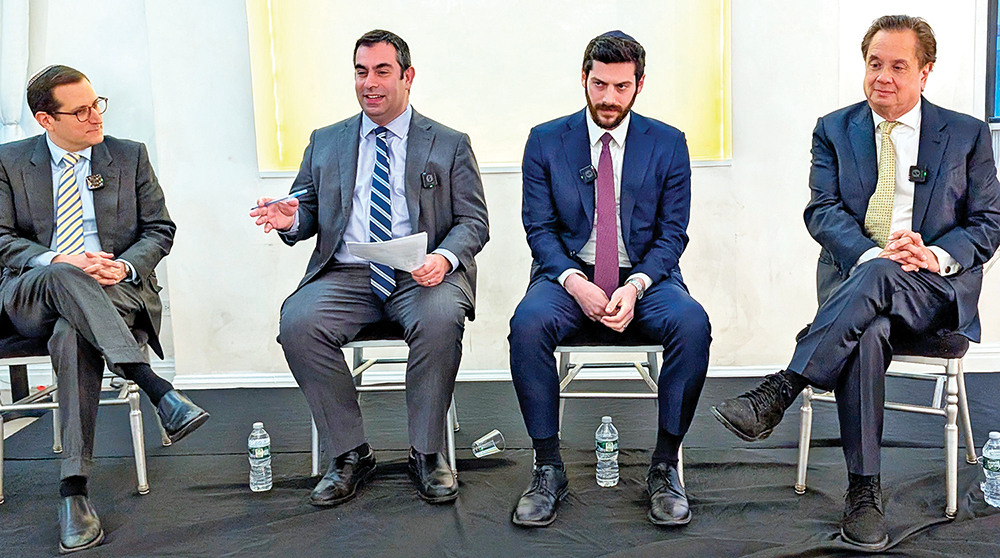
 Onstage (l-r) are Assemblyman Micah Lasher; moderator Josh Kraushaar, editor-in-chief of the newsletter Jewish Insider; Assemblyman Alex Bores; and constitutional attorney George Conway. (Credit Marc Gronich)
Next month, enrolled Manhattan voters in the Democratic party will be going to the polls to take the first step deciding which one of six candidates will succeed the retiring 78-year-old Rep. Jerrold Nadler, who has represented the borough in Congress since 1992. Prior to that he was a member of the New York State Assembly.
Six Democratic hopefuls have emerged as contenders for the seat, which Nadler described to The Jewish Link as the safest Democratic seat in the country. “If my district ever went Republican then there isn’t a congressional district in the country that would be safe,” Nadler said.
The six contenders are constitutional lawyer George Conway, 62; two members of the New York State Assembly — Micah Lasher, 44, and Alex Bores, 35; attorney, writer and political commentator Jack Schlossberg, 33; Nina Schwalbe, 60; a public health researcher who holds a Ph.D. in public health and Laura Dunn, 40, a civil and victim rights attorney.
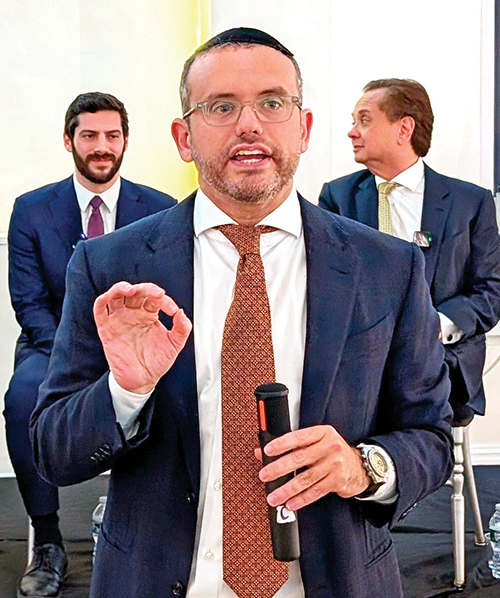 Prior to beginning the congressional candidate forum, Rabbi Daniel Sherman, spiritual leader of the West Side Institutional Synagogue, warms up the crowd. In the background is Assemblyman Alex Bores (left) and attorney George Conway. (Credit: Marc Gronich)
Earlier this month the latest of 12 planned panel discussions took place at the West Side Institutional Synagogue, a modern Orthodox congregation on West 76th Street. The evening was moderated by Josh Kraushaar, editor-in-chief of the online newsletter Jewish Insider. Only Conway, Lasher and Bores attended the forum. Schlossberg, Schwalbe and Dunn did not attend.
“I approached the candidates. The community wants to be incredibly engaged or has become incredibly engaged with politics. It was important for us to have this venue to be able to have a relationship and to hear from the candidates themselves,” WSIS Rabbi Daniel Sherman told The Jewish Link. “It’s incredibly important for the community to be engaged in a very serious way with the issues and the candidates at all levels and all parties. It was a Jewish community forum. The questions were all heavily tilted toward a concern and priority to our community.”
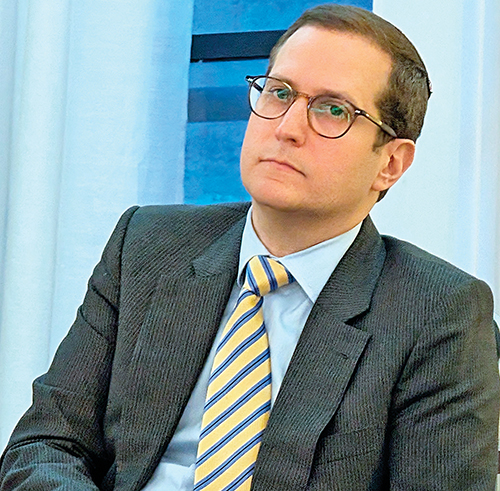 Assemblyman Micah Lasher waits to be called upon to kick off the forum with the first answer to a question.
(Credit: Marc Gronich)
The debate seemed, at times, to be a lovefest between Lasher, Bores and Conway as they agreed on every issue pertaining to Israel, antisemitism, new federal education tax credit for private and public schools, Iran policy, Block the Bombs, buffer zone legislation around houses of worship and Artificial Intelligence (AI). The one issue they differed on was how they would communicate with President Donald Trump if elected to Congress.
Kraushaar wanted to know from the candidates their reaction to Trump’s policies as it pertains to antisemitism on college campuses and what specific steps would they support as a member of Congress to protect Jewish students and the harassment that’s been taking place.
“When we saw the anti-Israel rhetoric at Columbia University, I called that out. I have repeatedly spoken out. And more than that, it’s the power of righteousness,” Lasher said. “There are a bunch of pieces where you have to speak out with moral clarity, build up governmental power in ways that are effective and build political strength for people in the Jewish community or to elect people to office who are willing to stand up, speak out and act likewise. I am personally motivated to do that as a member of Congress.”
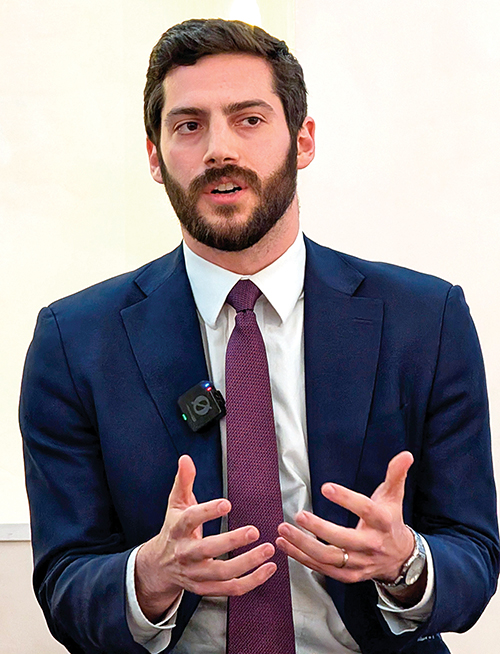 Assemblyman Alex Bores explains his position to the audience.
(Credit: Marc Gronich)
Bores took a wider approach: “There are other organizations that collect this data and call it out. The ADL for one. We need to be clear and unambiguous on antisemitism coming from either party. We need to be taking strong actions to fight it,” he said. “In New York City alone, as of January, year over year from the year before, antisemitic incidents in New York were up 182%. This is not a one party problem. This is a societal problem and we need to address it equally.”
Conway said, “We live in an era where our president is encouraging hatred among groups against smaller identifiable groups, against immigrants. He has given a permission structure for people to be their worst selves. One major step that we will have to take as a nation to get beyond antisemitism and all the other hatreds is to remove Donald Trump.”
Lasher is carrying the bill in the state assembly to add buffer zones around houses of worship.
“Right now, we are in the middle of trying to pass a state law to establish a buffer zone around houses of worship,” Lasher said, to which Bores added: “We can protect the right to express speech, to express political opinions. We can also express disapproval of expanded settlements in the West Bank and say that trying to intimidate people entering a house of worship should be out of bounds,” Bores told the audience of approximately 100. “Both of those things can and should be true. I support Micah’s bill on buffer zones. I’m a proud co-sponsor of it. I think we should pass it and we could look at things like that federally.
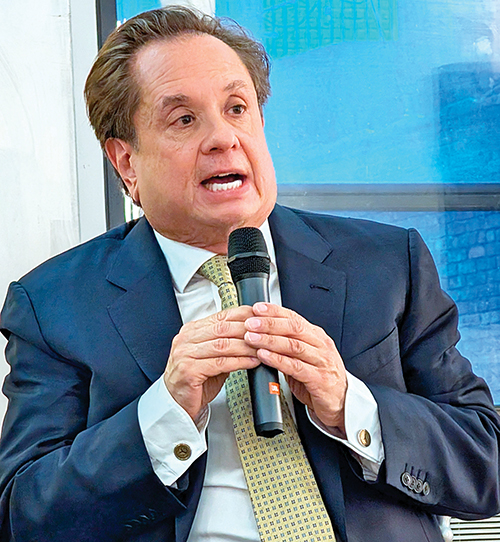 One-issue candidate, attorney George Conway, repeatedly said during the forum that he wants to get rid of President Donald Trump. (Credit: Marc Gronich)
“We need to be able to protect everyone’s ability to worship while we’re protecting everyone’s free speech. Everyone can be safe. We should change what the security grant funds can be used for. We should be expanding the amount of money that we are giving to security grants. Then everyone can be safe and we should change what that money can be used for. Right now, it can only be used for infrastructure and not for people. A lot of the costs of protecting these spaces are people. We can make those amendments.”
Conway echoed the sentiments of his two opponents. “We need protections like my fellow candidates have advocated for to create buffer zones around places of worship and other mechanisms to prevent violence. That being said, it doesn’t excuse any violence anywhere, inside, outside a buffer. We have to call that out. People who engage in that kind of violence and engage in that kind of rhetoric that encourages violence must be punished to the extent permissible in the Constitution.”
The candidates also weighed in on the future of Israel.
“I would speak from my heart as someone who shares the pain and the anxiety of everyone in this room about what is going to happen to Israel and what is going to happen to the Jewish community in America,” Lasher said.
“I would show that you can be someone who can get support from progressive groups and still stand for supporting our allies, supporting a safe, democratic Jewish state,” Bores said. “You need to be able to engage in all of the communities in order to do that. I would be very happy to play that role in Congress.”
“I would stand up against singling out Israel in an effort by some people to score political points. It’s just wrong, it’s destructive and it promotes division and antisemitism so I will stand up against that in the Democratic party,” Conway said.
“I enjoyed the questions and the answers and it’s given me a lot to think about,” Sherman told The Jewish Link. “There was definitely a lot of agreement but there were things that they disagreed upon and there’s what to think about for all of us in terms of figuring things out. I thought the answers overall were coherent to what the community wants and needs.”
The Democratic primary is Tuesday, June 23.