
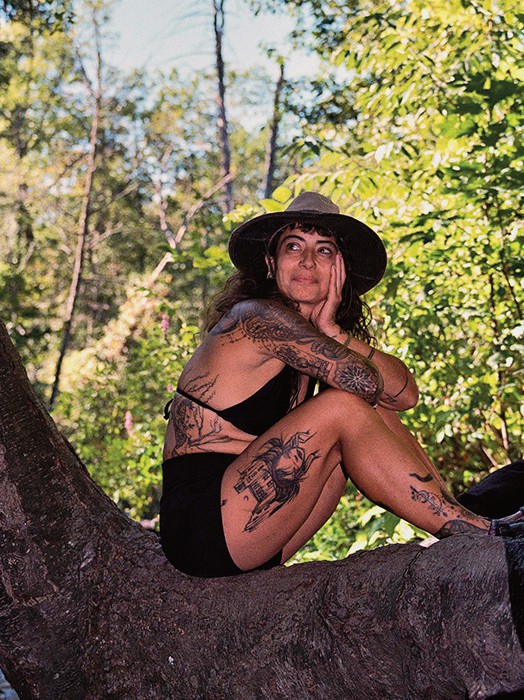

A New York native with Puerto Rican roots, Dishan is a wellness practitioner, builder, and community-focused visionary with over 23 years of experience in holistic health. Raised on Staten Island and a longtime Queens resident of 25 years, Dishan spent a decade building and operating Human@Ease Fitness & Wellness Collective in Brooklyn, creating a space centered on healing, movement, and connection.
After closing the studio in 2020 due to the pandemic, Dishan transitioned the Human@Ease vision into its next chapter, developing a non-profit healing and arts retreat center in Puerto Rico. The project is currently underway and designed to serve both the wellness and food security needs of the local community, blending creative expression, sustainable practices, and restorative experiences. With the main house already funded and under construction, Dishan is currently raising funds for the next phase of development and seeking volunteers to help bring the vision to life, creating a space where people can gather, heal, and build a more connected future.
In addition to this work, Dishan contributes seasonally as a Site Supervisor with Habitat for Humanity New York, helping lead the construction of homes across Queens and the Bronx. A hands-on builder at heart, Dishan is passionate about woodworking and is actively involved in constructing elements of the retreat center.
NB: Other than the amazing diversity, what do/did you love most about living in Queens (or Queens in general)? How has Queens changed over the years?
DE: What I’ve always loved most about Queens is that it still feels authentically New York to me. Even though the city has changed a lot over the years, Queens has held onto its neighborhood feel and cultural identity in a way that feels very grounded and real. I love that people from so many different backgrounds genuinely live side by side here, and that every neighborhood has its own personality. You can go to Astoria for amazing Greek food, Jackson Heights for incredible Indian food, Corona for Latin food, and right in Woodside we have amazing Thai and Filipino food. Compared to other parts of the city, Queens still feels a little slower, more communal, and more connected to the people who actually built their lives here.
NB: How does Queens inspire you? What are some of your favorite places to be inspired in Queens?
DE: Queens inspires me because so many different cultures and ways of living exist side by side in a very natural way. I’m also inspired by how much more bike accessible parts of the borough have become over the years. I’m an avid bike commuter, so I especially appreciate the changes along Queens Boulevard. One of my favorite places in Queens is the Sunday farmers market in Jackson Heights because it brings people together in a way that feels very real and connected.
NB: What advice do you have for readers who are hoping to develop their wellness, volunteering, and community-focused practices?
DE: New York has so much to offer when it comes to wellness, volunteering, and community spaces, and I think at some point most people feel called toward something that feels meaningful to them. My advice is to pay attention to that feeling and explore it, even if it feels unfamiliar or intimidating at first. Sometimes the things we feel resistance or fear around, whether it’s joining a martial arts class, attending a group event, or volunteering, are actually the things we most need to move toward. Following what feels meaningful in the moment is important because the pain of avoiding it is often greater than the perceived discomfort of taking action.
NB: How important is personal connection and communication (networking?) in your industry?
DE: Personal connection and community are not just important in wellness work, they’re really the foundation of it. You can’t build a meaningful or thriving wellness organization without genuine human connection, trust, and collaboration. A lot of healing and growth happens through relationships, shared experiences, and feeling supported by community. Networking is really about building authentic relationships with people who want these kinds of practices in their own lives and who want to be part of something that supports physical, personal, or even professional growth.
NB: What is the best piece of advice you’ve ever received? What is something you wish you knew a decade or two or three ago?
DE: One of the best pieces of advice I’ve ever received is pretty simple… “fake it till you make it.” I’ve carried that mindset into a lot of situations where I felt challenged or uncomfortable, and over time I realized something interesting happens. Eventually you don’t have to fake it anymore. By continuing to put yourself in unfamiliar situations, you build confidence through experience, and that confidence starts to become genuine.
As for what I wish I knew 10, 20, or 30 years ago, I’ve always had a hard time answering that because I don’t really live with regret. I genuinely like who I’ve become and where I am in life, and I think every stage of life gives you the understanding you’re meant to have at that moment. What I know now is what I need to know now, and what I knew back then was what I needed to know then.
NB: What are your favorite studios, parks, restaurants, coffee shops, communities, and venues in Queens? Favorite places for movement and wellness?
DE: Some of the spaces in Queens that have become part of my personal wellness and community life are New York Martial Arts Academy in Astoria, where I practice Jeet Kune Do, the martial art developed by Bruce Lee. Training there has been especially meaningful because learning this art was a childhood goal of mine, and it’s helped me become more confident and connected to my body. I also love AlterWorks Studio because they’ve built a strong community around pottery and supporting artists. Habitat for Humanity New York and Broadway Stages are two organizations I really respect for the work they do supporting local communities. I also enjoy visiting the farmers markets in Sunnyside and Jackson Heights. I mostly cook at home, but when I do decide to eat out, I like places that focus on quality ingredients and cleaner food, like Nisi Estiatorio and Sotto Le Stelle…if I’m craving pizza.
NB: What do you wish more people knew about being a wellness practitioner, builder, and community-focused visionary? What is something you wish you knew before you became a wellness practitioner, builder, and community-focused visionary?
DE: I think all of these practices, whether it’s wellness, building, volunteering, movement, or creativity, involve a kind of meaningful movement that reconnects us to ourselves. As New Yorkers, we’re constantly moving and staying busy, but a lot of that energy goes toward survival, work, and responsibilities. We don’t always make enough space to focus on becoming better versions of ourselves or doing things that feel genuinely fulfilling. I wish more people realized how valuable it is to bring practices into their lives that create a sense of purpose, connection, and growth. As for what I wish I knew before starting this path, I honestly don’t spend much time thinking that way. I feel like every stage of life teaches us what we’re ready to understand at that moment, and I’m grateful for the experiences that brought me to where I am now.
NB: What is something you wish I had asked? Please let me know what that question is, and answer it. Thank you.
DE: How can others learn more about your project? Although a lot of our focus right now is on the actual construction and development of the space, our website and social media are still very much under development as well. People can still follow us on Instagram at @humanatease or visit www.humanatease.com to learn more about the project and get future updates. People can also support our GoFundMe, where we’re currently raising funds for the construction of our “carpitas,” smaller glamping style accommodations and shared community spaces that will help us create more accessible retreat experiences and programming. People can also reach out to me directly for more information or if they’d like to be added to our mailing list for updates at infohumanatease@gmail.com.
NB: Do you have any events or projects coming up that you’d like to promote? Can you tell us more about them?.
DE: One of the projects I’m most focused on right now is Human@Ease Healing and Arts, a nonprofit retreat and community space I’m developing in Puerto Rico. Before this, I operated Human@Ease as a brick and mortar wellness center in Greenpoint for about 10 years before closing during the pandemic. In 2021, I facilitated a retreat in Puerto Rico, and the experience deeply impacted me. As a Puerto Rican New York native, I began to feel a much stronger connection to the land and a growing desire to create something meaningful there that centered around wellness, creativity, and community.
One thing that really stayed with me was seeing how dependent many communities have become on expensive imported and highly processed foods, despite the island’s incredible ability to grow fresh food locally. That experience made me want to create something that encourages people to reconnect with their health, nutrition, creativity, and sense of personal responsibility in a more empowering way. I also wanted to make these kinds of experiences more accessible through a nonprofit model, especially for people who normally would not have access to expensive wellness retreats.
We’re currently continuing construction on the property and organizing future community build initiatives where volunteers can come together to help create the space. The main house is already under construction, and we’re also raising funds to support future phases of the project, including community spaces, wellness programming, food sustainability initiatives, and creative workshops.
NB: If you could choose only one type of movement or wellness practice to represent Queens, what would it be and why?
DE: If I had to choose a practice that really captures the spirit and energy of Queens, it would probably be martial arts because it reflects the diversity and cultural exchange that exists here so naturally. Queens is one of those places where people from all over the world came here and brought their traditions with them, including their martial arts. You can find everything from Kung Fu and Tai Chi to Karate, Jiu Jitsu, Muay Thai, Filipino martial arts, boxing, mixed martial arts, and practices like Capoeira throughout the borough. In many ways, the growth of martial arts in Queens mirrors the immigrant communities that helped shape the borough itself. Different cultures, philosophies, and practices all existing side by side while bringing people together through discipline, confidence, and community.
NB: What is a typical day like for you?
DE: My days are pretty layered right now because I’m balancing both my nonprofit initiatives and consulting work, so a lot of my time goes toward strategically managing different projects and responsibilities at once. I usually wake up between 6:30 and 7:30 and start my day with stretching and some Kali practice, which is part of my Jeet Kune Do training. Then I make my morning specialty coffee, which has basically been my breakfast ritual for the past 15 years, and spend a little time reading. Lately I’ve been reading the Bible, not from a religious perspective, but because I find the history, symbolism, and stories fascinating.
After taking care of my animals, I usually move into work mode. Some days I’m doing site visits, working with Habitat for Humanity, or meeting with a client, but most days I’m working from home, planning the upcoming build scope for my nonprofit initiative, Human@Ease Healing and Arts, while also handling consulting work for clients. Throughout the week I also make time for the gym, pottery practice at AlterWorks Studio, and train at New York Martial Arts Academy 4-6 days a week. I usually wind down around 9:30 with a documentary, movie, or show before heading to bed around 11:30.
NB: Can you tell us more about Human@Ease and how it serves “both the wellness and food security needs of the local community, blending creative expression, sustainable practices, and restorative experiences”? How do you blend those practices together?
DE: Human@Ease Healing and Arts is really an extension of a lot of the things I’ve cared about throughout my life coming together into one space. The vision is to create a nonprofit retreat and community environment that blends wellness, creativity, and food sustainability in a way that feels accessible and grounded. I want it to be a place where people can reconnect with themselves through the meaningful experiences and environment we create there.
One of the major focuses of the project is helping people reconnect with healthier ways of living. Puerto Rico has such fertile land and an incredible ability to grow food locally, yet many communities still rely heavily on imported and processed foods. Part of the mission is helping people realize that we have more power and agency over our wellness and nutrition than we’ve often been led to believe.
A big reason I wanted to combine creativity with wellness is because I’ve seen how transformative creative practices can be in people’s lives. Whether someone is making pottery, building something with their hands, or exploring another creative outlet, it can create a real sense of fulfillment and empowerment. I think many adults lose touch with that side of themselves over time. To me, creativity is deeply connected to personal growth.
The project will also include workshops, volunteer build initiatives, and retreats that create opportunities for connection and collaboration. While the initiative is rooted in Puerto Rico, I also intend for it to become a bridge for the vast Puerto Rican communities and artists in New York, especially people who may not normally have access to these kinds of wellness and restorative experiences.
NB: What’s a wild story (PG-13) you have about NYC before the times of cell phones or social media? If you weren’t in NYC then, what’s a story you have of NYC past (or the past)?
DE: A wild thing to think about now is that before cell phones, social media, GPS, and constant communication, when I was around 10 years old growing up on Staten Island, I would take public transportation by myself all the way to Bayside to spend weekends with my favorite cousin and aunt. I’d take the ferry, hop on the subway, then transfer to the Long Island Railroad for what was basically a two-hour trip across the city, and at the time it felt completely normal. Looking back now, it’s kind of surreal because this was during a time when New York was actually much rougher than it is today, yet none of us had phones, tracking apps, or any way to constantly check in. At the same time, I do appreciate that those experiences gave me a strong sense of independence and confidence at a young age, even if 10 years old may have been pushing it a little. I think there’s probably a healthy balance somewhere between protecting kids and also allowing them enough freedom to build independence and trust in themselves.
NB: Can you tell us more about how you are a Site Supervisor with Habitat for Humanity New York, helping lead the construction of homes across Queens and the Bronx?
DE: This is my second season working with Habitat for Humanity as a seasonal Site Supervisor, and one of the things that initially drew me to the role was wanting to strengthen my construction knowledge while working on the development of my retreat center project in Puerto Rico. I had been finding it difficult to navigate construction projects and contractors on my own, so I wanted more hands-on experience in the field. At the same time, the work gave me an opportunity to contribute to something much bigger than myself and directly support local communities.
My role involves helping oversee volunteers through different scopes of work including construction, painting, renovations, and community improvement projects throughout Queens, Manhattan, and the Bronx, including collaborations with local churches and community spaces. One of my favorite parts of the job is working with volunteers from all different backgrounds, including corporate teams who want to become more involved in community initiatives. I have to say there is something pretty exhilarating about being a 4’11” female teaching a corporate banker how to safely use a power tool for the first time. Lol.
NB: Can you tell us more about how you are “seeking volunteers to help bring the vision to life, creating a space where people can gather, heal, and build a more connected future”? What makes for a “good” (successful? productive or effective? fulfilled?) volunteer? How can we make the future more connected? What kind of future do you hope for?
DE: Right now, a lot of the work behind Human@Ease Healing and Arts is truly a grassroots effort. Much of the project so far has been funded through my own savings and loans, and I’m currently seeking volunteers by reaching out through my personal network as well as connecting with nonprofit organizations in New York and Puerto Rico that already have strong volunteer communities. We’re looking for people who are hardworking, community driven, able to follow instruction, and ideally have some experience in community building projects or construction, although a willingness to learn and contribute meaningfully is just as important.
As far as creating a more connected future, I think radical communication and conscientiousness play a huge role. Even though technology has evolved rapidly, I think we’re still struggling in many ways with how we communicate emotionally and how easily people can become divided or manipulated by media and constant online engagement. I think we need to become better at listening, expressing our needs clearly, and approaching differences with curiosity instead of becoming so attached to our beliefs that they become inseparable from our identity. At the core, most people want similar things like safety, freedom, connection, purpose, and a better future. We just often disagree on how to get there.
I hope for a future where people become more aware of how outside influences, media systems, and constant digital engagement can shape our thinking and push people toward division and reaction instead of understanding. I think it’s important that we learn how to communicate more consciously, think more critically, and resist becoming so attached to ideology that we lose our ability to genuinely connect with one another as human beings.
—Nicollette Barsamian
The Local-Express interview series was originated on July 3, 2013 by Nicollette Barsamian.