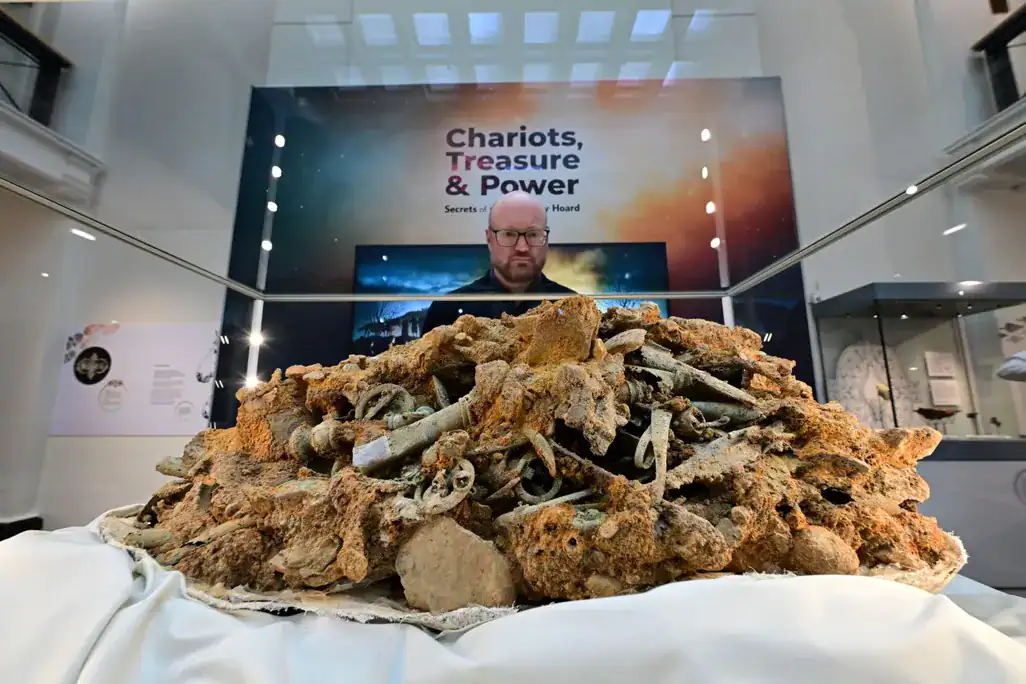
 The hoard on display at the Yorkshire Museum. Credit: Anthony Chappel-Ross/York Museums Trust
Late in 2021, a metal detectorist named Peter Heads swept his device across an unassuming field in Melsonby, North Yorkshire. To his surprise, beneath the soil lay an ancient ditch holding fragments of chariots, shattered weapons, and a battered feasting cauldron. In a neighboring ditch, archaeologists soon uncovered a massive, heavily corroded lump of iron wrapped in cloth.
The resulting excavation yielded the Melsonby Hoard, one of the largest collections of Iron Age metalwork ever found in the United Kingdom. This colossal trove of more than 800 objects, some of which were technologically advanced for their age, shows northern Britain was not an isolated, primitive frontier before the Roman conquest. Instead, the buried artifacts expose a vibrant, wealthy society bound by international trade and possibly linked to powerful female leadership.
Royal Arsenal
The sheer volume of the discovery left researchers stunned. Excavators from Durham University ultimately pulled hundreds of iron and copper-alloy artifacts from the Yorkshire dirt.
“Finding a hoard or collection of ten objects is unusual, it’s exciting, but finding something of this scale is just unprecedented,” Tom Moore, Durham University’s head of archaeology, told the Guardian, in 2025. “We were just lost for words.”
The hoard contains 28 stacked iron tires, linchpins, U-shaped brackets, and yoke fittings. Together, they form the first known archaeological evidence of four-wheeled, horse-drawn wagons in Iron Age Britain. Generations of historians assumed that Iron Age wealth concentrated almost exclusively in the southern regions of England.
“This shows that individuals there had the same quality of materials and wealth and status and networks as people in the south,” Moore added. “[The artifacts] challenge our way of thinking and show the north is definitely not a backwater in the Iron Age. It is just as interconnected, powerful and wealthy as Iron Age communities in the south.”
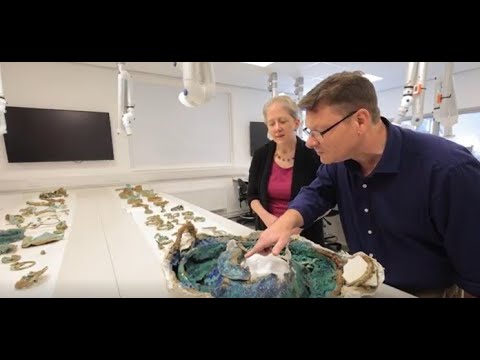
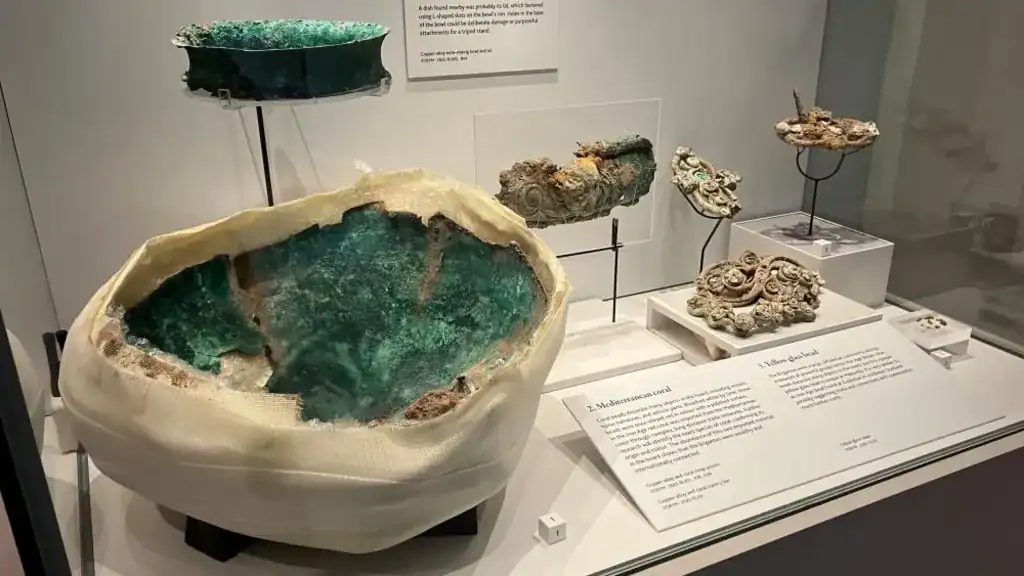 The wine-mixing bowl on display in its conservation plaster. Credit: Joanita Musisi/BBC
Inside the Enigmatic Block
Roughly 30% of the hoard is now on public display at the Yorkshire Museum in York, part of the exhibition “Chariots, Treasure and Power: Secrets of the Melsonby Hoard.” Inside a climate-controlled case at the museum rests “the block,” a 150-kilogram (330-pound) tangle of 88 fused items.
Although spearheads, chariot parts, and horse harnesses are visible on the surface, physically extracting them would damage the artifacts. Instead, researchers are relying on CT scans to safely examine the interior of the mass using X-rays. The craftsmen of these objects possessed extraordinary skill. They fashioned wine-mixing bowls and elaborately decorated them with carved Mediterranean coral.
×
Thank you! One more thing…
Please check your inbox and confirm your subscription.
“It is an incredibly tantalising object,” Emily North, the museum’s lead curator of archaeology, told The Guardian. “You can peek through the surface at some of the things that are hidden inside. There’s a stylised boar’s head that’s part of an object and also a man’s face … To see the face of an iron age Briton as they depicted themselves is something very, very special.”
 Close-up of the hoard. Credit: Gary Calton/The Guardian
Reflections of Female Power
The terrain surrounding Melsonby once belonged to the Brigantes, a powerful Celtic tribe that controlled vast swaths of northern England. At their peak, they operated a major power center at the nearby Stanwick hillfort. Their most famous leader was Queen Cartimandua, who reigned from roughly 43 C.E. until 69 C.E. and notably allied her people with the invading Roman Empire.
The staggering value of the hoard suggests it belonged to the highest echelons of Brigante society. A heavily corroded iron mirror anchors this theory. Throughout the Iron Age, such mirrors appear exclusively alongside powerful women, never in the graves of men or children. While the timeline makes it unlikely that Cartimandua herself owned the mirror, researchers believe her mother or grandmother might have possessed it.
“The mirror is my absolute favourite object,” North told the Guardian. “It is spectacular, and that’s not because of how it looks, because it doesn’t look like an awful lot at the moment. It is the clue that could solve the puzzle of why people buried this hoard.”
Instead of serving a vain purpose, the mirror likely acted as a spiritual tool.
“It is a magical object associated with female power,” North added. “This mirror would have given quite a distorted view of the person who was looking into it.”
 The now corroded mirror on display. Credit: Gary Calton/The Guardian
Destruction by Design
The hoard’s burial presents one final mystery. The ancient Britons systematically smashed, burned, and dismantled these objects before committing them to the earth. Someone deliberately bent the metalwork, burned the wooden chariot wheels, and bashed the large feasting cauldron with a rock. They then carefully separated the artifacts into two ditches.
Because excavators found no human remains at the site, a simple grave-goods explanation is unlikely. Why would a society painstakingly craft such valuable objects, only to violently destroy and bury them?
“It’s an absolute mystery why this vast mass of luxury expensive objects was destroyed and put into the ground,” North told the BBC. “I doubt I’ll see anything quite like this again in my career.”
Researchers will spend years picking apart the fused metal, searching for answers. But the violent end of this ancient treasure remains the hoard’s most stubborn secret.