
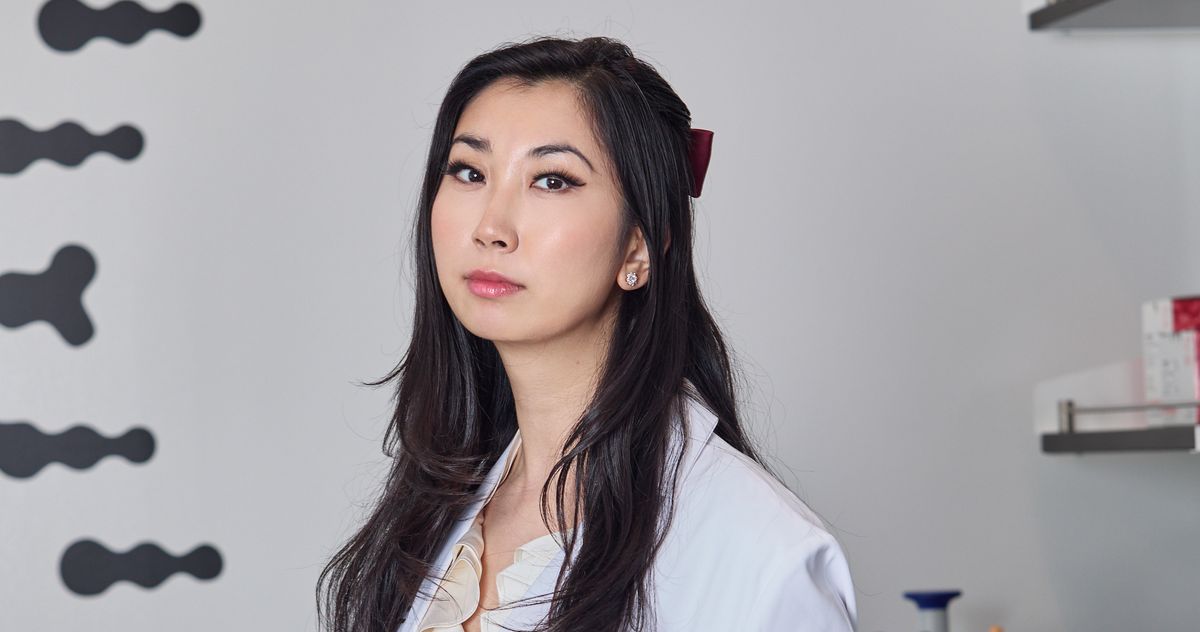
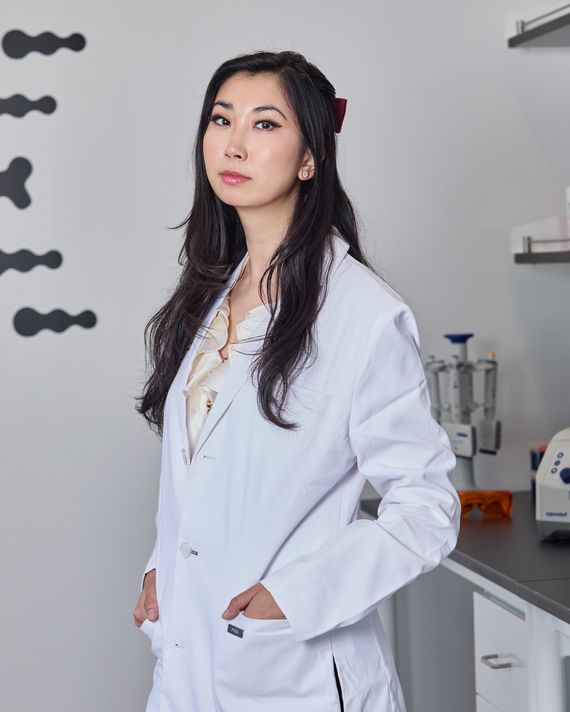
At 3:30 p.m. on a Friday, Cathy Tie sat in Carnegie Hall, wearing a pink sweatsuit bedazzled with cherries, eating a gyro. Tonight was her 30th-birthday party. She’d had a bad year. So she rented out Zankel Hall, which, it turns out, is a thing you can do: Call Carnegie, get the rate sheet, send money. Done. Zankel is graciously wood-paneled with only slight vibrations rumbling up from the Seventh Avenue subway, and it was very empty. In the house seats: just Tie, Tie’s friends Peter and Michael, who would be playing piano and singing some opera; Tie’s videographer; Tie’s page-turner; and Tie’s piano teacher, who had her hair messily clipped on top of her head and a way of pressing her fingers into your arm that made your whole self relax. That evening, as the program stated, Tie would perform “Piano Concerto No. 2 in G minor by Camille Saint-Saëns, bringing both technical rigor and expressive nuance.” Guests would be invited to “sing ‘HAPPY BIRTHDAY’ TO CATHY!” The dress code: black tie. At the bottom of the program was the double- helix-inflected logo for Origin Genomics, Tie’s newest company. Its stated goal is to gene-edit embryos to prevent inherited disease.
Tie is very tall, with perfect skin and a poker face. Sometimes she stonewalls; sometimes she’s very direct. She is slightly pigeon-toed. “I’m going to change into my gown so I get used to it,” she told me. “You can meet me in my dressing room.”
The room had a sign on the door that read “Cathy Tie.” Inside was an upright piano and the videographer, who shot music videos for the Weeknd. A caped, sequined Jenny Packham ensemble lay on the couch. “Is this your dress?” I asked.
“Gown,” Tie corrected.
Tie went into the bathroom to change. Kate Middleton wore the same gown to a James Bond premiere. Tie’s gown was Champagne pink instead of gold. Tie wasn’t nervous, just tired, she said. Her last year had been a lot. It started with several trips to China, where she’d been born, though not raised. She wanted to explore her roots, she said. She wanted to eat Peking duck. She wanted to know how an authoritarian government approached the genomics industry. While there, she happened to fall in love with He Jiankui, a Chinese scientist who made himself infamous in 2018, when he revealed that not only had he gene-edited embryos — he’d implanted those embryos in women. This resulted in three babies (who have been kept out of the public eye) and three years for He in prison.
“One thing led to another,” Tie told a reporter from the Free Press of her relationship with He. They held a 12-person wedding, which Tie’s family did not attend. The MIT Technology Review labeled Tie the “Bride of ‘China’s Frankenstein.’ ” He started tweeting things like “Good morning bitches. How many embryos have you gene edited today?”
That was April 2025. The next month, Tie packed up her Los Angeles apartment and boarded a flight back to Beijing. On a layover in Manila, airport officials informed Tie that China would not let her reenter the country. “I think that it’s ridiculous how a few months ago, people in the U.S. would say I am a CCP spy and people in China would say I’m a CIA spy. I’m actually Canadian,” Tie said two days later, still in Manilla. “I don’t have any other citizenship.”
Tie’s relationship ended. (Tie later clarified she and He never legally married.) She flew home to the Toronto suburb where she grew up and her parents still live. She felt unmoored. “My stuff” — really nice things, she noted — “was scattered across the world. I was just with two suitcases and my dog. I felt so anxious and confused.” She lived out of hotels and spent whole days at her piano teacher’s house. “Music became something I needed,” she said. In early August 2025, she announced a new venture: Manhattan Project. “Tackling the future $Trillion dollar germline gene correction industry,” Tie wrote again on X. “Imagine billions of people born without inherited disease.”
Tie undertook a personal rebrand a few weeks later. She cued up Lizzo’s song “Pink” — “When I wake up, in my own pink world …” — and with the help of the -Weeknd’s videographer, she made her own Barbie video: Tie, in pink sleep mask, stretching in bed; Tie waving awkwardly to neighbors; Tie reading a newspaper with the headline “Biotech Barbie Banned.”
Thus the bedazzled pink tracksuit and caped pink Jenny Packham gown. Tie is just a little surprised no one noticed the link with her Manhattan Project — that she’s Barbenheimer.
On the evening before the birthday party, Tie again took the stage, this time in the very tasteful brownstone on the Upper East Side where the Hastings Center for Bioethics was holding its annual debate. The event was billed as “The Embryo Frontier: Editing Human Life.” On the fight card: Tie, who had dropped out of college at age 18 after winning a Thiel Fellowship, and I. Glenn Cohen, deputy dean of Harvard Law School. Tie wore a black cape.
Both Cohen and Tie got off some nice lines.
COHEN: Shouldn’t society view children as “people rather than products”?
TIE [pushing back against Cohen’s argument that we need widespread public debate before proceeding]: The right standard is not consensus; it’s legitimacy.
When the first babies were born through IVF, she noted, the public found the technology mystifying and heretical. “People are tired of waiting for progress.”
Attendees had published white papers on the issue, hand-wringing about eugenics and “off-target” effects, and nothing much had changed since 2015. The gene-editing tools existed. Clinical trials for embryo editing remained illegal. Fear (or, one could say, prudence) dictated public policy. Why unleash into the human population altered genes that could be passed down through generations when, during the IVF process, you could just select for embryos that did not carry serious heritable disease?
Toward the end, at Tie’s request, the moderator invited to the podium a couple who had been trying for three years to conceive a child who did not inherit its mother’s rare, incurable illness. Nobody wants a sick kid. “I know my mother wouldn’t have passed it on … my grandfather wouldn’t have passed it on,” the woman said. The family disease would stop with her. Had embryo editing been an option, “We would by now have our first child. We’d probably be on to the second.” Didn’t families like theirs deserve this technology? Yes, there were risks. But what about the costs?
Over a post-debate dinner at Cafe Commerce, Tie told me she started questioning academic authority at age 15, when a teacher punished her for missing class to win a science fair. En route to the bathroom, Tie ran into a friend — or really, a former adviser to Manhattan Project, which had folded after just a few months. Before asking for her lamb chops to go, Tie pulled out of her purse — and gave to the adviser — two tickets to Carnegie Hall. Could he make it to her birthday party the following night?
Some came in long gowns. Some wore double-helix pins on their lapels. Tie had brought in a youth orchestra from Toronto to accompany her. The girls all wrapped pink ribbons around their violin necks or wore pink ribbons in their hair.
Before Tie performed, Peter Westcott, an assistant professor at Cold Spring Harbor Laboratory, where Tie serves on the board, sat down at the Steinway and played Rachmaninoff’s Prelude in E-flat major. You could feel the storms go through him. You could feel his elation to be playing in Carnegie Hall.
Tie performed last. She walked out — a little awkwardly in her heels — and arranged her pink cape behind the piano bench. Her hands moved fast with the program-promised technical rigor. Her face remained very still. She bowed when she finished. The orchestra played “Happy Birthday.” This was a remarkable thing to give oneself. Still, you wanted her to look happier. You wanted her to more obviously enjoy what the Thiel fellows in the room would call a supremely “high-agency” move.
“She’s very brave, very confident,” Tie’s piano teacher told me at the reception, amid the platters stacked with martini glasses and the cater-waiters passing stuffed mushrooms and chicken souvlaki. “Relax. I tell her to relax. Connect your brain to your heart. You make music, you do not have heart — this is not real music. Just bang, bang, bang.”
Tie’s parents did not attend the party, though she had seen them a few days before. She’d made “decisions they don’t understand,” Tie explained, “working on a technology that can be viewed as so controversial, moving around so much,” particularly to China, which they’d work so hard to leave. “They’re still catching up.”
The following Monday, I met Tie at her lab near her home in the neighborhood she requested I not mention “for privacy and security reasons.” She met me in the building’s lobby, just as I was about to ask the security for her by name. We rode the elevator up several floors and sat in a small, glass-fronted meeting room she’d booked. Beyond the windows you could see lab benches — beakers, chemical sinks, nitrogen spigots. “What happens out there?” I asked.
“So my lab is actually on the other side of the floor, private lab space. It’s where we do our biology and embryology work.”
Can we go see it?
No.
Tie’s plan for Origin Genomics is “to integrate into the existing IVF ecosystem.” The business is in “a pre-regulatory phase,” meaning it’s not yet legal. She’s raised some money (though she won’t say how much). She does not yet have approval from the Institutional Review Board to proceed with research.
Why keep returning to China? Why marry a gene-editing outlaw? What had she learned from this? Tie did not really want to discuss. Nor did Tie want to talk seriously about Los Angeles Project and her former co-founder Josie Zayner, a geneticist with a punk aesthetic, who once injected muscle-building DNA in her own body before a live audience and who for a time sold mail-order CRISPR kits. Zayner viewed gene-altering an arena for body autonomy. Los Angeles Project’s goal was to make fantastical animals like unicorns and glow-in-the-dark rabbits. Tie was “really inspired,” she said, by “different applications of gene editing from both an academic and industry perspective.” She liked playing with the bunnies in the lab. Plus, she said, “Frankly, I did want to build a unicorn.” (Zayner now runs the company, without Tie, under the name the Embryo Corporation.)
A 30-year-old woman with a reproductive-health startup. I wanted to be on her side. The dominant player in embryo editing, a start-up called Preventive, is funded by Sam Altman and Coinbase co-founder Brian Armstrong. Armstrong has talked about building “the Gattaca stack” — a set of tools to release baby-making from the limits of the human body: lab-grown gametes, screened embryos, artificial wombs. The company will likely run clinical trials outside the U.S., maybe in the UAE.
Tie feels misunderstood. “It’s very difficult for people to make sense of a young woman who can play piano at Carnegie Hall, who can debate the deputy dean of Harvard Law and work on science that is so controversial and, you know, start multiple companies. She has to be a spy or something. She must be this or she must be that.”
What she is, she claims, is something far more familiar: a young woman who felt deadened by her own success. Before the ill-advised marriage, before the unicorns, she made good on her Thiel fellowship and founded Ranomics, a biotech company that provides protein and cell-engineering services based on genetic analysis. “I felt very dull,” she told me. “I wanted a certain type of life. I wanted to seize the day, and somehow I ended up running a telehealth platform.” So she decided to transform herself into someone her teenage self would be proud of. “And then I got myself in all this trouble.”
Thank you for subscribing and supporting our journalism.
If you prefer to read in print, you can also find this article in the May 18, 2026, issue of
New York Magazine.
Want more stories like this one? Subscribe now
to support our journalism and get unlimited access to our coverage.
If you prefer to read in print, you can also find this article in the May 18, 2026, issue of
New York Magazine.
Related