

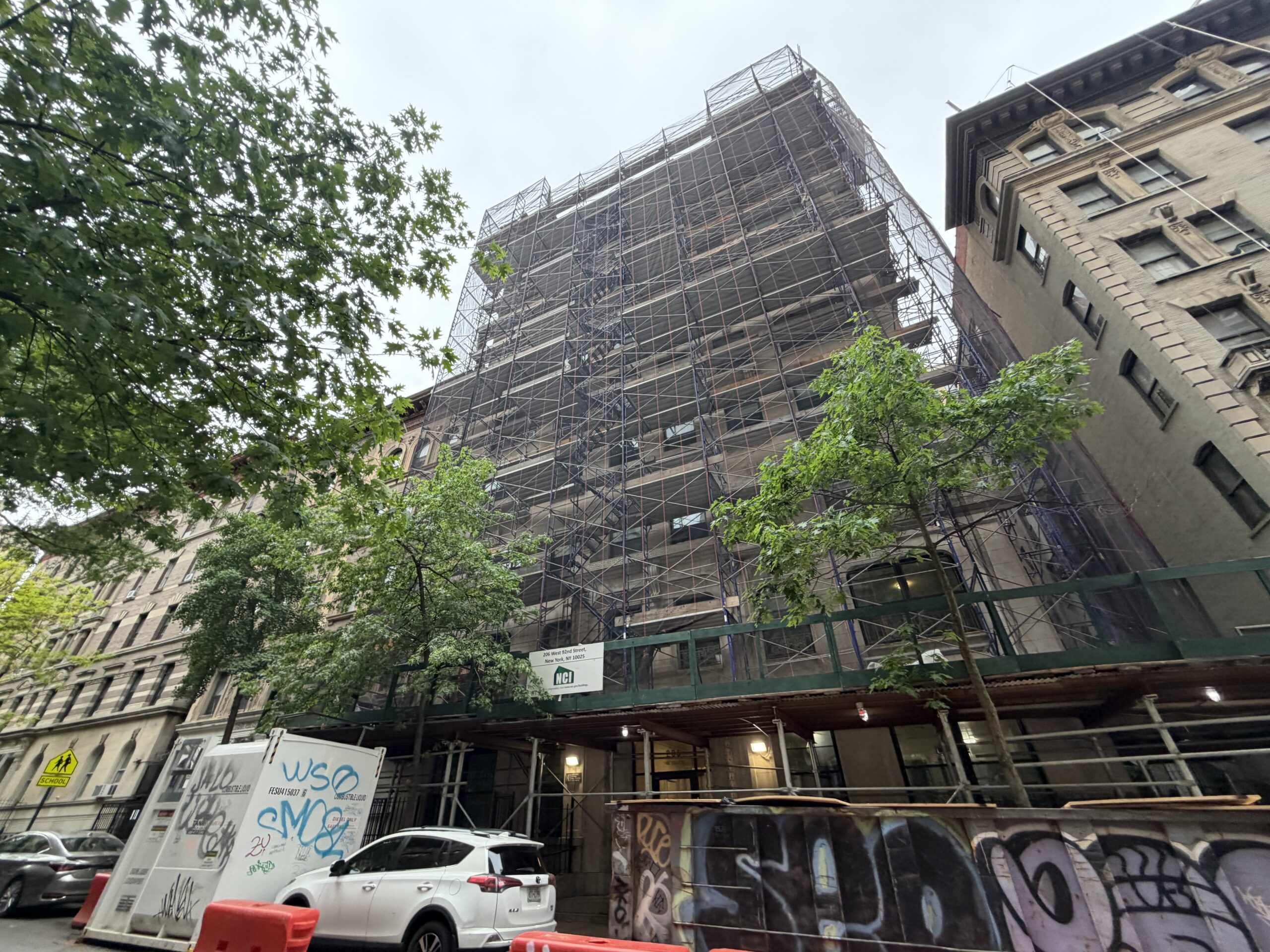
 A sidewalk shed at 206 West 92nd Street. Photos courtesy of Scott Etkin.
By Scott Etkin
In last month’s UWS Shed Watch column, West Side Rag described what the city’s Department of Buildings’ data reveals about sidewalk sheds on the Upper West Side. The UWS has around 400 sheds, the third-highest number of any neighborhood in the city, though the number of UWS sheds has declined approximately 25% since the summer of 2023, when former Mayor Eric Adams announced operation “Get Sheds Down.” But in that same time period, the average time a sidewalk shed remained in place ticked up by a couple of months – from 497 to 557 days.
This month, Shed Watch looks at the role played by what’s commonly known as “scaffolding” in New York City’s inspection requirements for building facades (technically, sidewalk sheds are the metal beams and wooden planks that form a ceiling over the sidewalk; scaffolding is the structure and netting that covers the building’s facade). We also look at how these regulations might be amended to reduce the usage of sheds and scaffolding.
On April 27th, the city received a stark reminder about scaffolding’s importance – as well as its imperfection – when a 30-foot chunk of decorative stone fell to the ground from between the 15th and 16th stories of a building in Tribeca. Fortunately, no one was injured, but questions immediately arose: how did this happen at a building that, at the time, was wrapped in scaffolding and netting?
According to the city’s Department of Buildings, whose headquarters is coincidentally across the street from the Tribeca building, the scaffolding was there to protect passersby while the facade was repaired and inspected, in accordance with city regulations. But the netting was improperly secured, and the building had been cited for this violation even before the chunk of stone fell.
While the netting failed to do its job in this instance, the mishap also illustrates how vital scaffolding is to public safety. “There is no shed [or scaffolding] that is not needed in the city,” the DOB’s Assistant Commissioner of Existing Buildings Compliance Olga Suto said on a phone call with the Rag.
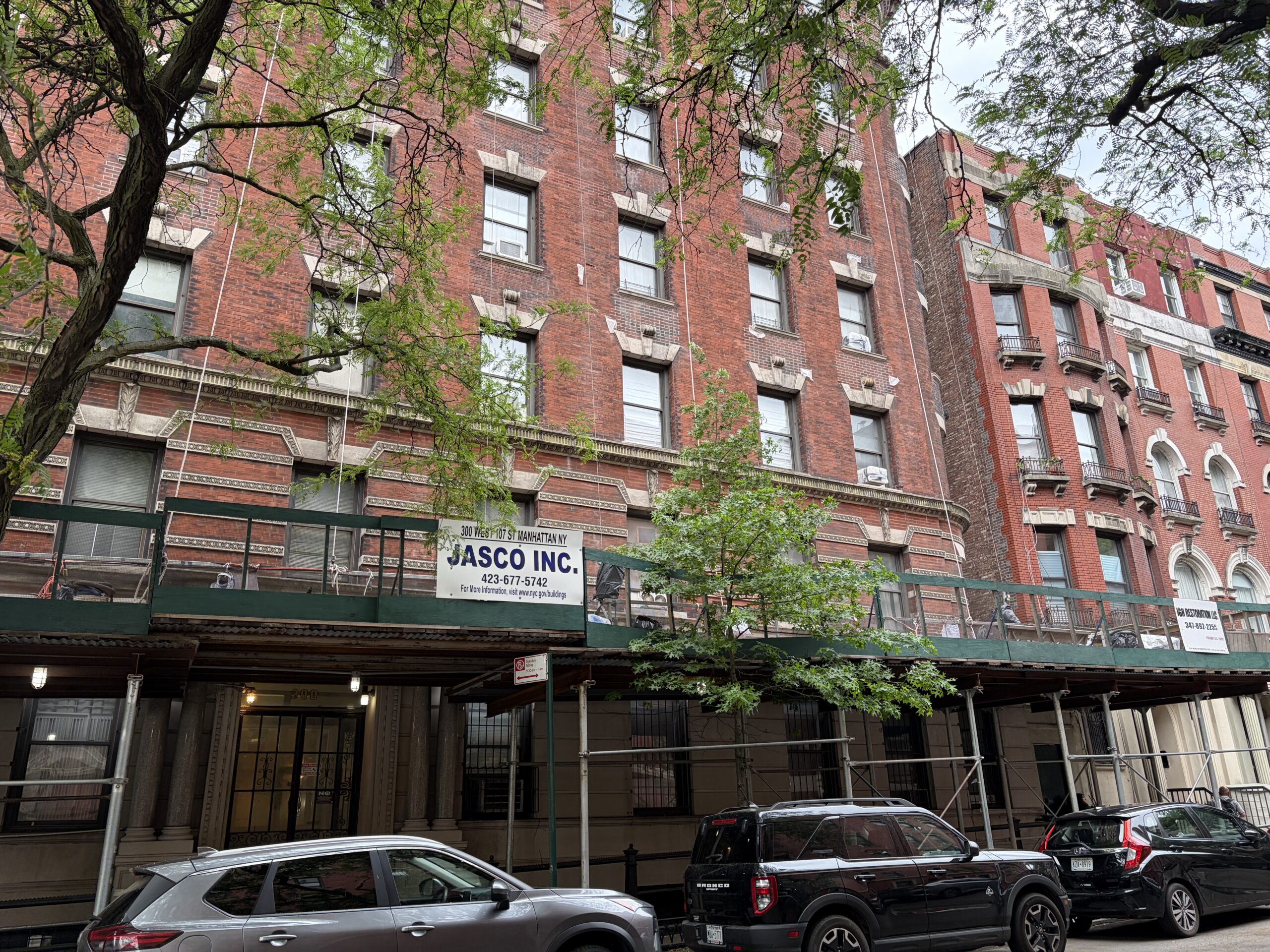 A sidewalk shed going up at 300 West 107th Street.
In the case of the Tribeca building, the scaffolding was in place to enclose a dangerous facade in need of repair. But many of the sidewalk sheds we see are not there for needed repairs; they are put up to conduct routine inspections carried out as part of the DOB’s Facade Inspection & Safety Program (FISP).
There are 17,000 buildings that fall under the city’s facade inspection program. “We have one set of requirements for all of these buildings,” said Suto. At a high level, the main requirement is simple: Owners of properties taller than six stories must have the exterior of the building inspected every five years and file a technical facade report with the DOB.
For building owners to meet the agency’s rules, they must hire a Qualified Exterior Wall Inspector (QEWI) to do a visual inspection from the ground and a hands-on inspection up on the building itself. There are more than 500 firms approved to carry out these inspections in the city. The DOB also has its own inspectors, who do inspections only from the ground using binoculars and digital cameras.
The city’s inspection program mandates that for a hands-on inspection, the contracted inspectors must examine the building’s facade up close every 60 linear feet. Usually, that means erecting a sidewalk shed topped with scaffolding.
Building owners and the contracted inspector can instead decide to access the facade through other means, if conditions allow. These alternatives include using a boom truck (a large truck with a crane mounted on its bed), walking along the building’s fire escapes, or – by far the most exciting option – using industrial rope to rappel down the facade. Some modern buildings have window-washing rigs, which can be repurposed for inspections.
Each of these options has its own benefits and limitations. Boom trucks, for example, can only reach 15 to 20 stories. They also might require a permit from the NYC Department of Transportation. Using fire escapes seems like an opportunistic solution, but not all fire escapes cover enough of the building’s facade to access every 60 feet.
Once the contracted inspectors are positioned on the building’s facade, they touch the material to see if it crumbles, sound it with a mallet to test if it’s hollow, and take photos. This information is then recorded in a report that is submitted online to the DOB.
The duration of an inspection varies, depending on the size of the building, the type of rig used to access the facade, and the availability of the contract inspectors. Suto estimated that a hands-on inspection could take up to a week, whereas a visual inspection, which involves walking the perimeter of the building at ground level and scanning it with binoculars, can be done in a couple of hours.
An experienced inspector can still conduct an effective visual survey, even from a distance, according to Suto. “You would be amazed at how well our inspectors are finding things that QEWIs and other people do not, and they are doing it from the ground,” she said.
Visual inspections are faster and cheaper than hands-on inspections. As a result, they’re a priority as the agency and the City Council seek to streamline the inspection process through new legislation.
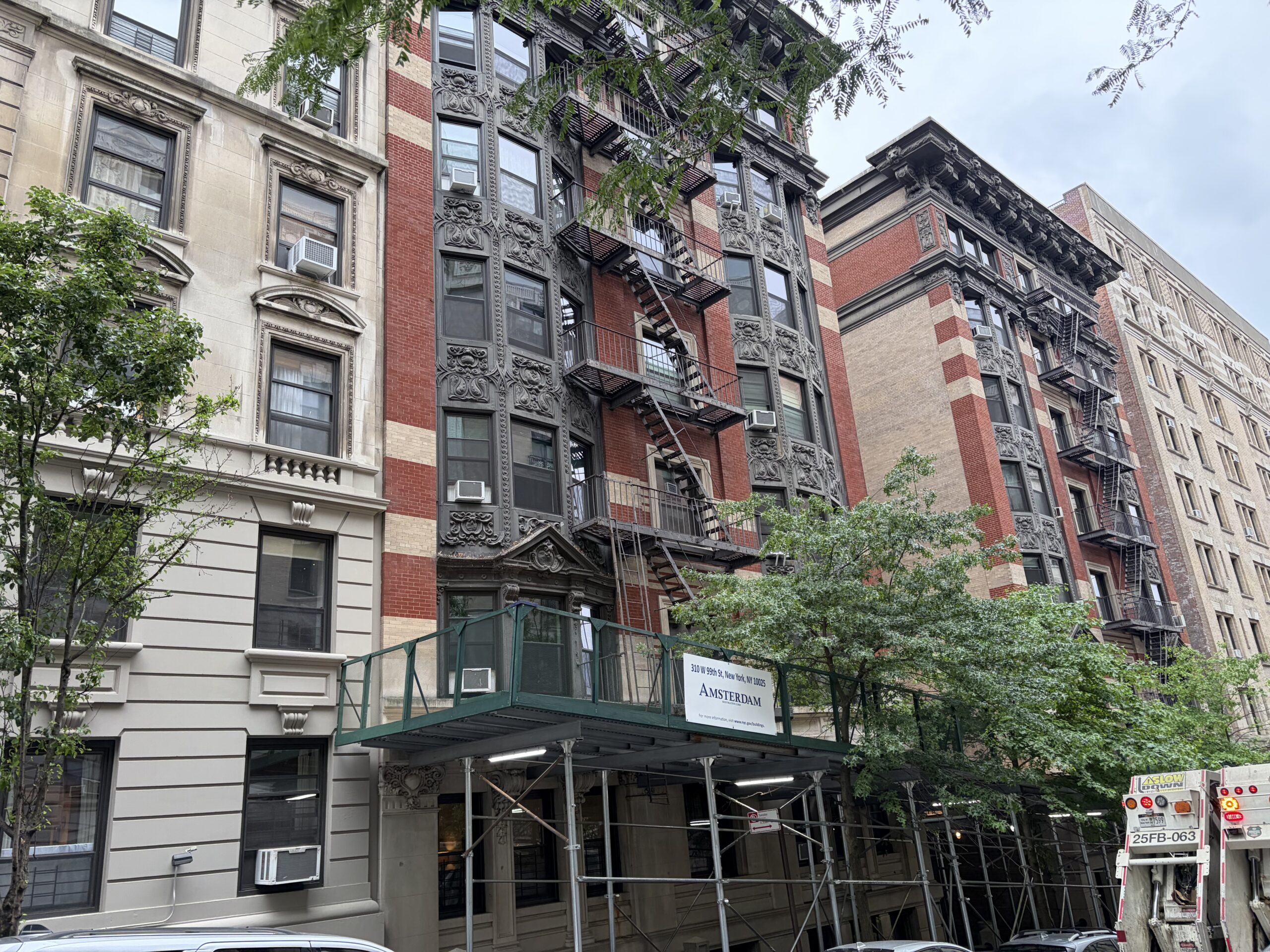 A sidewalk shed at 310 West 99th Street.
The engineering firm Thornton Tomasetti highlights a shift toward more visual inspections as one of its recommendations in its review of the city’s facade inspection policies. The report, commissioned by the DOB in 2024 and published last December, offers several ways the DOB can make inspections less onerous or less frequent – and thus, in principle, reduce the time sidewalk sheds and scaffolding remain in place for inspections. One recommendation, which the city is pursuing, is to change the inspection cycle from every five years to every six years. If this legislative change is implemented, this would be the first adjustment in the cycle timeframe in the inspection program’s 45-year history.
The report also suggests that the DOB could safely allow the facade of certain buildings to only be inspected every 100 feet, instead of every 60 feet. Lower-risk buildings could also enter a program where they skip the close-up inspection for a full cycle.
While implementing such reforms would likely reduce the amount of scaffolding citywide, the effect might be muted on the Upper West Side. The UWS has among the highest concentrations of sidewalk sheds in the city because of its older building stock and, in particular, high prevalence of fragile ornamentation that requires extra maintenance.
Terra-cotta is the most problematic building material when it comes to maintenance, according to Suto, and there is plenty of it on the Upper West Side.
In March, Mayor Zohran Mamdani’s announcement about reforming facade inspection rules – including extending the timeline for inspections from five to six years, and allowing lower-risk buildings to get an inspection only every 12 years – cites the Thornton Tomasetti report.
Though legislation from the City Council could change inspection rules, it will be a while until the effects are seen on the ground. FiSP runs on a five-year cycle, and changes will not be implemented until the next cycle begins in 2030.
Until then, the city continues to live with the ups and downs of scaffolding. “Nobody likes sidewalk sheds, right?” said Suto. “But for us, they are not created equal.”
Read more: UWS Shed Watch: A New Monthly Column from West Side Rag
Subscribe to West Side Rag’s FREE email newsletter here. And you can Support the Rag here.