
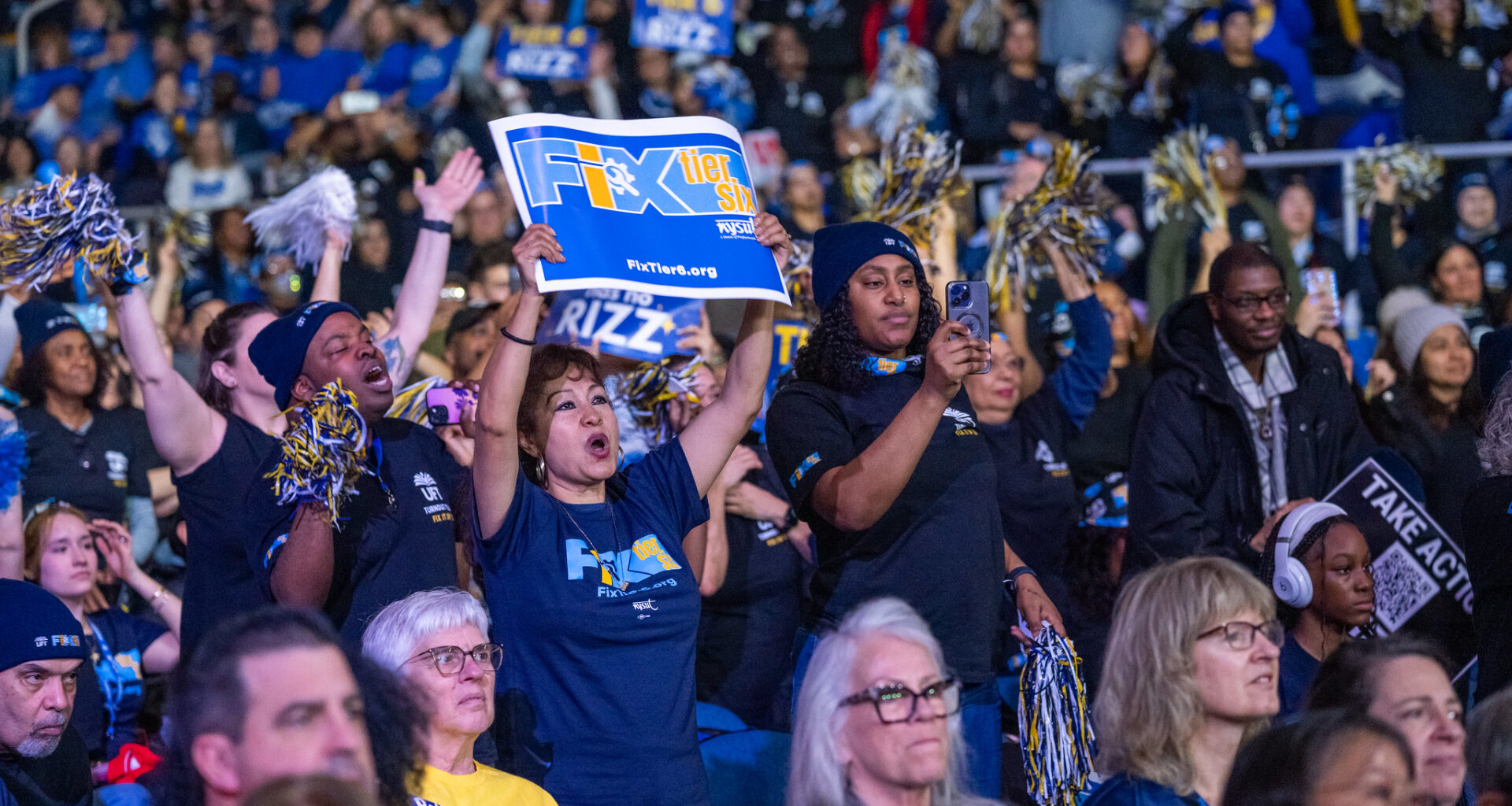
Union members at a Public Employees Union Rally for Tier 6 changes in March.
Darren McGee/Darren McGee/ Office of Governor
ALBANY — In March, standing in front of thousands of energized labor union members in Albany, state Assembly Speaker Carl E. Heastie told the energized crowd that he was one of the biggest advocates for getting rid of the sixth pension tier for government employees.

“This is the year we need to blow that s__ away,” Heastie said.
Article continues below this ad
But political dreams have faced a reality check for New York’s top unions, which called on lawmakers to roll back changes made in 2012 that created the new pension plan with less generous benefits and more required years of work compared to previous packages.
In April, unions advanced overlapping but different “Fix Tier 6” priorities, with the United Federation of Teachers and New York State United Teachers focusing on allowing retirement at age 55 for those with 30 years of service, while the Public Employees Federation emphasized both earlier retirement options and reducing employee contribution rates.
According to a source in Gov. Kathy Hochul’s office speaking Friday, a deal reached with lawmakers would lower the retirement age for teachers and reduce pension contribution costs while boosting overtime-related retirement benefits for police, firefighters and other public employees. The agreement is expected to be rendered in legislative language next week.
Make the Times Union a Preferred Source on Google to see more of our journalism when you search.
Add Preferred Source
All of the top Democrats in the state, including Hochul and state comptroller Thomas P. DiNapoli, supported the union’s push to change Tier 6. The changes were one of the biggest fiscal and political choke points in the already overdue state budget, alongside Hochul’s big-ticket policy fights on auto insurance, immigration, climate and housing.
Article continues below this ad
The proposal to sweeten the package also faced pushback from local governments and other critics, who said that undoing the 2012 reforms would burden state and municipalities with hundreds of millions of dollars in additional costs, which they say will inevitably result in higher property taxes.
Proposed changes to Tier 6
The overall estimated cost of the changes will be $557 million, with the state contributing $118 million and other parties paying $440 million, according to estimates from the governor’s office. This is down from an original proposal that would have cost $1.5 billion.
Gov. Kathy Hochul rallied with unions on March 8 for changes to the Tier 6 pension system.
Darren McGee/Darren McGee/ Office of Governor
The deal struck by lawmakers and the governor would lower the retirement age for teachers from 63 to 58 after 30 years of service.
Article continues below this ad
State and local public employee contributions would be lowered to a range of 3% to 5.75% depending on salary bracket. Police and fire department employees would see an increased cap on the amount of overtime that can be included in the calculation of retirement benefits from 15% of wages to 25%.
All other public employees, largely sheriffs and corrections officers, will see an increased cap as well. This will go from $22,000 to $30,000.
Rob Merrill, a spokesman for the Public Employees Federation, which represents over 50,000 state government workers, declined to comment on the proposed changes until the legislation is introduced.
Melinda Person, the president of the New York State United Teachers, praised the proposed changes.
Article continues below this ad
“This Tier 6 agreement is proof that when workers organize and stay united, change is possible,” Person said in a statement. “This victory belongs to every member who spoke out, rallied, lobbied and kept the pressure on. We are taking an important step toward building a fairer future for the next generation of public workers.”
How much it will cost?
Tier 6 was created for employees hired on or after April 1, 2012, and supporters of the original law argued it would save state and local governments tens of billions over time.
Under the current state rules, Tier 6 members contribute 3% to 6% of pay depending on earnings and receive full benefits at age 63, though they can retire earlier with permanent reductions. The New York State and Local Retirement System says Tier 6 is now its largest member group in service and accounts for more than half of total membership.
Article continues below this ad
It is also widely unpopular among state workers because the benefits are less generous than earlier pension tiers.
Tier 6 had already been softened in recent years: In 2022, lawmakers made it possible for Tiers 5 and 6 members to vest after five years of service, down from 10 years. Another change in 2024 temporarily excluded certain overtime from the calculation of Tier 6 contribution rates.
The overall cost of the new proposed changes to Tier 6 will be studied by the state comptroller’s office soon after the bill is introduced. The governor’s office estimates say that lowering the retirement age will cost $166 million, but there will be no cost incurred by the state.
Addressing employee contributions for state and local employees would cost $244 million, with the state footing $85 million. The changes made to police and fire departments would cost $74 million and cost the state $13 million.
Article continues below this ad
Proposed changes to overtime will cost $72 million, with $20 million coming from the state.
On Wednesday, Heastie said that New York has earmarked at least $50 million for local governments to cover the increased costs.
The state’s push to overhaul Tier 6 pensions has clashed with the fiscal realities facing local governments already under financial strain. That includes the city of Albany’s widening budget gap and recent warnings by officials in Rochester about unsustainable pension and health care costs.
One of the central arguments behind Tier 6 reform is that offering better pensions is the key to solving public-sector staffing shortages.
Article continues below this ad
However, state and local officials have previously told the Times Union that younger workers increasingly prioritize salary, flexibility, work-life balance and health insurance over retirement benefits.
Labor leaders and Democratic lawmakers argue that deteriorating working conditions, particularly in high-stress sectors such as corrections, have eroded the appeal of public service jobs.
In a statement to the Times Union, Chris Koetzle, the executive director of the New York Association of Towns, said that while his organization supports “fair retirement security for public workers, reforms must be balanced and fiscally responsible.”
Article continues below this ad
He said the proposed changes will be felt in local governments for years to come.
“Policies that increase long-term pension burdens without providing sustainable funding solutions could force local governments into difficult choices: higher property taxes, cuts to services, delayed infrastructure projects, or reduced staffing,” Koetzle said. “Upstate communities and small towns cannot continue to absorb unfunded mandates from Albany without consequences at the local level.”