

A version of this article originally appeared in The Back Room, our lively recap funneling only the week’s must-know art industry intel into a nimble read you’ll actually enjoy. Artnet News Pro members get exclusive access—subscribe now to receive the newsletter in your inbox every Friday.
What a week in New York City! Around $2.1 billion worth of art sold across the Big Three auction houses’ evening sales (day sales are being tallied as this newsletter goes to press). That was up more than 100 percent from last May, where the same sales brought in just over $1 billion.
Let’s break down how each house fared.
Phillips Makes a Comeback
Everyone’s favorite underdog pulled big numbers out of the hat this season, bringing in $115.2 million across 41 lots at its modern and contemporary auction, up 121.5 from the equivalent sale last May. It was a white-glove affair, at least if you exclude two withdrawn lots.
The result was good news for a house that has had a hard run of late. Last year, Phillips brought in just $390.9 million in fine-art sales, its lowest total since 2016.

Andy Warhol, Sixteen Jackies (1964) Courtesy of Phillips.
A bevy of guarantees and its recently launched priority bidding helped the house achieve its strongest New York spring sale since 2022, when it brought in around $225 million. (It’s still a long way from that figure.)
The firm used to be the place for young artists to set records, but the ultra-contemporary sector has yet to warm up again and more established names dominated its evening sale. The top lot on Tuesday night was Andy Warhol’s Sixteen Jackies (1964), which sold for $16.2 million against a $15 million low estimate (sale prices include fees, estimates do not).
Christie’s Continues to Dominate
Christie’s had a first-place $1.3 billion haul, which came from 105 lots and three evening sales: the records-heavy $630.8 million S.I. Newhouse collection and its 20th- and 21st-century auctions. That’s a stunning 115.6 percent increase from the same sales last year, which included Len Riggio’s holdings.
Three big auction records were set, led by Jackson Pollock’s Number 7A (1948), which sold for $181.2 million, nearly triple the artist’s previous high. Constantin Brancusi’s bronze Danaïde (1913) fetched $107.6 million, around 50 percent above the sculptor’s prior auction peak. Both were from the Newhouse trove. Meanwhile, a 1964 Mark Rothko work owned by Agnes Gund, No. 15 (Two Greens and Red Stripe), sold for $98.4 million.

Constantin Brancusi, Danaïde (ca. 1913). Courtesy of Christie’s Images, Ltd. 2026.
If you ignore the Newhouse works, which “slightly distort the sales with the sheer star power of the lots and their resulting prices,” advisor Morgan Long said, “the auctions are still quite different from where we were a year ago.” She pointed to an influx of new buyers with cross-category interests. The Newhouse sale was “just the spectacle” these buyers needed to get them excited about looking at amazing objects once again. It certainly got Nicole Kidman looking.
Sotheby’s Comes in Strong
Sotheby’s kicked off the marquee week extravaganza way back on May 14 with a $433.1 million contemporary auction that included its “The Now” sale. It was preceded by a swift single-owner sale of holdings from the late dealer Robert Mnuchin. Including a solid $303.4 Impressionist and modern sale on Tuesday, the house netted around $737 million across 102 lots—a 97.9 percent increase in value over last May.
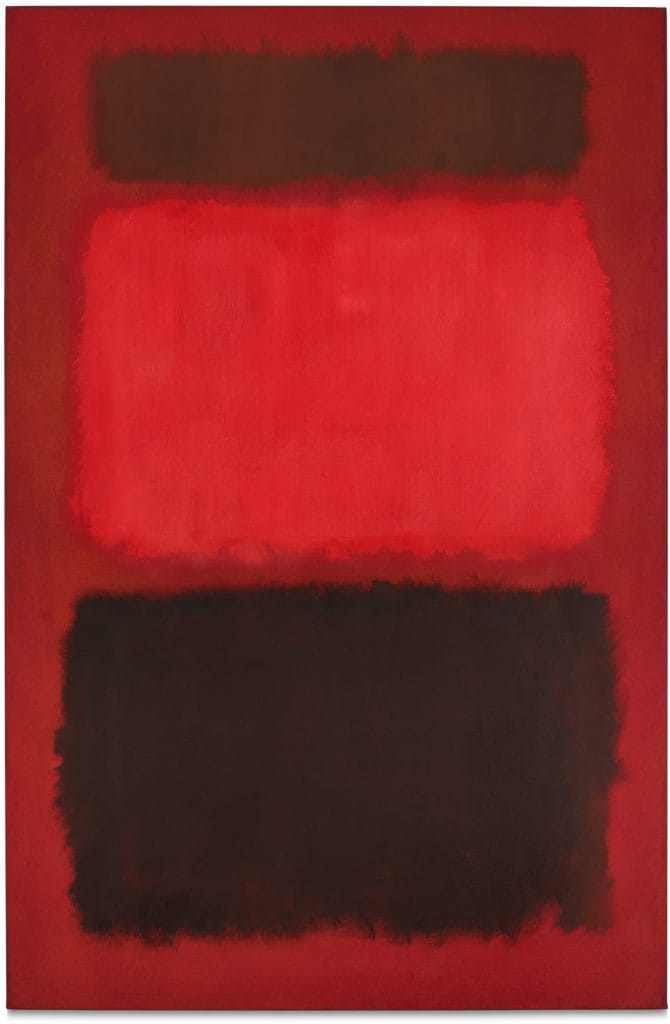
Mark Rothko, Brown and Blacks in Reds (1957). Courtesy of Sotheby’s.
Top lots included one of Mnuchin’s Rothko, Brown and Blacks in Reds (1957), which went for $85.8 million last Thursday, and La Chaise Lorraine (circa 1919) by Henri Matisse, which sold for $48.4 million on Tuesday after a 10-minute bidding battle.
The Bottom Line
Still, it seems that the market is largely narrowing upward, with trophy lots doing a lot of the heavy lifting. There were still signs of a softness in every sale, but as Long told me, “sellers are becoming slightly more realistic in terms of estimates and a willingness to just move on from holding works and, if necessary, take a loss.” That’s good news for business sentiment.
And at least among the Big Three this season, there were no real losers.