
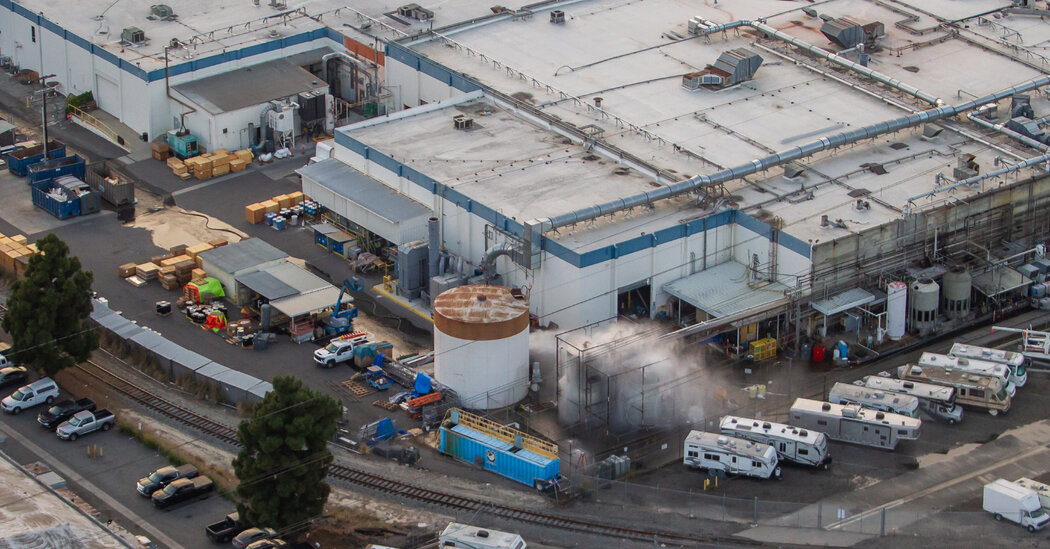
Officials struggling to contain a cracked tank of a volatile toxic chemical in Southern California said on Monday that they had averted the worst-case scenario of a major explosion, but stressed that the risk of a smaller blast remained.
Fears of a catastrophic detonation, which first emerged on Thursday, have forced the evacuation of more than 40,000 residents who live near the industrial site in Garden Grove, Calif. The Orange County Fire Authority said the mandatory orders would remain in place for now as the department’s standoff with the 22-year-old tank stretched into its fifth day. The fire authority planned to hold another news conference at 6 p.m. Pacific on Monday.
“The crisis is not averted,” TJ McGovern, the fire authority’s interim chief, said at an earlier briefing. “The threat is not eliminated.”
The tank could still leak or explode, he said, but not to the extent officials initially feared. The crisis, which led to a presidential emergency declaration on Monday, appeared to ease after firefighters reported that a crack had relieved intense pressure on the tank and helped drop temperatures inside.
“The trajectory is headed in the right direction for the first time since Thursday,” said Thomas J. Umberg, a state senator who represents the area that has been evacuated.
“The challenge now is that people want to get back in their homes,” he said, adding, “and they can’t go back until it’s safe.”
Erika Ocana, who is among those living closest to the plant, does not know when her street will be safe again — and officials’ muddled communications haven’t helped, she said.
“Everything they’re posting and saying, they’re not really clear about it,” Ms. Ocana said. “Is it going to explode or not? When are we going to know? Are we going to be safe? They’re confusing everybody.”
On Monday afternoon, she decided she couldn’t wait for answers. Ms. Ocana, her four children and her mother had evacuated earlier in a rush, without knowing how long they’d be gone. And her mother, a diabetic, was running low on insulin.
Ms. Ocana and her 16-year-old son grabbed masks and drove to their cordoned-off block. A sheriff’s deputy allowed them through, she said, but he warned them, “If anything happens, you’re on your own.”
Streets inside the evacuation zone looked “like a ghost town,” Ms. Ocana said, and their home smelled “like a plasticky rotten egg.” They collected the medicine and hurried out.
Ms. Ocana’s family is among the thousands now scattered across the region during a busy holiday weekend, when accommodations in the area, near Disneyland, were already sold out or pricey.
Maricela Bernal, who lives with her family just down the street from the tank, is not sure how much longer they can afford the hotel room she booked last week. Ms. Bernal is nervous about going to a county-run shelter, she said, because she does not want to risk her 3-month-old daughter getting sick in such close and crowded quarters.
She said officials were not communicating clearly. If the situation was improving, she wondered, why were streets still closed and helicopters still buzzing overhead? “Are things getting better, or are they not?” she asked.
The bulging tank upended a quinceañera on Saturday for Ms. Bernal’s older daughter, Crystal Bolanos.
The festivities, held just outside the evacuation zone, went on as planned, but many friends and family members canceled as they also navigated the evacuation.
“It was stressful and overwhelming,” Crystal said.
California’s governor, Gavin Newsom, said on Monday that the Trump administration’s emergency declaration would help displaced people and shuttered businesses. The state has sent nearly 800 emergency personnel to the scene, Mr. Newsom said.
Firefighters first responded on Thursday to the industrial site, belonging to GKN Aerospace, after learning that a tank containing about 7,000 gallons of the chemical methyl methacrylate was becoming pressurized and releasing gas while it overheated.
On Friday, after the tank’s temperature increased and its casing bulged, a sign it could soon explode, the local authorities issued initial evacuation orders. On Sunday, officials said they’d found that the tank had cracked, relieving some of the internal pressure. The temperature inside slowly dropped, possibly solidifying some of the liquid inside.
“The crack is there,” Craig Covey, an incident commander with the fire authority, said on Monday. “And the tank has released its pressure.”
Mr. McGovern, the interim fire chief, said he was unsure residents would be able to safely return.
Todd Spitzer, the Orange County district attorney, said in an interview on Monday that he had started a criminal investigation into GKN, which is based in Britain and produces parts for military and civilian aircraft.
“Their cooling system failed, and they don’t have any backup?” he said.
He said he had also begun a criminal investigation into whether hotels were illegally gouging people who had been forced to evacuate from their homes. He acknowledged, though, that during a holiday weekend, prices might have risen anyway.
“We’re going to look at it,” he said. “People are exploiting this crisis.”