
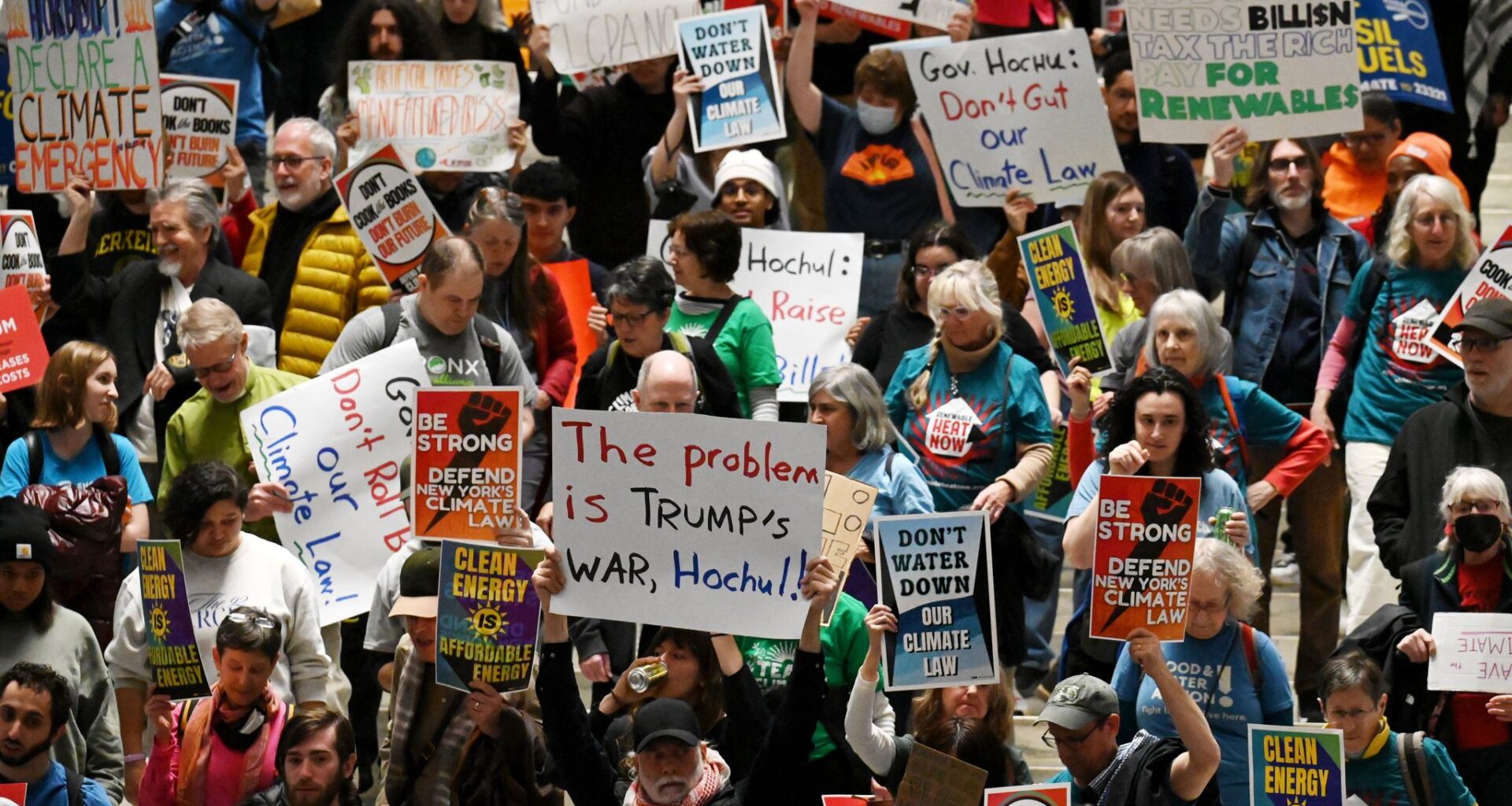
Environmental advocates march through the Legislative Office Building in March during a rally held in opposition to Gov. Kathy Hochul’s plan to adjust the provisions of New York’s Climate Act. The changes will include empaneling a new commission to study utility rates. (Will Waldron/Times Union)
Will Waldron/Times Union
ALBANY — Legislation that will change the emissions mandates enacted by New York’s 2019 Climate Act will include empaneling a new commission to study the causes and origins of New York’s rising utility rates and recommend ways to reduce them.

The formation of the “temporary blue ribbon commission on residential affordability through energy savings” is among a multitude of legislative measures that are itemized in the budget bill that was being circulated among lawmakers and lobbyist over the holiday weekend. It’s expected to be voted on this week by the state Legislature.
Article continues below this ad
A copy of the draft legislation obtained by the Times Union indicates the minority Republican leaders of the Assembly and Senate would not be given the ability to appoint any of the nine members of the commission. The draft of the bill stipulates that five of the members will be appointed by Gov. Kathy Hochul, and Senate Majority Leader Andrea Stewart-Cousins and Assembly Speaker Carl E. Heastie would each appoint two members.
It’s unusual for the legislative minority leaders not to be given some voice on statewide commissions, so it’s possible that provision is still being negotiated. The panel will also include the chair of the Public Service Commission or their designee — who will chair the panel — and the president of the New York State Energy Research and Development Authority.
The qualifications of the commission’s members would exclude someone from the energy sector from being appointed to the panel, including any consultant, advisor or board member from a utility corporation or electric plant operator. Instead, the bill stipulates that the members, who will not be compensated, must have professional or academic expertise in areas that include utility regulation, consumer advocacy, utility management and compliance, energy or public utility law, or energy market regulation.
Make the Times Union a Preferred Source on Google to see more of our journalism when you search.
Add Preferred Source
The legislation calls for the commission to meet at least once a month and to produce a report within one year that would include identifying the causes and origins of rising utility rates, examining the regulatory models of entities that deliver electric power, and determining whether any Public Service Commission orders, actions or statutes are impeding the ability of utility corporations to construct, own or operate power generating facilities.
Article continues below this ad
The blue ribbon commission also would report on the methodology used to determine a utility corporation’s return on equity, any divergence between those returns and capital investments, and whether the fiscal impacts on ratepayers can be “minimized and made more transparent.” The commission also would be tasked with examining actions in other states to lower utility rates and institute cost control measures.
Other measures included in the legislation would provide for more regulatory control of the internal operations, grid development strategies and profit margins of utility companies, which have come under fire from many lawmakers who have accused them of seeking rate increases that pad the income of executives and shareholders. Those critics also have cast blame on utility companies for pushing for increased reliance on fossil fuels in contravention of the Climate Act mandates.
Scrutiny of profits
The legislation also will require gas and electric corporations, if they are applying to raise rates, to disclose the compensation of their senior management, including the chief executive officer, as well as the median annual compensation for all of their employees. Any filing with the Public Service Commission seeking to raise utility rates also would need to include a second “budget-constrained proposal that separately addresses operating expenses, capital expenditures, programmatic or policy expenditures, commodity supply costs, taxes and other costs not within the control of the corporation.”
Article continues below this ad
If the Public Service Commission authorizes a change in rates that would result in rate increases of more than 3% for residential gas or electric services, the legislation would allow for the commission to install an “independent affordability monitor” inside the gas or electric corporation for at least a year. The monitor would be under contract with the commission and not allowed to have any affiliation with the utility company where they are installed.
Those monitors would report to the commission and have the power “to examine records, including but not limited to the accounts, books, contracts, property, assets, procurement history, taxes, accounting, operations, maintenance, past and present customer billing systems … as well as financial documents, reports and papers of the corporation.”
The legislation has drawn the ire of environmental advocates because it’s most notable proposals will change the mandates of the 2019 Climate Act that established New York’s requirements for 70% renewable electricity sources by 2030 and net-zero emissions by 2040. Energy and business sector stakeholders have for years said those mandates would be unattainable, cause electricity costs to soar and could lead to energy shortfalls.
The legislation proposes changing those targets to a 60% reduction of emissions by 2040 — from 1990 levels — and change the formula used to measure greenhouse gas emissions from a 20-year to a 100-year time span, which will lower the measurable amounts that some fossil fuels have on the atmosphere.
Article continues below this ad
In an apparent effort to appease critics of those changes, the legislation is imposing the increased scrutiny on utility companies and making it harder for them to raise delivery or electricity charges. The legislation also would prohibit utility companies from passing any expenditures for their lobbying efforts onto consumers’ bills.
Earlier this year, Hochul’s administration conceded that the Climate Act’s sweeping mandates — as written — would result in significant future price increases for utility and gas consumers. Environmental advocates have disputed that prediction, but many Democratic lawmakers have reluctantly joined the governor’s side on the issue, drawing praise from energy sector leaders and led Republicans to question what took them so long to concede the point.
The budget allocates $1 billion in rebates for utility customers, the governor said and a $1 billion allocation for sustainable energy projects, but it’s unclear where that money will come from, how it will be distributed or who would be eligible.
The proposed changes follow an October ruling by a state Supreme Court Justice who said the state Department of Environmental Conservation needed to follow the Climate Act’s statutory mandate to establish rules to ensure New York reaches its targets of achieving a 40% reduction in greenhouse gas emissions by 2030. The rules were supposed to be in place two years ago, and environmental advocacy groups sued the state to force compliance.
Article continues below this ad
But the proposed reduction target for 2040 that applies to the Department of Environmental Conservation does not necessarily apply to the energy sector, which must adhere to the state Public Service Commission’s mandatory emissions reductions, which are not expected to be adjusted in the budget.
“New York has led and will continue to lead on clean energy and climate, but reality has been harsh,” Hochul said earlier this month. “We cannot meet the current timelines without driving energy costs higher. The facts bear that out, and I cannot let that happen.”
Hochul said the amendments to the Climate Act are necessary to “strike the right balance between our clean energy ambitions and the affordability pressures that real New Yorkers are facing right now. So we’re adjusting the CLCPA implementation timeline in targeted ways so it works for everyone.”
The governor’s public remarks on the issue have been largely void of saying whether repowering antiquated fossil-fuel power plants will be done to help the state meet its future energy needs.
Article continues below this ad
Those plants, blamed for much of the state’s carbon emissions, are essential during times of grid stress, particularly in New York City. But many of the generating plants are up to 70 years old. Energy sector leaders said repowering those plants — which would make them more efficient and reduce their emissions — offers the best pathway to enhance reliability and protect consumers from future price fluctuations.
The New York State Energy Research and Development Authority released a memo in February asserting that to bring emissions down enough to meet the 2030 requirements, the state would need to implement a highly costly version of a program that would place a price on carbon emissions so heavy industry pays an additional amount to operate. The money from that program is intended to be partly directed to households in the form of rebates and otherwise invested in clean energy technology.
Under the deal being brokered in the state budget, the regulations establishing the greenhouse gas reductions would not go into place until 2028. The go governor’s office said the new emissions target of a 60% reduction of 1990 levels by 2040 will be included in the 2028 regulations.
Article continues below this ad
The state has not formulated a detailed plan for pulling away from a power grid that’s more than 70 years old, and as more than 85% of electricity being supplied to New York City and Long Island is from gas and oil.