
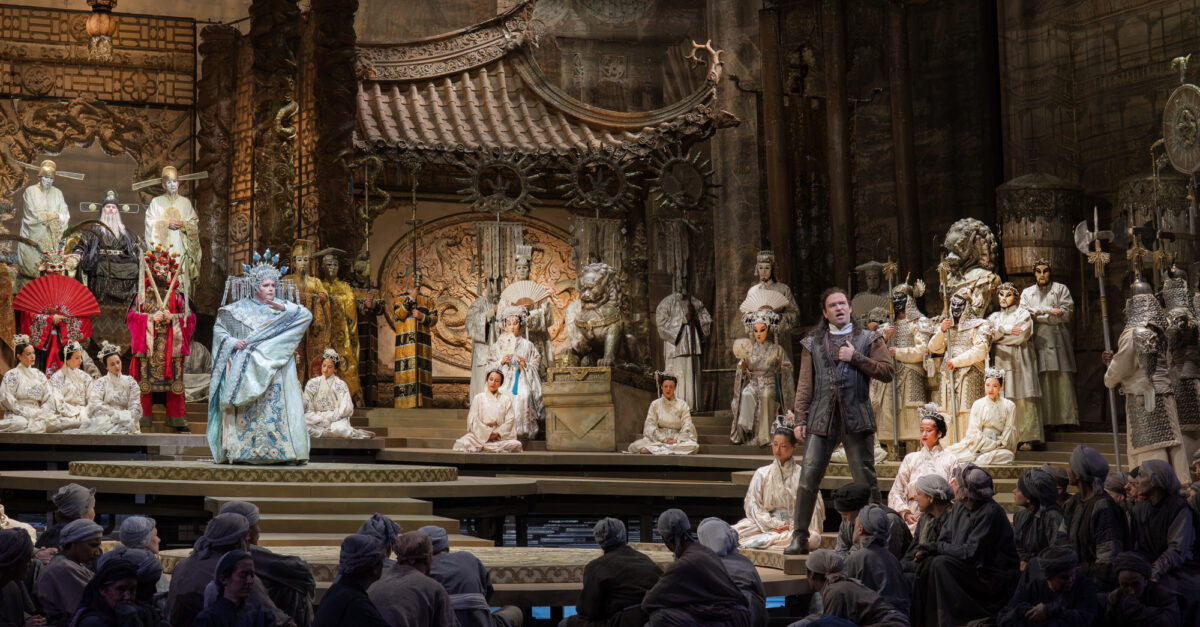
Over the course of the Metropolitan Opera’s first 100 years, the company had staged only two productions of Puccini’s final masterpiece, Turandot. When, in the 1980s, the Met sought a director to deliver a new vision for such a monumental work, the company turned to one of the most in-demand artists of the day: Franco Zeffirelli. By the time his new staging of Turandot premiered on March 12, 1987, the legendary Italian director-designer was well established at the Met and renowned internationally for his grand theatrical vision: His staging of Barber’s Antony and Cleopatra inaugurated the Met’s new house at Lincoln Center in 1966, utilizing every element of stage technology available n the state-of-the-art theater, and his lavish takes on Puccini’s La Bohème (1981) and Tosca (1985) were instant classics.
With its awe-inspiring gilded scenery and intricately decorated costumes, Zeffirelli’s Turandot was exactly what audiences hoped for, drawing “gasps of delight and astonishment” (The New York Times). Critics, too, gave glowing praise to the new staging, with the New York Post calling the production “a big, eye-catching, densely packed, opulent new production staged by the master of monumentality.” Performances that spring were some of the hottest tickets in the city.
After nearly four decades of sensational performances, Zeffirelli’s grand vision of mythic China was due for some restoration. This spring’s performances mark a major milestone in the Met’s efforts to keep this fan-favorite production on stage far into the future. Thanks to a generous gift from C. Graham Berwind, III, the staging has undergone extensive refurbishment over the past year: The scenery got a much-needed facelift, and the costumes also received some extra TLC.
The work has included rebuilding the main structural elements in Acts II and III from the ground up, and since there were no technical sketches to refer to, the Met’s top-notch carpenters relied on the existing set itself as their reference. Several of the props, too, have been remade with newer, more durable materials, including Turandot’s royal veil, which shelters the icy princess in her grand Act II entrance.
Nearly a century after its Met premiere and after almost 400 performances, Turandot has more than secured its place as a pillar of the Met’s repertory, and in its newly rejuvenated incarnation, Franco Zeffirelli’s spectacular staging will continue to dazzle audiences for decades to come.